𝐇𝐂𝐂𝐂𝐈 𝐀𝐍𝐃 𝐔𝐍𝐈𝐕𝐄𝐑𝐒𝐈𝐓𝐘 𝐎𝐅 𝐇𝐀𝐖𝐀𝐈‘𝐈 𝐀𝐓 𝐇𝐈𝐋𝐎 𝐀𝐃𝐕𝐀𝐍𝐂𝐄 𝐈𝐍𝐃𝐈𝐆𝐄𝐍𝐎𝐔𝐒 𝐈𝐍𝐍𝐎𝐕𝐀𝐓𝐈𝐎𝐍 𝐓𝐇𝐑𝐎𝐔𝐆𝐇 𝐂𝐎𝐈𝐋 𝐒𝐏𝟐𝟓, 𝐏𝐑𝐎𝐃𝐔𝐂𝐈𝐍𝐆 𝐅𝐈𝐕𝐄 𝐒𝐓𝐔𝐃𝐄𝐍𝐓 𝐂𝐎𝐋𝐋𝐀𝐁𝐎𝐑𝐀𝐓𝐈𝐕𝐄 𝐎𝐔𝐓𝐏𝐔𝐓𝐒
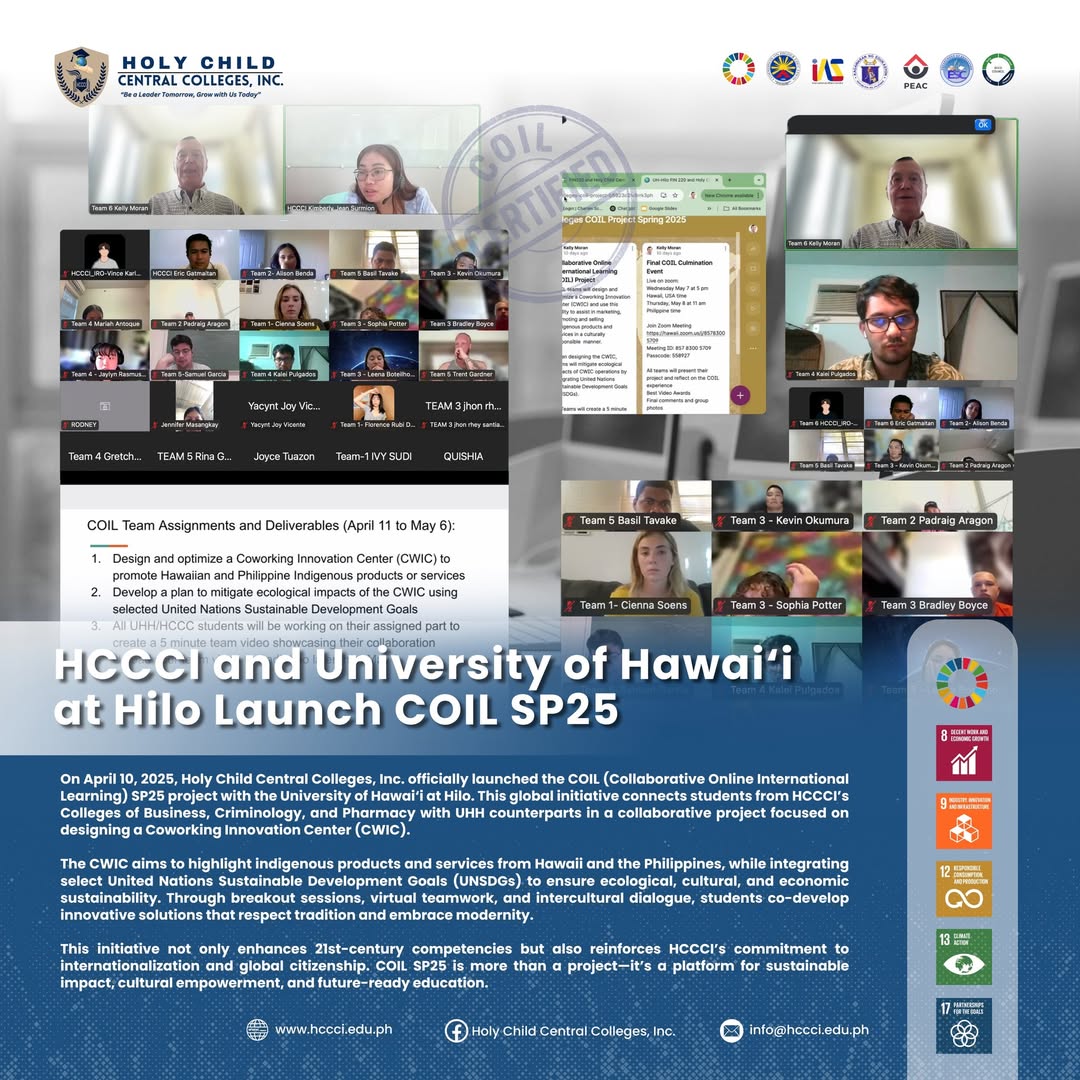
Holy Child Central Colleges, Inc. (HCCCI) and the University of Hawai‘i at Hilo (UHH) strengthened their international academic partnership through COIL SP25, a Collaborative Online International Learning project officially launched on April 10, 2025. Bringing together students and faculty from the Philippines and Hawai‘i, the initiative provided an international learning platform for exploring Indigenous products and services, developing innovative concepts, and connecting local knowledge with contemporary approaches to enterprise, wellness, and technology.
COIL SP25 builds on an earlier collaboration between HCCCI and UHH, during which business students from both institutions worked together to develop business plans for products from Indigenous groups. The previous engagement established a foundation for further collaboration, particularly in exploring how products rooted in local communities and cultural traditions could be developed and presented through entrepreneurial approaches. Building on this experience, the Spring 2025 project expanded the scope of participation to include students from Pharmacy, Business, and Criminology, creating a more interdisciplinary learning environment where students could contribute perspectives from their respective academic fields.
The project centered on the development of a Coworking Innovation Center (CWIC) concept, envisioned as a collaborative platform highlighting Indigenous products and services from both the Philippines and Hawai‘i. Through this shared initiative, students explored how locally rooted products, services, and cultural resources could be connected with contemporary ideas in business development, wellness, digital technology, and innovation. The project encouraged participants to look beyond the conventional classroom setting and consider how academic knowledge and creative thinking could be applied to concepts with practical and community relevance.
The official kick-off ceremony on April 10, 2025, was hosted by Mr. Kelly Moran and Ms. Jenna Feng of the University of Hawai‘i at Hilo, who welcomed the participating students and introduced the collaborative initiative. Representing HCCCI, faculty members Kimberly Jean B. Surmion, RPh, MSPharm; Eric A. Gatmaitan, MBA; and Rodney C. Sumugat, RCrim guided the participating learners from the Colleges of Allied Health and Sciences, Business Studies, and Criminal Justice. Their involvement connected the international project with the students' academic programmes and supported the integration of disciplinary knowledge into the collaborative learning experience.
Following the launch, participating students engaged in virtual teamwork and intercultural dialogue, working toward the development of concepts aligned with the project's focus on Indigenous products, services, and innovation. The collaboration brought together different academic perspectives and encouraged students to consider how products and services could respond to contemporary interests while retaining connections to local resources and cultural contexts. Through the CWIC concept, the project provided a common direction for exploring possibilities in enterprise development and creative problem-solving.
The interdisciplinary nature of COIL SP25 was reflected in the range of concepts developed by the participating teams. Rather than producing outputs confined to a single academic discipline, the students explored different applications of innovation, including wellness-related services, Indigenous products, digital technology, and traditional food production. These concepts became the teams' final project outputs, providing tangible documentation of the ideas developed through the international collaboration.
Team 1 developed Mana Movement Yoga Studio and Boutique, a concept combining movement, wellness, and boutique services. The proposed venture reflects an approach to integrating wellness-related activities with a service-oriented enterprise concept. The team's final output is available here: Mana Movement Yoga Studio and Boutique.
Team 2 worked on Indigenous Products, directly addressing one of the central themes of COIL SP25. The team's concept highlights Indigenous products as potential areas for promotion, enterprise development, and innovation. It reflects the project's interest in recognizing the value of locally rooted products and exploring how they may be presented within contemporary business and market contexts. The team's final output is available here: Indigenous Products.
Team 3 developed Pono Wellness, a concept focused on wellness and service-oriented innovation. Its inclusion demonstrates how the project extended beyond physical products to explore services that respond to interests in health and well-being. The team's final output is available here: Pono Wellness.
Team 4 presented Tides and Traditions App, a concept connecting digital technology with traditions and cultural experiences. The proposed application illustrates how students explored the use of technology in developing ideas related to culture and contemporary user experiences. It also demonstrates the range of disciplines and areas of innovation considered during the project. The team's final output is available here: Tides and Traditions App.
Team 5 developed Traditional Candy Making, a concept centered on traditional food production. The output brings attention to traditional food products as a potential area for creative development and enterprise exploration. It also connects the project's focus on local products and cultural resources with opportunities to consider how traditional food-making practices may be presented through contemporary product concepts. The team's final output is available here: Traditional Candy Making.
Taken together, the five outputs demonstrate the breadth of ideas explored by the students through COIL SP25. From wellness and service concepts to Indigenous products, digital applications, and traditional food production, the projects reflect different ways of approaching innovation while considering the relevance of local products, cultural resources, and community-based ideas. More importantly, they provide concrete examples of how students from different academic backgrounds participated in an international collaborative learning experience and translated the project's themes into specific outputs.
Beyond the development of the five concepts, COIL SP25 provided students with opportunities to engage in international collaboration, communicate across cultural contexts, exchange perspectives, and work toward shared project objectives. Working with an international partner exposed learners to approaches and viewpoints beyond their immediate academic environment. The experience also encouraged them to consider how ideas and practices from different communities could inform the development of products and services. These learning opportunities are important in preparing students to participate in increasingly interconnected professional and social environments.
The initiative also connects with several United Nations Sustainable Development Goals (UNSDGs). Its international and interdisciplinary learning activities contribute to SDG 4: Quality Education, particularly through collaborative and globally connected learning experiences. The exploration of business and enterprise concepts is relevant to SDG 8: Decent Work and Economic Growth, while the development of proposed products, services, and a digital application provides a connection to SDG 9: Industry, Innovation and Infrastructure. The partnership between HCCCI and UHH also reflects SDG 17: Partnerships for the Goals, demonstrating how institutions from different countries can work together to create learning opportunities and collaborative outputs. Furthermore, the project's emphasis on Indigenous products and cultural resources provides a thematic connection to inclusive development and the recognition of local knowledge.
For HCCCI, COIL SP25 represents a continuing effort to integrate internationalization into the academic experience through meaningful partnerships and collaborative learning activities. It builds on an established relationship with the University of Hawai‘i at Hilo, expands participation across academic programmes, and provides students with opportunities to apply their knowledge in an international setting. The five team outputs serve as tangible records of the students' work and illustrate the range of concepts developed during the collaboration.
Through COIL SP25, HCCCI and the University of Hawai‘i at Hilo brought together students and faculty from different academic and cultural contexts to explore the relationship between Indigenous products, services, innovation, and global learning. The project demonstrates how international academic partnerships can extend beyond institutional exchanges and create opportunities for students to collaborate, develop ideas, and engage with issues that connect local communities to wider global perspectives.
By connecting local knowledge with international collaboration, COIL SP25 advances HCCCI's continuing efforts to develop globally engaged learners who value cultural diversity, embrace innovation, and recognize the potential of education to contribute to inclusive and sustainable development.