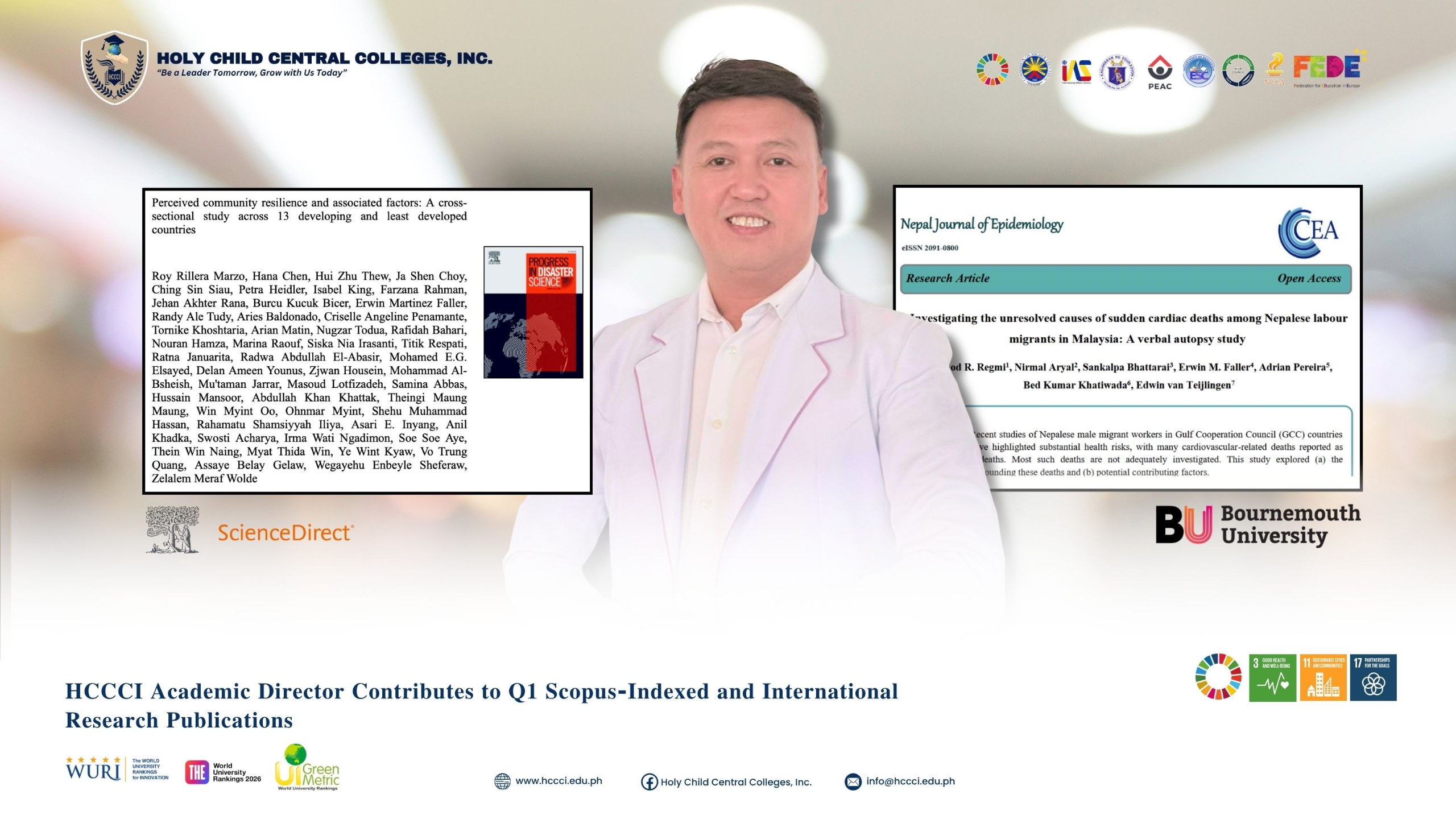
𝐇𝐂𝐂𝐂𝐈 𝐀𝐜𝐚𝐝𝐞𝐦𝐢𝐜 𝐃𝐢𝐫𝐞𝐜𝐭𝐨𝐫 𝐂𝐨𝐧𝐭𝐫𝐢𝐛𝐮𝐭𝐞𝐬 𝐭𝐨 𝐐𝟏 𝐒𝐜𝐨𝐩𝐮𝐬-𝐈𝐧𝐝𝐞𝐱𝐞𝐝 𝐚𝐧𝐝 𝐈𝐧𝐭𝐞𝐫𝐧𝐚𝐭𝐢𝐨𝐧𝐚𝐥 𝐑𝐞𝐬𝐞𝐚𝐫𝐜𝐡 𝐏𝐮𝐛𝐥𝐢𝐜𝐚𝐭𝐢𝐨𝐧𝐬
Holy Child Central Colleges, Inc. (HCCCI) continues to strengthen its research profile through the international scholarly contributions of its Academic Director, Dr. Erwin M. Faller, whose collaborative research addresses community resilience, disaster preparedness, and the health and working conditions of migrant workers. His involvement in these studies reflects the institution’s engagement in research that responds to pressing development challenges and contributes evidence relevant to policy, public health, and community well-being.
One of the featured studies, “Perceived Community Resilience and Associated Factors: Cross-Sectional Study Across 13 Developing and Least Developed Countries,” is in press in Progress in Disaster Science, an Elsevier-published, Q1 Scopus-indexed journal. The study examines factors associated with perceived community resilience across 13 developing and least developed countries, generating insights relevant to disaster risk reduction, preparedness, and community resilience. Dr. Faller serves as the Philippine Lead Researcher in the international collaboration led by Prof. Roy Rillera Marzo. The Philippine research team also includes Dr. Randy Ale Tudy of the University of Southeastern Philippines, Dr. Aries Baldonado of St. Alexius College, and Dr. Criselle Angeline Penamante of the University of Santo Tomas, alongside collaborators from participating countries.
The study is relevant to Sustainable Development Goal (SDG) 11: Sustainable Cities and Communities, particularly the broader objective of strengthening community resilience and reducing vulnerability to disasters. It also relates to SDG 13: Climate Action, through its relevance to preparedness and resilience-building in the face of disaster risks. By examining resilience across diverse national contexts, the research contributes to the evidence base that can inform future approaches to community preparedness and risk reduction.
Dr. Faller’s international research engagement also extends to public health and migrant workers’ welfare. He co-authored “Investigating the Unresolved Causes of Sudden Cardiac Deaths Among Nepalese Labour Migrants in Malaysia: A Verbal Autopsy Study,” published in the Nepal Journal of Epidemiology, Volume 16, Issue 3, in 2026. Led by Dr. Pramod Regmi, the study examined the circumstances surrounding the unexpected deaths of Nepalese migrant workers in Malaysia and explored potential contributing factors, including cardiovascular health risks, lifestyle behaviours, and working conditions. The publication was also featured in Bournemouth University’s Research Blog in the United Kingdom on October 7, 2026, extending its reach to a wider academic audience.
The findings highlight concerns relevant to SDG 3: Good Health and Well-Being, particularly the prevention and management of cardiovascular risk factors and the need for targeted health-promotion strategies. The study also relates to SDG 8: Decent Work and Economic Growth, given its examination of working conditions and the importance of stronger occupational health protections for migrant workers. The international research team includes Dr. Nirmal Aryal, Mr. Sankalpa Bhattarai, Mr. Adrian Pereira, Mr. Bed Kuma Khatiwada, and Prof. Edwin van Teijlingen, alongside Dr. Faller. Their work emphasizes the need for evidence-informed interventions that address the intersecting health and occupational risks faced by migrant workers.
Across both studies, SDG 17: Partnerships for the Goals is reflected in the collaboration among researchers from different countries, institutions, and disciplines. These partnerships enable the exchange of expertise and perspectives, supporting research on complex challenges that cross national boundaries. The studies demonstrate how international scholarly collaboration can contribute to knowledge relevant to disaster resilience, public health, and the protection of vulnerable populations.
Together, these contributions highlight HCCCI’s participation in international research networks and its engagement with scholarship addressing significant global concerns. Through Dr. Faller’s collaborative work, HCCCI contributes to research discussions that can inform evidence-based approaches to community resilience and migrant health while strengthening the institution’s research visibility and commitment to sustainable development.