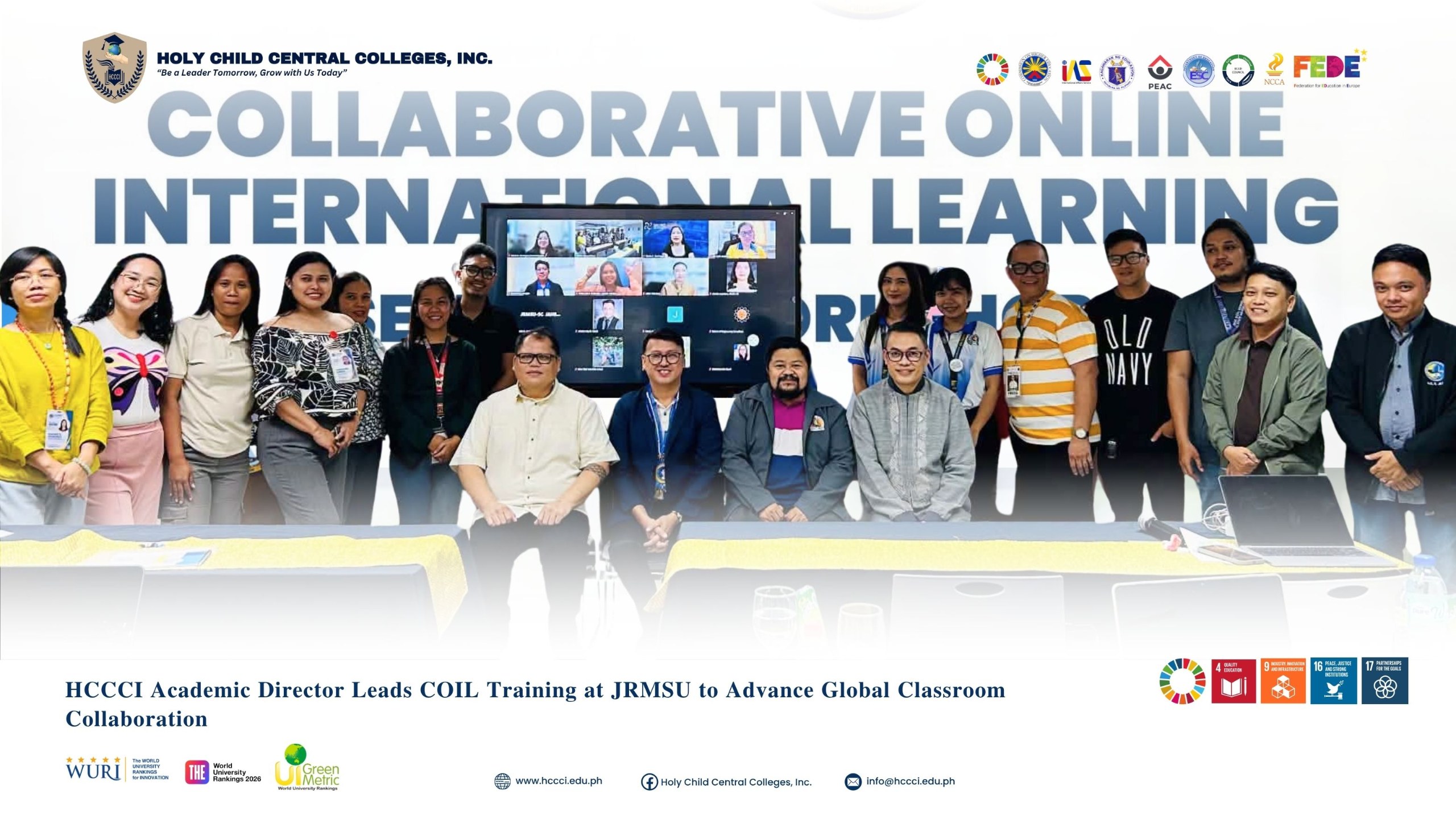
𝐇𝐂𝐂𝐂𝐈 𝐀𝐜𝐚𝐝𝐞𝐦𝐢𝐜 𝐃𝐢𝐫𝐞𝐜𝐭𝐨𝐫 𝐋𝐞𝐚𝐝𝐬 𝐂𝐎𝐈𝐋 𝐓𝐫𝐚𝐢𝐧𝐢𝐧𝐠 𝐚𝐭 𝐉𝐑𝐌𝐒𝐔 𝐭𝐨 𝐀𝐝𝐯𝐚𝐧𝐜𝐞 𝐆𝐥𝐨𝐛𝐚𝐥 𝐂𝐥𝐚𝐬𝐬𝐫𝐨𝐨𝐦 𝐂𝐨𝐥𝐥𝐚𝐛𝐨𝐫𝐚𝐭𝐢𝐨𝐧
Holy Child Central Colleges, Inc. (HCCCI) advanced its engagement in internationalized education as Academic Director Dr. Erwin M. Faller served as resource speaker at a Collaborative Online International Learning (COIL) Seminar-Workshop hosted by Jose Rizal Memorial State University (JRMSU) on October 16, 2026, at the JRMSU Main Campus Library.
Conducted in a hybrid format, the seminar-workshop brought together selected faculty members from JRMSU’s five campuses to strengthen their understanding of COIL and explore how cross-border academic collaboration can be integrated into classroom instruction. The activity was organized through the university’s Office of the Vice President for External Affairs, Linkages, and Resource Generation, in coordination with the Office of the Vice President for Academic Affairs.
Dr. Faller facilitated sessions on COIL planning and design, guiding participants through the process of developing collaborative learning experiences with international academic partners. The discussions emphasized the importance of purposeful instructional design, clear learning objectives, and activities that enable students from different cultural and educational backgrounds to exchange perspectives and work toward shared academic goals. The sessions highlighted that successful COIL implementation requires more than digital connectivity; it depends on meaningful collaboration between educators, coordinated learning activities, and opportunities for intercultural engagement.
Representatives from Colegio de San Francisco Javier, Inc., an invited partner institution, also participated in the activity, underscoring the role of institutional linkages in expanding opportunities for academic exchange. Such engagement can help educators establish connections beyond their immediate institutional settings and create pathways for future collaborative learning initiatives.
For HCCCI, Dr. Faller’s participation reflects the institution’s continuing engagement in faculty development, internationalization, and innovative teaching practices. Through COIL, educators can connect their classrooms with international partners and enable students to collaborate across borders without requiring physical mobility. This approach can broaden access to global learning experiences while helping students develop intercultural communication, collaboration, and critical-thinking skills.
The initiative supports Sustainable Development Goal (SDG) 4: Quality Education by promoting innovative teaching approaches and strengthening faculty capacity to design globally connected learning experiences. It also aligns with SDG 17: Partnerships for the Goals by highlighting the importance of institutional cooperation, knowledge-sharing, and collaborative approaches to international education.
The seminar-workshop also reflected JRMSU’s efforts to prepare its faculty for increasingly interconnected learning environments. By equipping educators with foundational knowledge of COIL planning and design, the activity provided a basis for exploring how international perspectives can be incorporated into teaching and how academic partnerships can support more engaging learning opportunities for students.
Through Dr. Faller’s contribution, HCCCI continues to participate in knowledge-sharing initiatives that advance collaborative teaching, international academic linkages, and innovative approaches to higher education. The engagement reinforces the role of faculty development and institutional partnerships in making international learning more accessible and meaningful for educators and students alike.