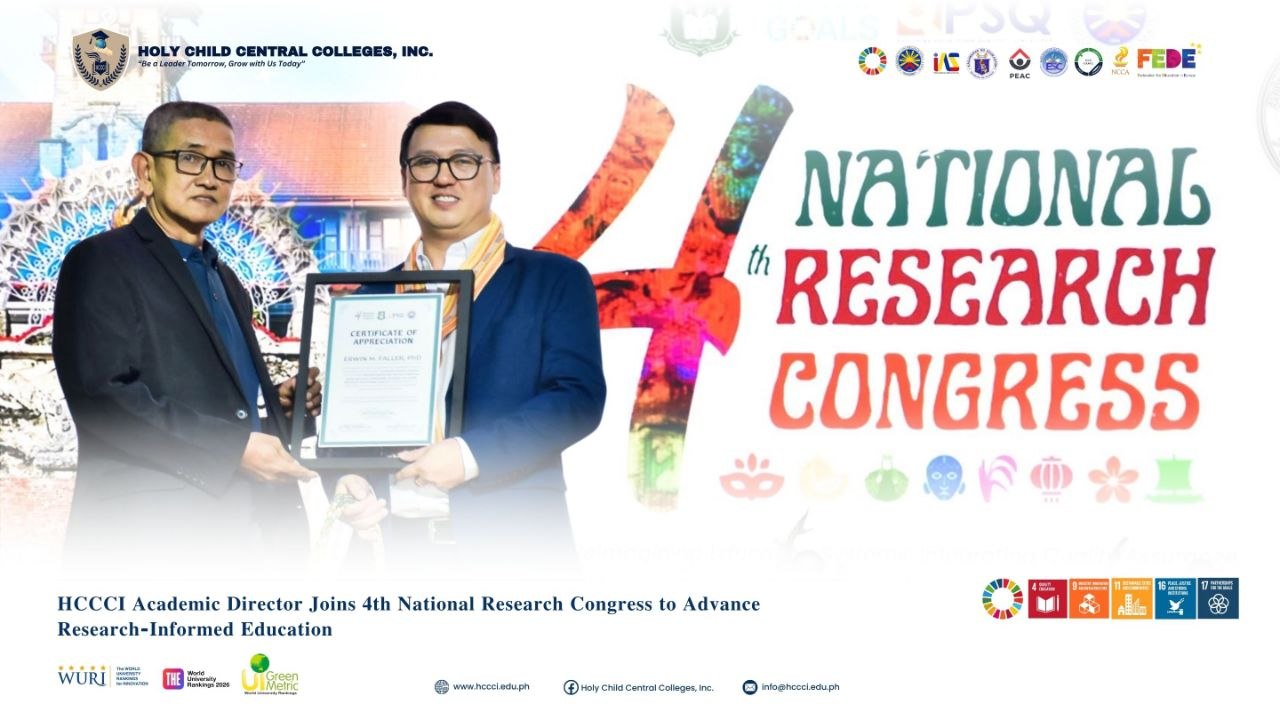
𝐇𝐂𝐂𝐂𝐈 𝐀𝐜𝐚𝐝𝐞𝐦𝐢𝐜 𝐃𝐢𝐫𝐞𝐜𝐭𝐨𝐫 𝐉𝐨𝐢𝐧𝐬 𝟒𝐭𝐡 𝐍𝐚𝐭𝐢𝐨𝐧𝐚𝐥 𝐑𝐞𝐬𝐞𝐚𝐫𝐜𝐡 𝐂𝐨𝐧𝐠𝐫𝐞𝐬𝐬 𝐭𝐨 𝐀𝐝𝐯𝐚𝐧𝐜𝐞 𝐑𝐞𝐬𝐞𝐚𝐫𝐜𝐡-𝐈𝐧𝐟𝐨𝐫𝐦𝐞𝐝 𝐄𝐝𝐮𝐜𝐚𝐭𝐢𝐨𝐧
Dr. Erwin M. Faller, Academic Director of Holy Child Central Colleges, Inc. (HCCCI), joined fellow academic leaders as a plenary speaker at the 4th National Research Congress, held on October 13–14, 2026, at The Summit Centre in Tetuan, Zamboanga City. His participation brought HCCCI’s academic leadership into a national research forum focused on exchanging ideas and examining how research can inform educational practice, institutional development, and responses to emerging challenges in education.
Hosted by Universidad de Zamboanga (UZ), the two-day congress gathered educators, researchers, and academic professionals to discuss the role of research in improving educational quality, encouraging innovation, and preparing learners for an increasingly complex and changing world. Dr. Faller shared the plenary platform with Dr. Mark Irvin C. Celis and Dr. Ronald V. Amorado, contributing to the congress’s broader conversation on the direction and development of education.
Participation in a national research forum provides academic leaders with opportunities to engage with perspectives beyond their own institutions, exchange professional insights, and reflect on how research can inform academic decisions. For HCCCI, Dr. Faller’s involvement underscores the importance of connecting institutional leadership with wider scholarly conversations, where evidence, experience, and emerging ideas can contribute to the continuous improvement of teaching and learning.
Research serves not only as a means of generating new knowledge but also as a foundation for examining existing practices, identifying areas for improvement, and developing responses to educational needs. When research findings inform academic planning and decision-making, institutions are better positioned to assess the relevance of their programs, strengthen teaching approaches, and pursue improvements grounded in evidence. These considerations reinforce the importance of maintaining an active connection between research, academic leadership, and institutional development.
The congress also highlighted education’s broader responsibility to prepare individuals for an uncertain future and to translate knowledge into meaningful action. In her opening remarks, Dr. Jo-Anne Bernardo, Vice President for Academic Affairs of UZ, reflected on the role of education in equipping people to navigate a future that cannot be predicted with certainty. Meanwhile, Hon. Maria Isabelle Climaco-Salazar, Zamboanga City Vice Mayor, emphasized the practical value of research in helping government institutions improve services and respond to community needs.
These perspectives reinforced the relevance of research beyond academic publication. Research can inform institutional decisions, support public service, and help educators and policymakers better understand the challenges facing the communities they serve. By encouraging dialogue between academic and public-sector perspectives, the congress highlighted how evidence-informed approaches can contribute to educational improvement and wider social development.
The event was organized by the UZ Centre for University Research and Innovation (UZ-CURI) under the leadership of Research Director Dr. Joselito Ignacio, as Universidad de Zamboanga marked its 78th year of service in education. The gathering also demonstrated the value of bringing higher education institutions and research communities together to exchange expertise, examine shared concerns, and strengthen a collective commitment to relevant and responsive education.
Dr. Faller’s participation aligns with Sustainable Development Goal (SDG) 4: Quality Education, particularly through professional knowledge-sharing and the advancement of research-informed educational practice. It also reflects SDG 17: Partnerships for the Goals, through engagement with academic peers and institutions in a shared effort to advance educational knowledge and improvement.
For HCCCI, academic leadership involves more than managing institutional operations. It also entails remaining engaged with wider scholarly communities, learning from the experiences of other institutions, and contributing to conversations that shape educational practice. Through participation in forums such as the National Research Congress, HCCCI continues to recognize research as an essential component of academic development and a resource for informed institutional decision-making.
By engaging in national research conversations, HCCCI reinforces its commitment to quality, relevant, and continuously improving education. Dr. Faller’s participation reflects the value of academic leadership that remains connected to research and professional collaboration, helping ensure that institutional development is informed not only by internal priorities but also by broader discussions and evolving perspectives across the education sector.