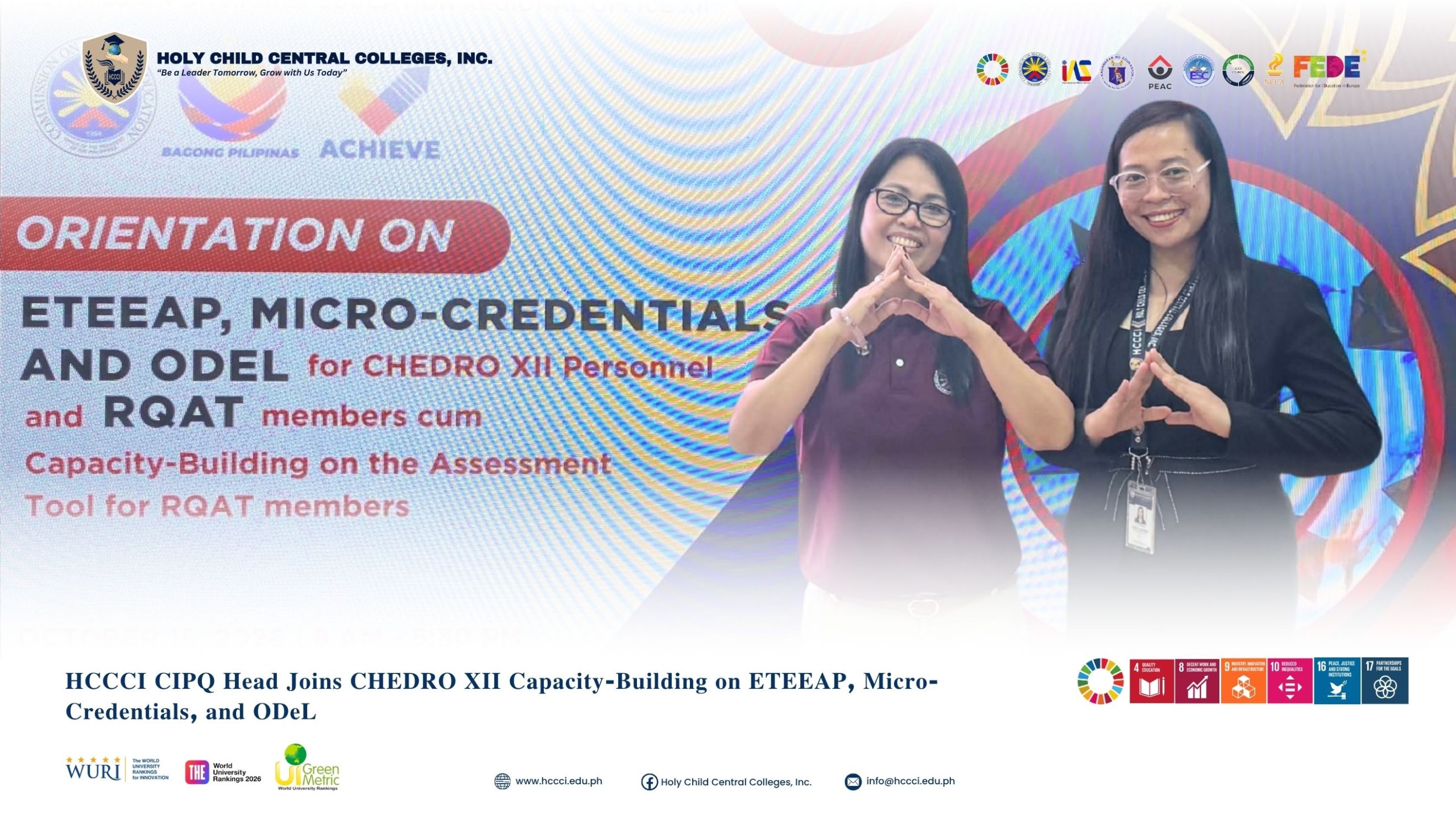
𝐇𝐂𝐂𝐂𝐈 𝐂𝐈𝐏𝐐 𝐇𝐞𝐚𝐝 𝐉𝐨𝐢𝐧𝐬 𝐂𝐇𝐄𝐃𝐑𝐎 𝐗𝐈𝐈 𝐂𝐚𝐩𝐚𝐜𝐢𝐭𝐲-𝐁𝐮𝐢𝐥𝐝𝐢𝐧𝐠 𝐨𝐧 𝐄𝐓𝐄𝐄𝐀𝐏, 𝐌𝐢𝐜𝐫𝐨-𝐂𝐫𝐞𝐝𝐞𝐧𝐭𝐢𝐚𝐥𝐬, 𝐚𝐧𝐝 𝐎𝐃𝐞𝐋
Holy Child Central Colleges, Inc. (HCCCI) strengthened its institutional quality assurance efforts through the participation of Mrs. Juliet Arellano-Castañas, LPT, MAEd, Head of the Center for Institutional Performance and Quality (CIPQ), in the Orientation on Expanded Tertiary Education Equivalency and Accreditation Program (ETEEAP), Micro-Credentials, and Open and Distance e-Learning (ODeL) for CHEDRO XII Personnel and RQAT Members cum Capacity-Building on the Assessment Tools for RQAT Members on October 15, 2026, at Yakal Hall, Cinco Niñas, Koronadal City.
Organized for personnel of the Commission on Higher Education Regional Office XII (CHEDRO XII) and members of the Regional Quality Assessment Team (RQAT), the activity aimed to deepen participants’ understanding of ETEEAP, micro-credentials, and ODeL while strengthening their competencies in applying assessment tools for quality evaluation. The program featured orientation sessions on the three higher education initiatives and a workshop on ETEEAP assessment tools facilitated by Dr. Annabelle R. Dafielmoto, Supervising Education Program Specialist and focal person for ETEEAP and ODeL.
Mrs. Arellano-Castañas’ participation reflects HCCCI’s continuing efforts to strengthen its internal quality assurance practices through professional development and engagement with evolving higher education policies, program requirements, and assessment procedures. These areas are particularly relevant to CIPQ’s role in monitoring institutional performance, evaluating compliance with applicable standards, and identifying opportunities for improvement across the institution.
As HCCCI continues to advance its quality assurance framework, participation in regional capacity-building initiatives helps strengthen the institutional knowledge and competencies needed to support evidence-informed planning, systematic evaluation, and continuous improvement. This engagement reinforces the importance of quality assurance as a shared institutional responsibility and a foundation for delivering relevant, responsive, and quality higher education.