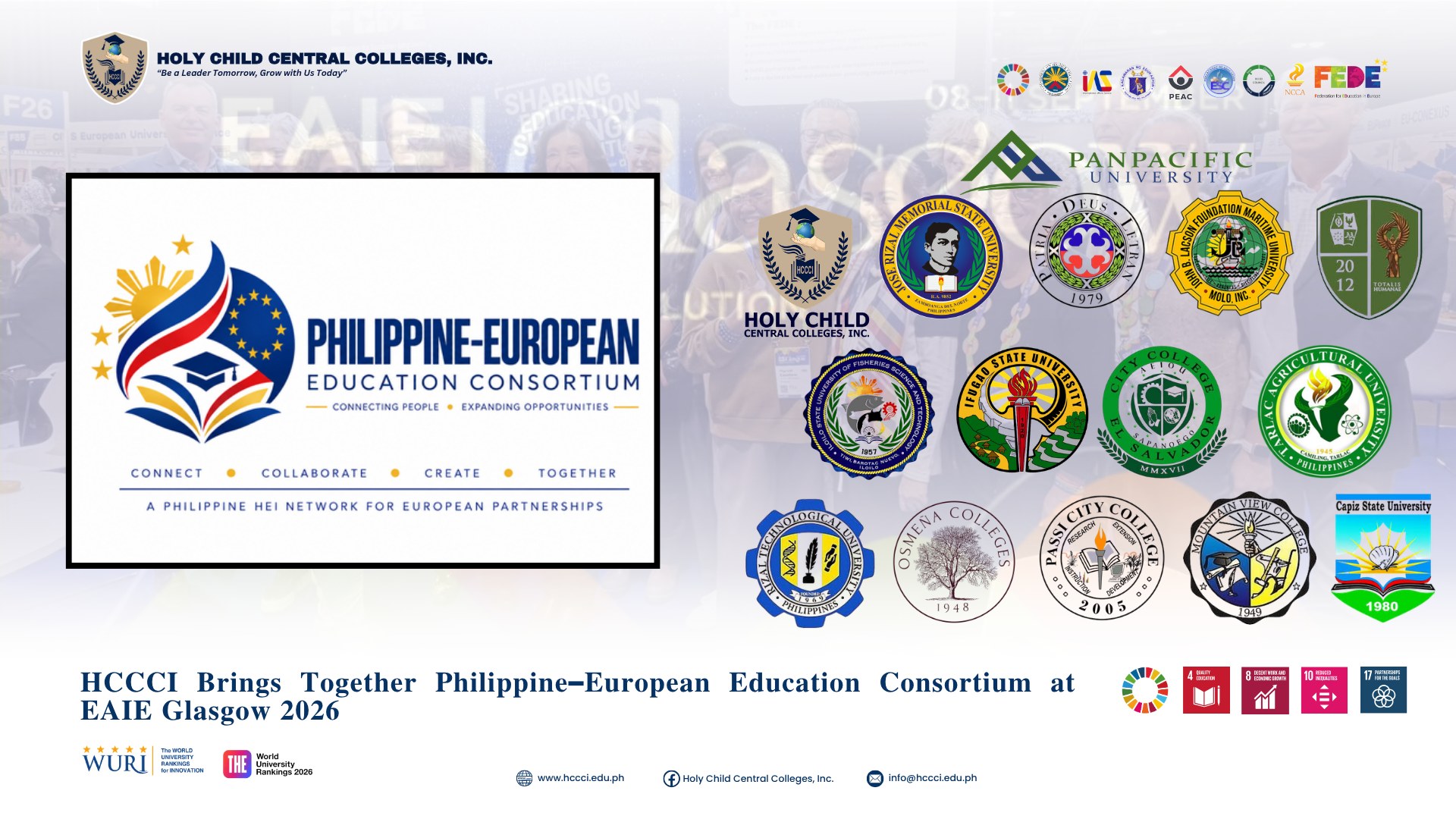
𝐇𝐂𝐂𝐂𝐈 𝐁𝐫𝐢𝐧𝐠𝐬 𝐓𝐨𝐠𝐞𝐭𝐡𝐞𝐫 𝐏𝐡𝐢𝐥𝐢𝐩𝐩𝐢𝐧𝐞–𝐄𝐮𝐫𝐨𝐩𝐞𝐚𝐧 𝐄𝐝𝐮𝐜𝐚𝐭𝐢𝐨𝐧 𝐂𝐨𝐧𝐬𝐨𝐫𝐭𝐢𝐮𝐦 𝐚𝐭 𝐄𝐀𝐈𝐄 𝐆𝐥𝐚𝐬𝐠𝐨𝐰 𝟐𝟎𝟐𝟔
Holy Child Central Colleges, Inc. (HCCCI) brought together the Philippine–European Education Consortium (PEEC) during the 36th Annual EAIE Conference and Exhibition held from September 8–11, 2026, in Glasgow, Scotland. The initiative gathered Philippine higher education institutions from different regions and institutional sectors to create a shared platform for exploring academic partnerships and strengthening engagement with European institutions.
The PEEC brings together representatives from Panpacific University, Holy Child Central Colleges, Inc. (HCCCI), Jose Rizal Memorial State University, City College of Angeles, Colegio de San Juan de Letran Calamba, Iloilo State University of Fisheries Science and Technology, John B. Lacson Foundation Maritime University–Molo, Ifugao State University, City College of El Salvador, Tarlac Agricultural University, Capiz State University, Rizal Technological University, Osmeña Colleges, Passi City College, and Mountain View College.
As the convening institution of PEEC, HCCCI provided an avenue for these Philippine higher education institutions to come together at one of the international higher education sector’s major gatherings. HCCCI’s role in the consortium is to facilitate connections among participating Philippine institutions and create opportunities for collective engagement with prospective European academic partners.
The formation of PEEC reflects a shared interest among participating institutions in advancing internationalization through cooperation and institutional networking. Rather than operating as a single institution, the consortium brings together institutions with different academic programs, mandates, geographical locations, and areas of expertise, allowing members to explore common interests while maintaining their respective institutional identities.
At EAIE Glasgow 2026, PEEC provided an opportunity for the participating institutions to introduce their respective academic communities and explore possible areas of cooperation with European counterparts. These areas may include student and faculty mobility, collaborative research, joint academic initiatives, capacity-building programs, international learning opportunities, and other forms of institutional partnership.
The participation of the consortium also provided a space for Philippine institutions to exchange experiences with one another. The presence of SUCs, private higher education institutions, local colleges, and other academic institutions demonstrated the breadth of the Philippine higher education sector and the different pathways through which institutions can pursue internationalization.
Looking beyond EAIE Glasgow 2026, PEEC intends to build on the connections established during the conference by developing more structured cooperation among its member institutions and prospective European partners. Among the areas being explored are student and faculty mobility, visiting professor and lecturer exchanges, collaborative research and publications, joint webinars and academic forums, Collaborative Online International Learning (COIL), short-term international programs, and capacity-building activities for internationalization officers and academic leaders. The consortium may also explore opportunities for joint participation in international projects and funding programs, including initiatives supported through European higher education cooperation mechanisms. These directions are aligned with existing Philippine internationalization priorities that emphasize mobility, partnership-building, joint programs, research links, capacity development, and transnational higher education.
PEEC also envisions creating opportunities for its member institutions to share expertise and resources with one another, particularly in areas such as internationalization strategies, global classroom initiatives, research collaboration, curriculum development, and digital academic engagement. In the longer term, the consortium can serve as a platform for identifying complementary programs among Philippine institutions and connecting these strengths with European institutions seeking academic partners. Such collaboration could help transform initial contacts established in Glasgow into sustained institutional relationships.
The initiative contributes to Sustainable Development Goal 4 (Quality Education) by encouraging academic cooperation, international learning, and knowledge exchange; SDG 8 (Decent Work and Economic Growth) by supporting opportunities for skills development, professional exposure, and international competencies; SDG 10 (Reduced Inequalities) by creating broader opportunities for Philippine higher education institutions from different regions and institutional contexts to participate in international academic networks; and SDG 17 (Partnerships for the Goals) through the development of institutional networks and cross-border academic collaboration.
For HCCCI, convening PEEC at EAIE Glasgow 2026 is a step toward creating a more connected Philippine higher education network with stronger links to Europe. The consortium provides participating institutions with a shared platform to learn from one another, pursue common internationalization goals, and develop opportunities that can reach students, faculty members, researchers, and academic communities.
As PEEC moves forward, the goal is to turn connections into collaboration and collaboration into sustained academic opportunities. From the initial gathering in Glasgow, the consortium can continue developing a network where Philippine institutions work together, engage European counterparts, and create pathways for mobility, research, international learning, and institutional development.
With HCCCI serving as the convening institution of PEEC, the consortium provides a continuing platform through which participating Philippine institutions can connect with European counterparts and explore opportunities that contribute to the internationalization of Philippine higher education.