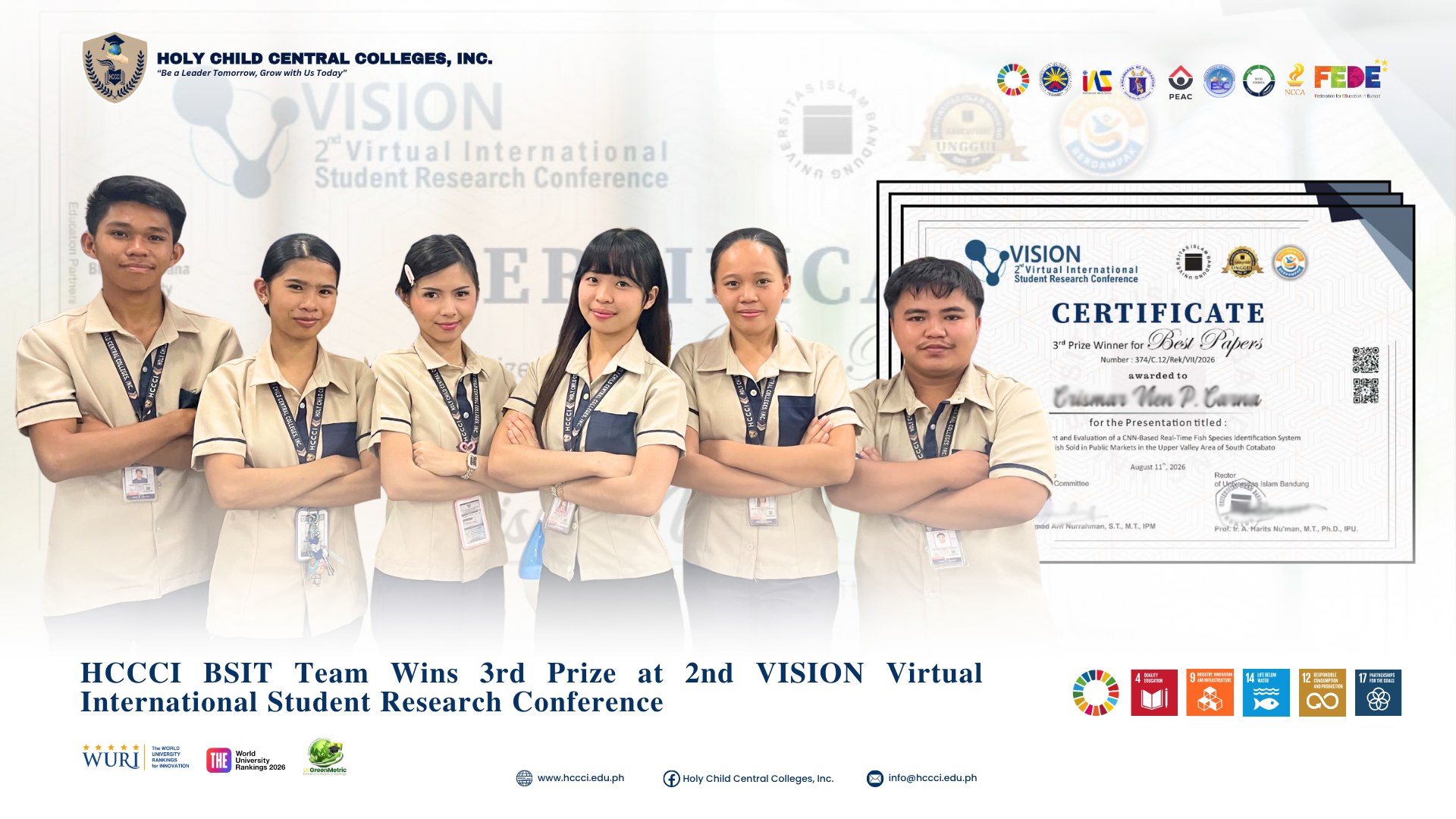
𝐇𝐂𝐂𝐂𝐈 𝐁𝐒𝐈𝐓 𝐓𝐞𝐚𝐦 𝐖𝐢𝐧𝐬 𝟑𝐫𝐝 𝐏𝐫𝐢𝐳𝐞 𝐚𝐭 𝟐𝐧𝐝 𝐕𝐈𝐒𝐈𝐎𝐍 𝐕𝐢𝐫𝐭𝐮𝐚𝐥 𝐈𝐧𝐭𝐞𝐫𝐧𝐚𝐭𝐢𝐨𝐧𝐚𝐥 𝐒𝐭𝐮𝐝𝐞𝐧𝐭 𝐑𝐞𝐬𝐞𝐚𝐫𝐜𝐡 𝐂𝐨𝐧𝐟𝐞𝐫𝐞𝐧𝐜𝐞
A research team comprising second-year Bachelor of Science in Information Technology (BSIT) students from the College of Computer Studies of Holy Child Central Colleges, Inc. (HCCCI) secured 3rd Prize in the Best Papers category at the 2nd VISION Virtual International Student Research Conference, held on August 11, 2026. The team was recognized for its study on an artificial intelligence-powered fish species identification system designed to help consumers identify aquatic species sold in public markets across the Upper Valley Area of South Cotabato.
Titled “Development and Evaluation of a CNN-Based Real-Time Fish Species Identification System for Fish Sold in Public Markets in the Upper Valley Area of South Cotabato,” the study addresses the challenges of seafood mislabeling and the difficulties consumers face in distinguishing among fish species. Misidentification and mislabeling can affect consumer confidence, food safety, and purchasing decisions, highlighting the need for accessible and reliable identification tools in public markets.
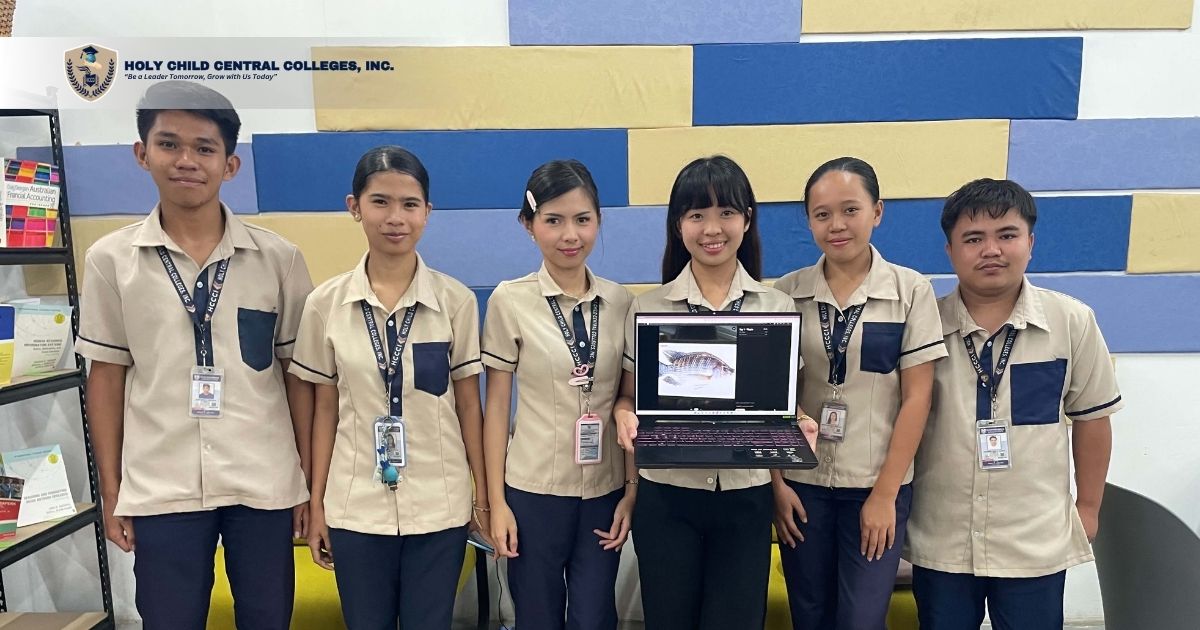
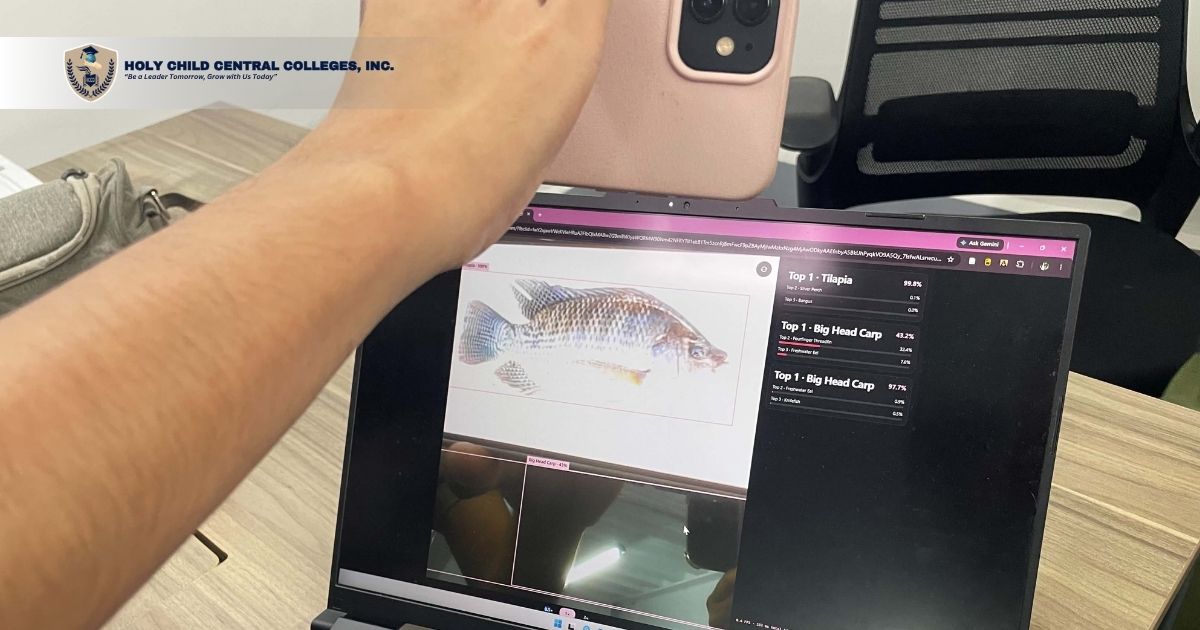
To address these concerns, the researchers developed a system that uses a convolutional neural network (CNN), a deep learning approach used for image recognition and classification. The study employed a ResNet50 model trained on a combined dataset of 22,304 images representing 40 fish species. The researchers also incorporated YOLOv8-based detection and converted the model to ONNX format to support lightweight deployment on smartphones for practical, real-time use.
Although the model was trained on a broader collection of fish species, its field application focused on five commonly sold aquatic products: bangus, catfish, tilapia, horse mackerel, and shrimp. Through image-based identification, the system was designed to help consumers recognize these species more conveniently when purchasing seafood in public markets.
The evaluation results demonstrated the system’s technical performance and potential for practical use. It achieved an overall classification accuracy of 93.57%, with weighted precision, recall, and F1 scores of 0.94 each. The system also completed classification in approximately 65 milliseconds per image, indicating its capacity to process images within a timeframe suitable for real-time mobile applications.
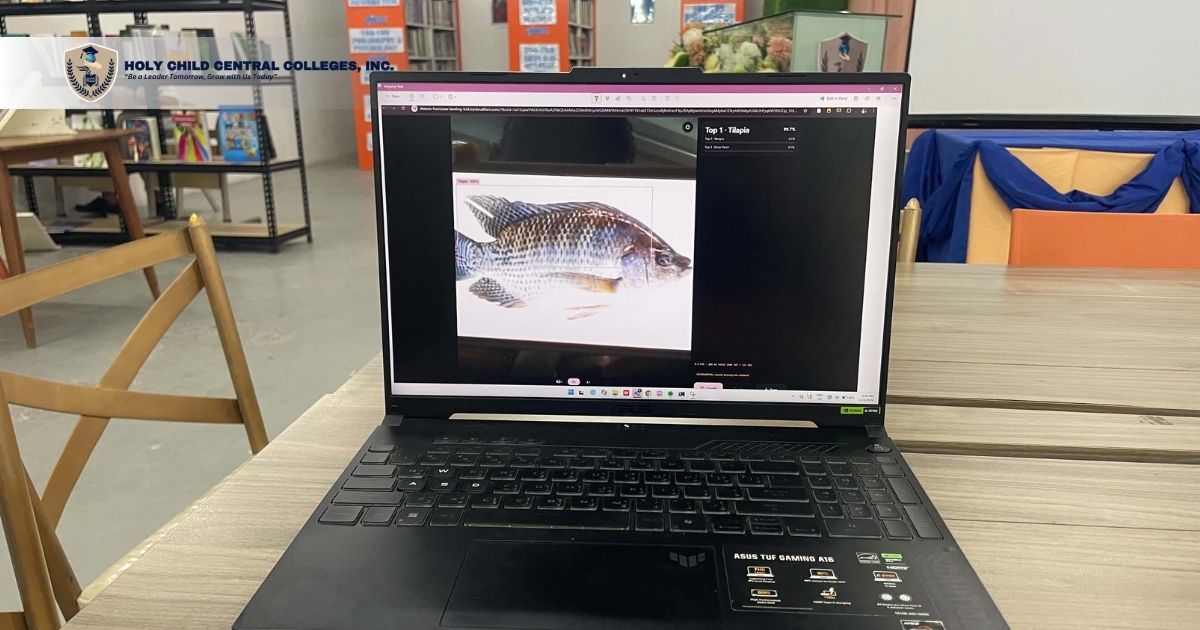
These findings illustrate how artificial intelligence can be applied to concerns encountered in everyday transactions. By developing a consumer-facing identification tool, the researchers explored how machine learning and mobile technology can make fish species identification more accessible, particularly to individuals who may not have specialized knowledge of aquatic species.
The award-winning research was collaboratively developed by Irish O. Legada, Mary Brigid P. Penado, Michyla Joy B. Isidro, Rianne Kate Pelle, Crismar Vien P. Carna, and John Rex T. Tabirao, all second-year BSIT students from the College of Computer Studies. The certificate was issued in the name of Crismar Vien P. Carna as the team’s representative; however, the 3rd Prize recognition acknowledges the collective research efforts and contributions of the entire team.
The study has practical relevance for seafood consumers, particularly those who purchase fish in public markets, as it explores a technology-assisted approach to species identification. Its potential application also offers an opportunity to connect information technology with food commerce and aquatic resource management, demonstrating the value of interdisciplinary research in addressing community needs.
The research contributes to several United Nations Sustainable Development Goals (SDGs). It supports SDG 4: Quality Education by providing students with opportunities to apply classroom learning through research and technological development. It advances SDG 9: Industry, Innovation and Infrastructure through the application of artificial intelligence and mobile computing to practical challenges. Its focus on informed seafood purchasing aligns with SDG 12: Responsible Consumption and Production, while its contribution to species identification and awareness of aquatic resources relates to SDG 14: Life Below Water. The team’s participation in an international research conference also aligns with SDG 17: Partnerships for the Goals by providing opportunities for academic exchange, research dissemination, and engagement with the wider scholarly community.
The achievement reflects HCCCI’s commitment to developing students who can translate technical knowledge into research-based solutions. It also highlights the importance of teamwork, creativity, and social responsibility, consistent with the institution’s STAIRS core values. By encouraging undergraduate research that responds to actual needs, the institution continues to strengthen an academic environment where innovation is connected to meaningful applications.
With this achievement, BSIT student researchers demonstrate that undergraduate research can contribute to discussions on technology, consumer protection, and sustainability. Their success reinforces the importance of supporting student-led innovation and providing opportunities for young researchers to present their work, share knowledge, and contribute solutions to challenges within their communities and beyond.