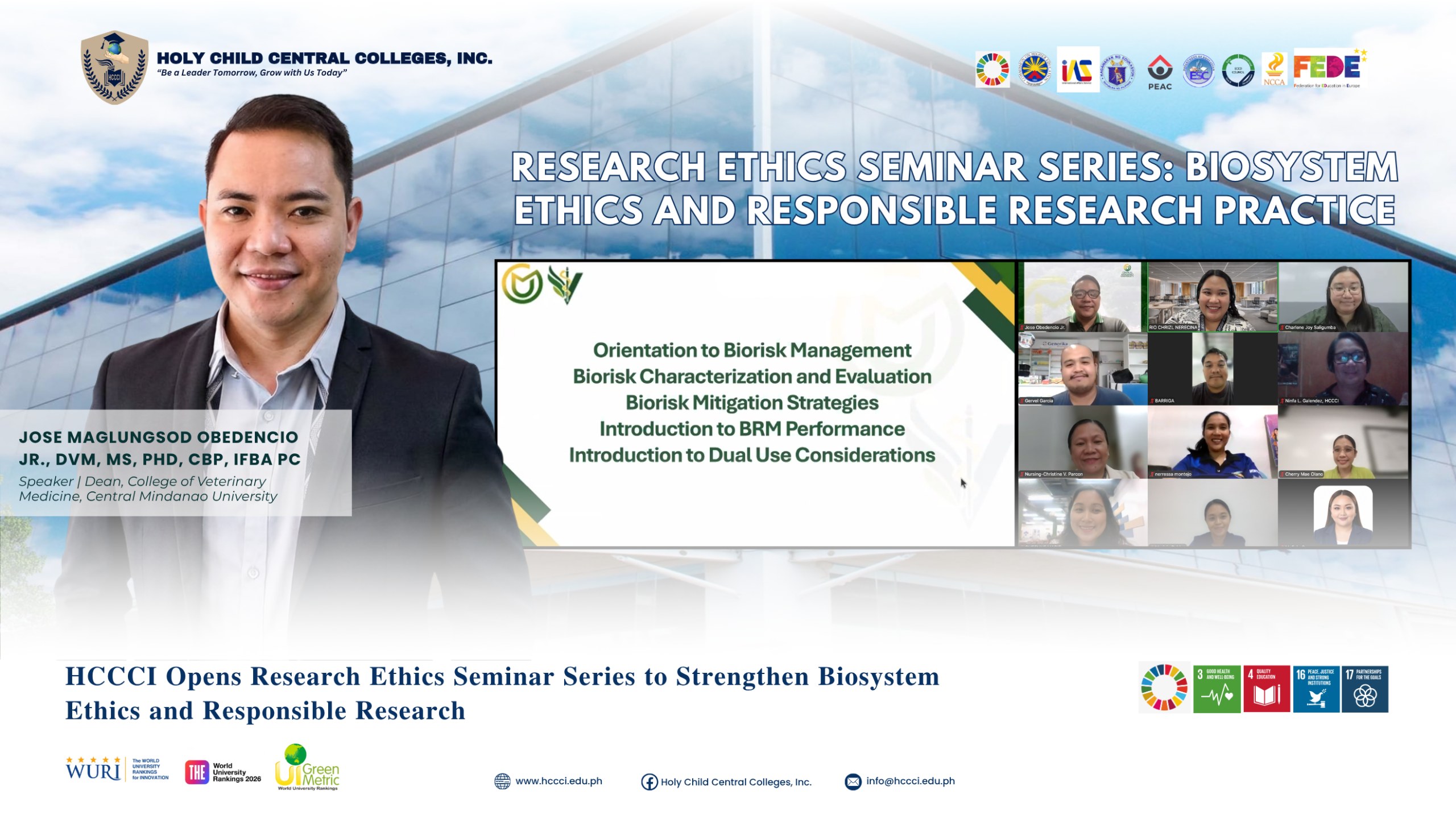
𝐇𝐂𝐂𝐂𝐈 𝐎𝐩𝐞𝐧𝐬 𝐑𝐞𝐬𝐞𝐚𝐫𝐜𝐡 𝐄𝐭𝐡𝐢𝐜𝐬 𝐒𝐞𝐦𝐢𝐧𝐚𝐫 𝐒𝐞𝐫𝐢𝐞𝐬 𝐭𝐨 𝐒𝐭𝐫𝐞𝐧𝐠𝐭𝐡𝐞𝐧 𝐁𝐢𝐨𝐬𝐲𝐬𝐭𝐞𝐦 𝐄𝐭𝐡𝐢𝐜𝐬 𝐚𝐧𝐝 𝐑𝐞𝐬𝐩𝐨𝐧𝐬𝐢𝐛𝐥𝐞 𝐑𝐞𝐬𝐞𝐚𝐫𝐜𝐡
Holy Child Central Colleges, Inc. (HCCCI) opened its Research Ethics Seminar Series on October 8, 2026, with Day 1 focusing on Biosystem Ethics and Responsible Research Practice. Anchored in the theme “Ethics Before Evidence: Advancing Responsible Research Practice,” the seminar marked an institutional effort to strengthen research capacity while reinforcing the principle that scientific inquiry must be conducted with due regard for safety, ethical responsibility, and the potential consequences of research on people, communities, and biological systems.
Spearheaded by Charlene Joy T. Saligumba, LPT, Research Ethics Coordinator, the seminar brought together administrators, program heads, faculty members, research personnel, and members of the HCCCI Institutional Research Ethics Board (IREB). The activity aimed to deepen participants’ understanding of responsible research practices and encourage the integration of ethical considerations into research planning, implementation, and review. It also provided an opportunity for members of the academic community to strengthen their shared understanding of the safeguards and institutional responsibilities that support credible and accountable research.
The opening day featured Dr. Jose M. Obedencio Jr., DVM, MS, PhD, CBP, IFBA PC, of the College of Veterinary Medicine, Central Mindanao University, as resource speaker. His discussions covered biorisk management, biorisk characterization and evaluation, and biorisk mitigation strategies. These topics addressed the importance of identifying biological hazards, assessing the likelihood and potential consequences of exposure, and determining appropriate measures to prevent or reduce risks associated with research activities.
Through these discussions, participants were introduced to the importance of approaching biological research systematically and responsibly. Biorisk management requires researchers to consider not only the scientific objectives of a study but also the materials, procedures, environments, and individuals that may be affected by their work. Risk assessment and mitigation are therefore essential components of research planning, helping ensure that scientific activities are undertaken with appropriate precautions and a clear understanding of potential harm.
The seminar’s broader intention was to reinforce that research ethics is not merely a procedural requirement to be addressed before a study begins. It is an ongoing responsibility that informs decisions throughout the research process—from selecting appropriate methods and evaluating potential risks to implementing safeguards, maintaining accountability, and communicating findings responsibly. By developing this understanding among faculty members, researchers, and academic leaders, HCCCI seeks to encourage research practices that uphold scientific rigor while respecting the welfare of people and the integrity of the systems involved.
The initiative also highlights the role of HCCCI’s Research and Academic Affairs functions in advancing an institutional research culture. Research development requires more than encouraging faculty members and students to undertake studies; it also involves providing guidance, strengthening competencies, promoting ethical review, and ensuring that research activities are aligned with appropriate standards. Through initiatives such as the Research Ethics Seminar Series, the institution can reinforce the connection between research capability, academic quality, and responsible knowledge production.
The involvement of the Research Director and members of the HCCCI IREB was particularly relevant to this objective. Research development and ethics review serve complementary purposes: research initiatives expand knowledge and address institutional or community concerns, while ethical oversight helps ensure that the methods used to pursue these objectives are responsible and appropriately safeguarded. Strengthening the understanding of researchers and research personnel can help promote earlier consideration of ethical requirements and improve coordination between researchers and the institutional structures responsible for research review and governance.
The seminar was supported by Dr. Erwin M. Faller, Academic Director, together with HCCCI’s program heads. Representatives from the Center for Institutional Performance and Quality (CIPQ), the Quality Assurance Office, the Information Office, and the Academic Affairs Office also participated. Their presence reflected the cross-functional nature of responsible research, which requires coordination among academic leadership, research personnel, quality assurance, and institutional support offices. Such collaboration helps position research ethics as a shared institutional responsibility rather than the concern of individual researchers or a single office alone.
The program was moderated by Rio Chrizl M. Nerecina, LPT, Information Officer, and concluded with the recognition of Dr. Obedencio for sharing his expertise with the HCCCI community. His contribution supported the seminar’s goal of exposing participants to specialized knowledge and practical considerations relevant to responsible research.
The seminar aligns with Sustainable Development Goal (SDG) 3: Good Health and Well-Being, through its emphasis on biorisk awareness and practices intended to protect people from biological hazards; SDG 4: Quality Education, by supporting continuing professional development and strengthening research competencies; and SDG 9: Industry, Innovation and Infrastructure, by promoting responsible research capacity and innovation. These connections reflect the importance of developing knowledge and technical capabilities alongside the ethical safeguards needed to apply them responsibly.
As Day 1 concluded, the seminar reinforced a central principle: the value of scientific discovery depends not only on the findings produced but also on the integrity of the process through which those findings are generated. Responsible research requires researchers to anticipate risks, observe appropriate safeguards, and remain accountable for the potential effects of their work. This commitment is essential to maintaining trust in research and ensuring that the pursuit of knowledge serves a constructive purpose.
Through its Research Ethics Seminar Series, HCCCI continues to advance its intention of cultivating a research culture grounded in scientific rigor, biosafety, ethical responsibility, and institutional accountability. By strengthening the capacities of researchers, engaging academic and administrative offices, and reinforcing the role of ethical review, the institution seeks to make responsible practice an integral part of research and academic development. The initiative affirms that research excellence is not defined by discovery alone, but by the responsibility with which knowledge is pursued, produced, and applied.