𝐇𝐂𝐂𝐂𝐈 𝐂𝐨𝐧𝐭𝐢𝐧𝐮𝐞𝐬 𝐑𝐞𝐬𝐞𝐚𝐫𝐜𝐡 𝐄𝐭𝐡𝐢𝐜𝐬 𝐒𝐞𝐦𝐢𝐧𝐚𝐫 𝐒𝐞𝐫𝐢𝐞𝐬, 𝐒𝐭𝐫𝐞𝐧𝐠𝐭𝐡𝐞𝐧𝐬 𝐄𝐭𝐡𝐢𝐜𝐚𝐥 𝐏𝐫𝐚𝐜𝐭𝐢𝐜𝐞 𝐢𝐧 𝐇𝐮𝐦𝐚𝐧 𝐑𝐞𝐬𝐞𝐚𝐫𝐜𝐡
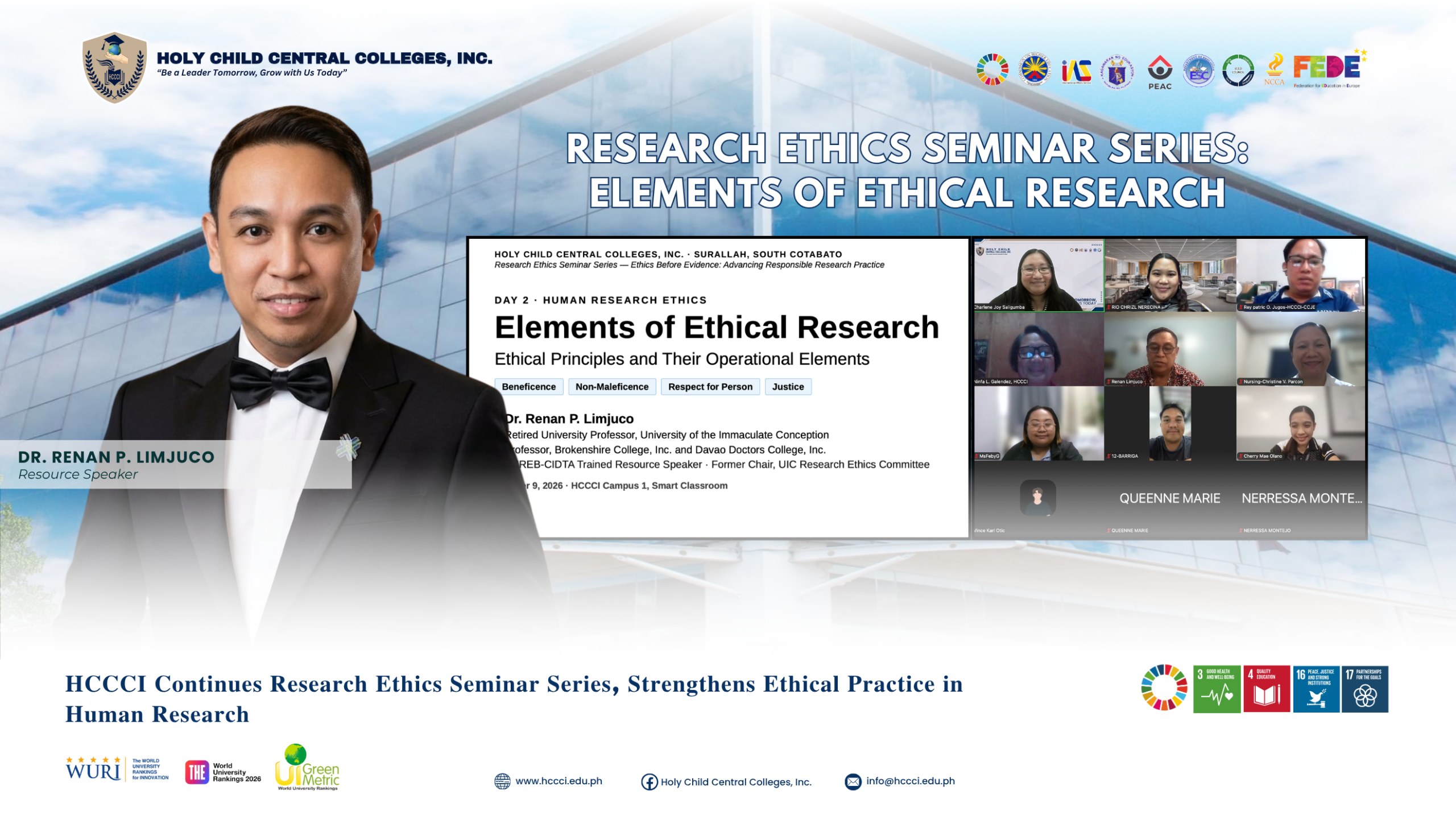
Holy Child Central Colleges, Inc. (HCCCI) continued its Research Ethics Seminar Series on October 9, 2026, with Day 2 focusing on Human Research Ethics and the Elements of Ethical Research. Held at the HCCCI Campus 1 Smart Classroom under the theme “Ethics Before Evidence: Advancing Responsible Research Practice,” the seminar emphasized the importance of protecting the rights, dignity, safety, and welfare of human research participants while strengthening the institution’s capacity for responsible research.
Spearheaded by Charlene Joy T. Saligumba, LPT, Research Ethics Coordinator, the session brought together administrators, program heads, faculty members, research personnel, and members of the HCCCI Institutional Research Ethics Board (IREB). The activity continued the institution’s efforts to build a research culture in which ethical considerations are integrated into the planning, review, and conduct of research rather than treated as a requirement separate from the research process.
The Day 2 resource speaker, Dr. Renan P. Limjuco, a PHREB-CIDTA-trained professional, discussed the ethical principles that guide research involving human participants: beneficence, non-maleficence, respect for persons, and justice. His presentation examined the significance of these principles and their operational elements in guiding researchers’ decisions, particularly when studies involve individuals whose rights, welfare, and personal information require appropriate protection.
Beneficence calls on researchers to consider potential benefits and promote participant welfare, while non-maleficence emphasizes the responsibility to avoid or minimize harm. Respect for persons recognizes individual autonomy and the importance of informed, voluntary participation, while justice calls for fairness in the selection and treatment of research participants and in the distribution of research benefits and burdens. Together, these principles provide a foundation for evaluating whether research is ethically acceptable and conducted with due regard for the people involved.
The discussion reinforced that ethical research requires more than obtaining consent or complying with prescribed procedures. Researchers must carefully consider how participants are recruited, how risks and benefits are assessed, how confidentiality is protected, and how information is collected, stored, and used. These responsibilities extend throughout the research process and are essential to maintaining public trust in academic inquiry.
The seminar also highlighted the complementary roles of research development, academic leadership, and ethical oversight. With the participation of the Research Director and members of the HCCCI IREB, the session supported a shared understanding of how ethical review and responsible research practices contribute to institutional research governance. Strengthening researchers’ knowledge of ethical principles can help promote more thoughtful study design, better preparation for ethics review, and greater accountability in conducting research.
The initiative was supported by Dr. Erwin M. Faller, Academic Director, together with HCCCI’s program heads. Representatives from the Center for Institutional Performance and Quality (CIPQ), the Quality Assurance Office, the Information Office, and the Academic Affairs Office also participated. Their involvement reflected the institution’s collaborative approach to research governance, recognizing that research integrity depends on the shared responsibility of researchers, academic leaders, quality assurance personnel, and institutional support offices.
The seminar aligns with Sustainable Development Goal (SDG) 3: Good Health and Well-Being, through its emphasis on protecting the welfare of human research participants; SDG 4: Quality Education, by advancing research ethics education and continuing professional development; and SDG 9: Industry, Innovation and Infrastructure, by strengthening research capacity and promoting responsible innovation.
As Day 2 concluded, the seminar reinforced a central principle: the value of research rests not only on the findings it produces but also on the fairness, care, and integrity with which those findings are obtained. Scientific rigor and ethical responsibility must work together to ensure that the pursuit of knowledge respects participants’ rights and remains accountable for its potential effects on individuals and communities.
Through its continuing Research Ethics Seminar Series, HCCCI reaffirms its commitment to strengthening research capacity, supporting ethical oversight, and embedding responsible practice within its academic culture. By bringing together researchers, academic leaders, and institutional offices, the initiative advances a shared commitment to research that is not only credible and rigorous but also respectful of human dignity and responsive to the welfare of the communities it seeks to serve.