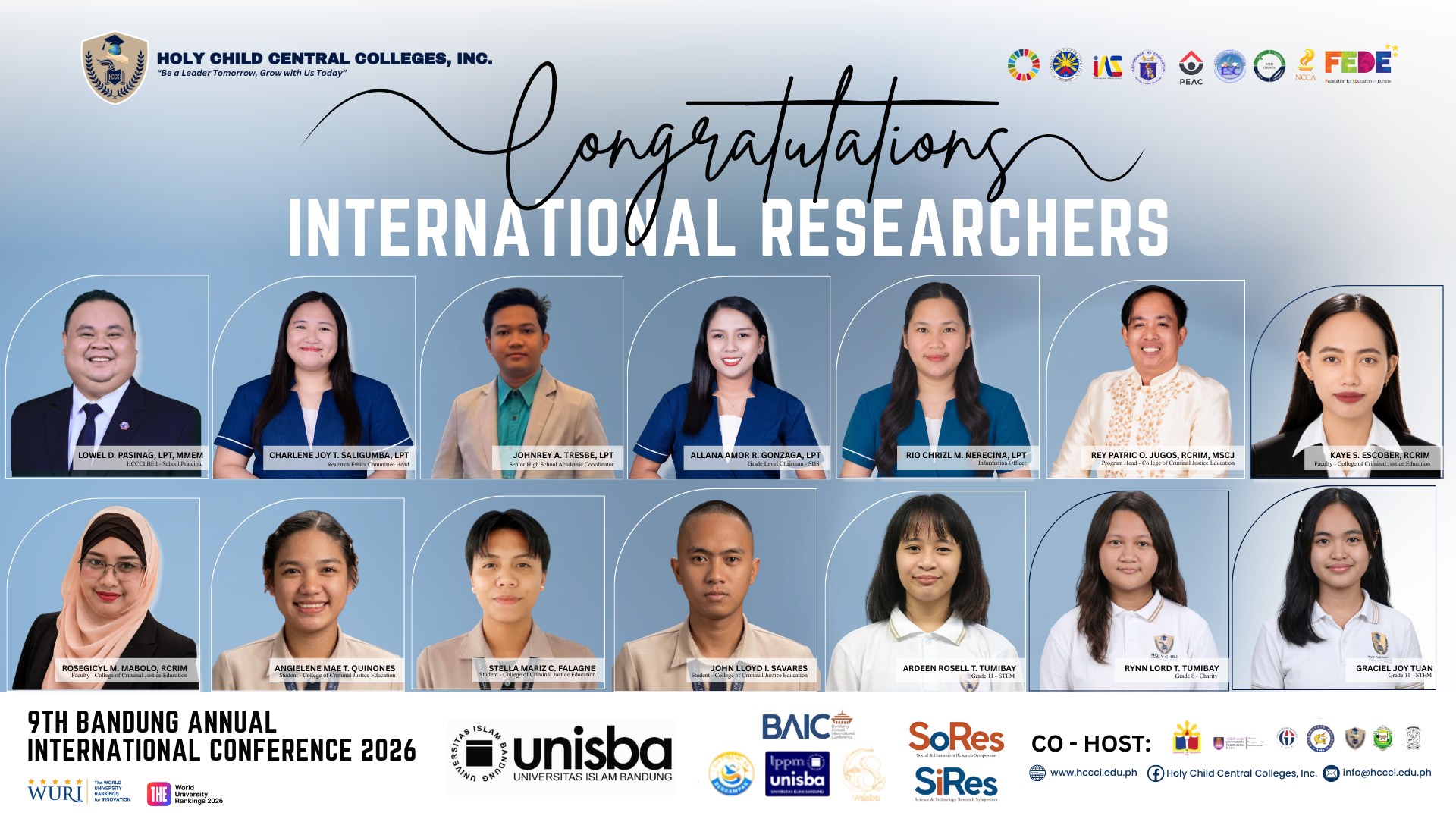
𝐇𝐨𝐥𝐲 𝐂𝐡𝐢𝐥𝐝 𝐂𝐞𝐧𝐭𝐫𝐚𝐥 𝐂𝐨𝐥𝐥𝐞𝐠𝐞𝐬 𝐒𝐡𝐢𝐧𝐞𝐬 𝐚𝐭 𝐭𝐡𝐞 𝟗𝐭𝐡 𝐁𝐚𝐧𝐝𝐮𝐧𝐠 𝐀𝐧𝐧𝐮𝐚𝐥 𝐈𝐧𝐭𝐞𝐫𝐧𝐚𝐭𝐢𝐨𝐧𝐚𝐥 𝐂𝐨𝐧𝐟𝐞𝐫𝐞𝐧𝐜𝐞 𝟐𝟎𝟐𝟔
Holy Child Central Colleges, Inc. (HCCCI) proudly celebrates its faculty and student researchers who represented the institution at the 9th Bandung Annual International Conference (BAIC) 2026, hosted by Universitas Islam Bandung (UNISBA) in Indonesia, with SoRes (Social and Humaniora Research Symposium) and SiRes (Science and Technology Research Symposium) as co-organizing tracks. Carrying the theme "Green Halal Economy and Innovation: Advancing Circularity and Community Resilience," the international conference brought together approximately 90 research presenters from participating institutions in the Philippines, India, and Malaysia.
The event provided an avenue for researchers to present their studies, exchange scholarly perspectives, and explore innovative approaches to sustainability, circularity, and community resilience. HCCCI was among the participating Philippine institutions alongside Urdaneta City University, Golden State College (GSC), Santo Nino College Foundation, Inc. and New Hope School of Agriculture and Fishery, Inc., as well as international institutions including Universitas Islam Bandung, MES College Marampally in Kerala, India, Universiti Sains Islam Malaysia, Academy of Contemporary Islamic Studies of Universiti Teknologi MARA, Malaysia, and Rajagiri College of Social Sciences, Kalamassery, India. This participation reflects HCCCI's growing culture of research excellence, spanning leadership psychology, language and communication, and educational technology, and its commitment to preparing both faculty and students for meaningful engagement in the international academic community
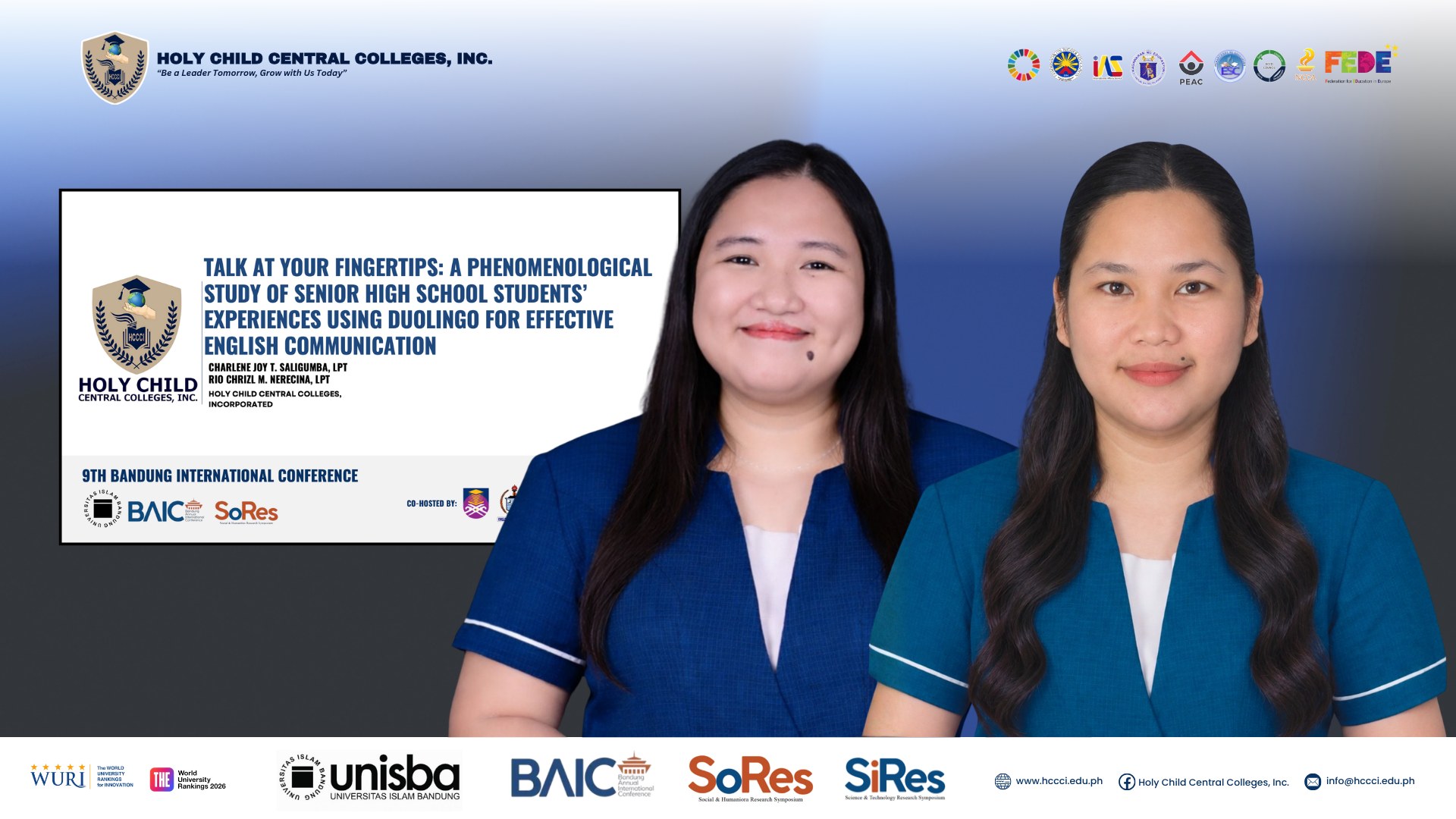
Leading this lineup is "Talk at Your Fingertips: A Phenomenological Study of Senior High School Students' Experiences Using Duolingo for Effective English Communication," authored by Charlene Joy T. Saligumba, LPT, Faculty and Research Ethics Committee Head, together with Rio Chrizl M. Nerecina, LPT, Information Officer. The study explored the lived experiences of six Senior High School students using Duolingo, a Mobile-Assisted Language Learning (MALL) application, to develop effective English communication skills. Through semi-structured interviews, the research uncovered how students experienced growth in vocabulary, sentence construction, comprehension, and confidence, while also encountering challenges such as limited real interaction, repetitive activities, and technical difficulties.
A major highlight of HCCCI's participation at BAIC 2026 was the recognition of Rio Chrizl M. Nerecina, LPT, as Best Presenter for this study, a distinction that underscored the quality of the research presentation and the institution's commitment to developing researchers capable of competing on the international stage. The study offers valuable insights for English teachers on the potential of mobile-assisted language learning tools to strengthen communication skills, aligning with SDG 4 (Quality Education) through its exploration of innovative, technology-supported pathways to English language learning.
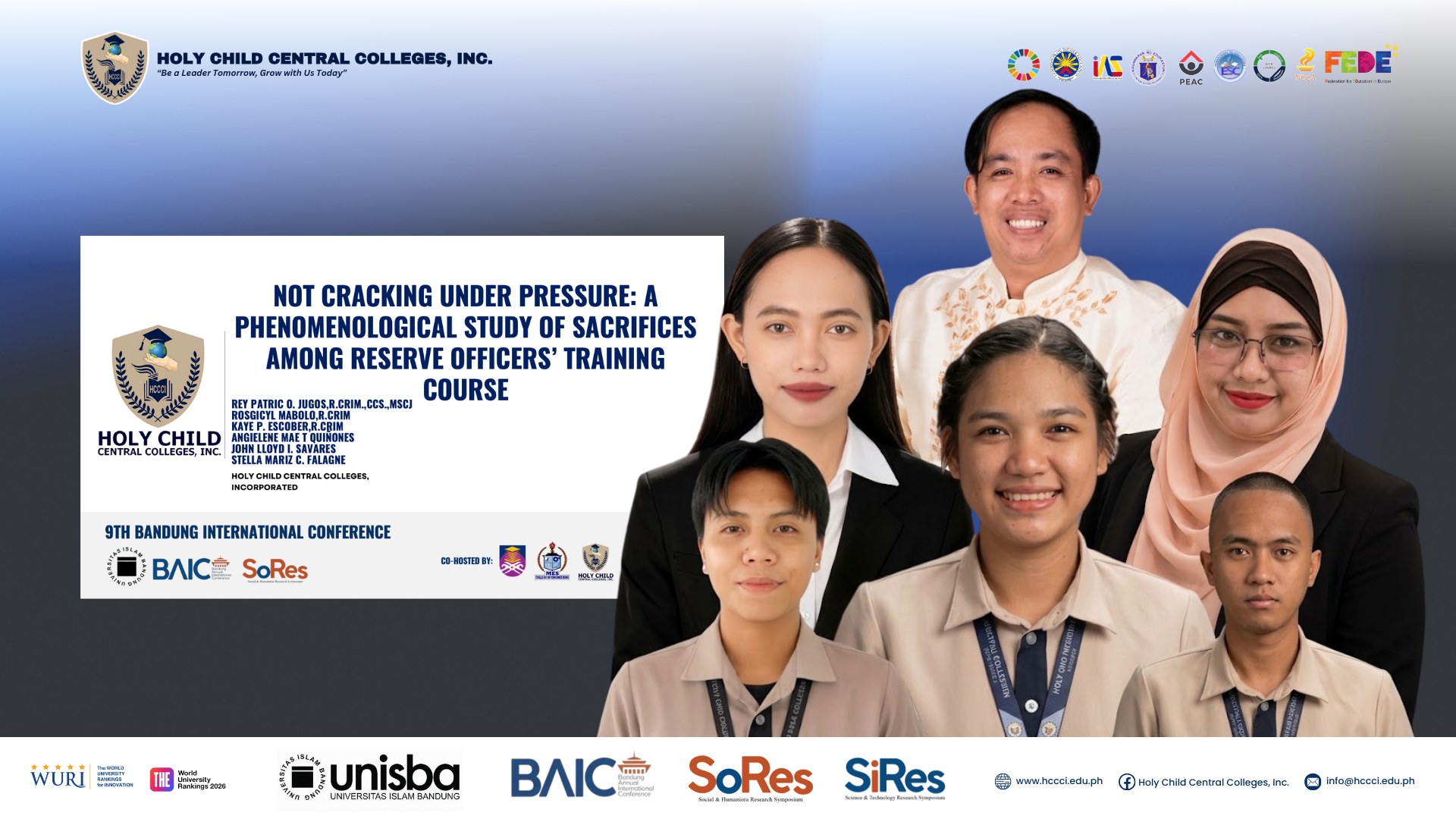
Also presented was "Not Cracking Under Pressure: A Phenomenological Study of Sacrifices Among ROTC Cadet Officers," a collaborative research undertaking between faculty and students of the College of Criminal Justice Education. The study was led by Rey Patric O. Jugos, RCrim, MSCJ, Program Head, together with faculty members Kaye S. Escober, RCrim, and Rosegicyl M. Mabolo, RCrim, alongside students Angielene Mae T. Quiñones, John Lloyd I. Savares, and Stella Mariz C. Falagne. The study explored the lived experiences, forms of sacrifice, and resilience of twelve cadet officers from HCCCI's Reserve Officers' Training Corps program. Anchored on Transcendental Phenomenology and complemented by Identity Fusion Theory and Quest for Significance Theory, the research revealed that sacrifice among cadet officers is a multifaceted, purpose-driven journey involving trade-offs in time, finances, personal well-being, and comfort, experienced not merely as burden but as transformative discipline shaping character, competence, and commitment. The findings contribute evidence-based recommendations for more responsive ROTC program policies, aligning with SDG 16 (Peace, Justice, and Strong Institutions), as explicitly recognized in the study, as well as SDG 4 (Quality Education) through its contribution to youth leadership formation.
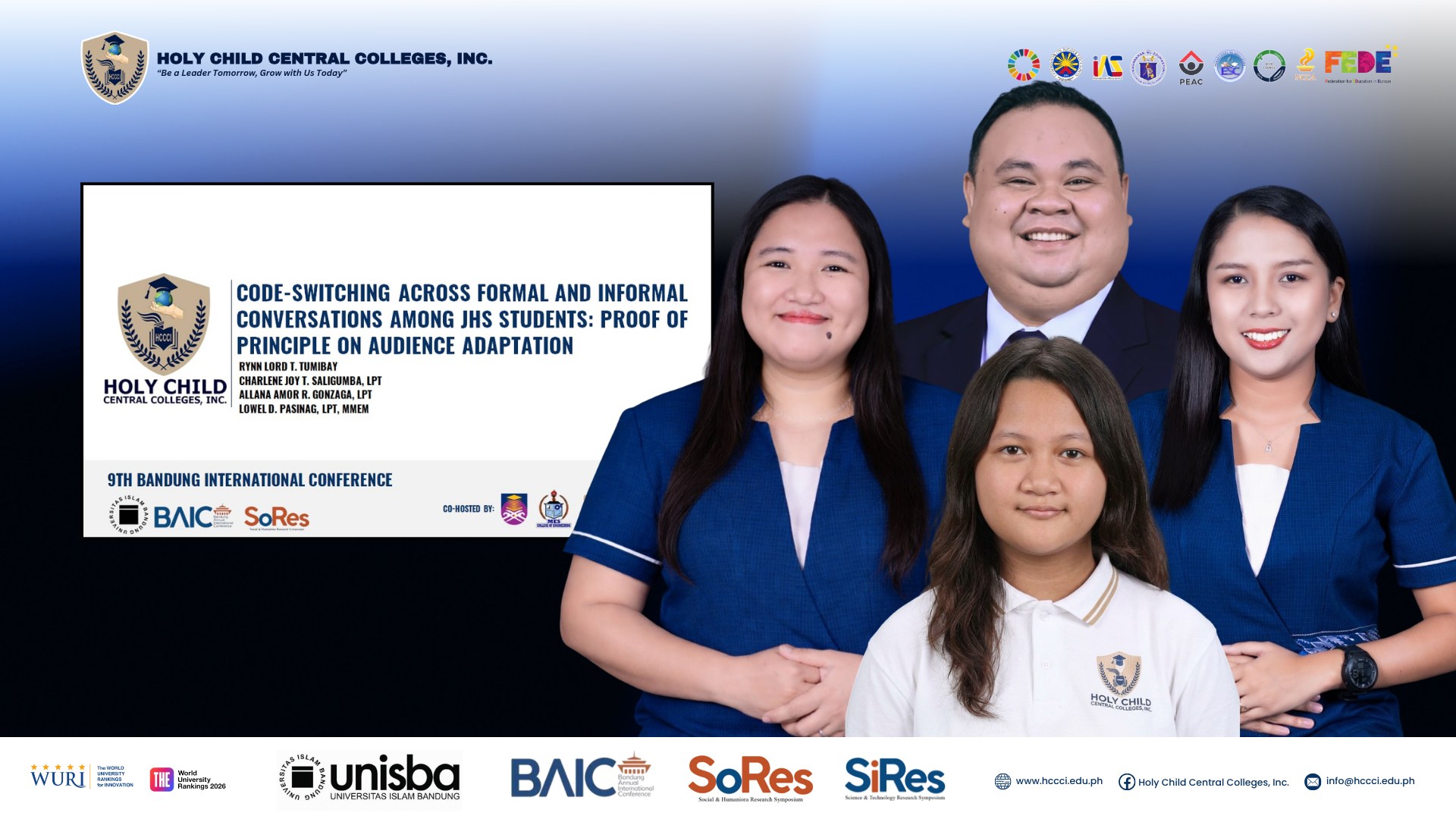
Another study featured was "Code-Switching Across Formal and Informal Conversations Among JHS Students: Proof of Principle on Audience Adaptation," which examined Filipino-English code-switching among 30 purposively selected Junior High School students across formal and informal conversational contexts. Through structured communication tasks representing teacher-student and peer-to-peer interactions, the research found that students code-switch more frequently and playfully with peers, while adopting more formal language with teachers, demonstrating clear awareness of social roles and audience expectations. The study positions code-switching as an adaptive communication strategy essential to developing students' communicative competence, aligning with SDG 4 (Quality Education) through its insight into nurturing language awareness in learning environments.
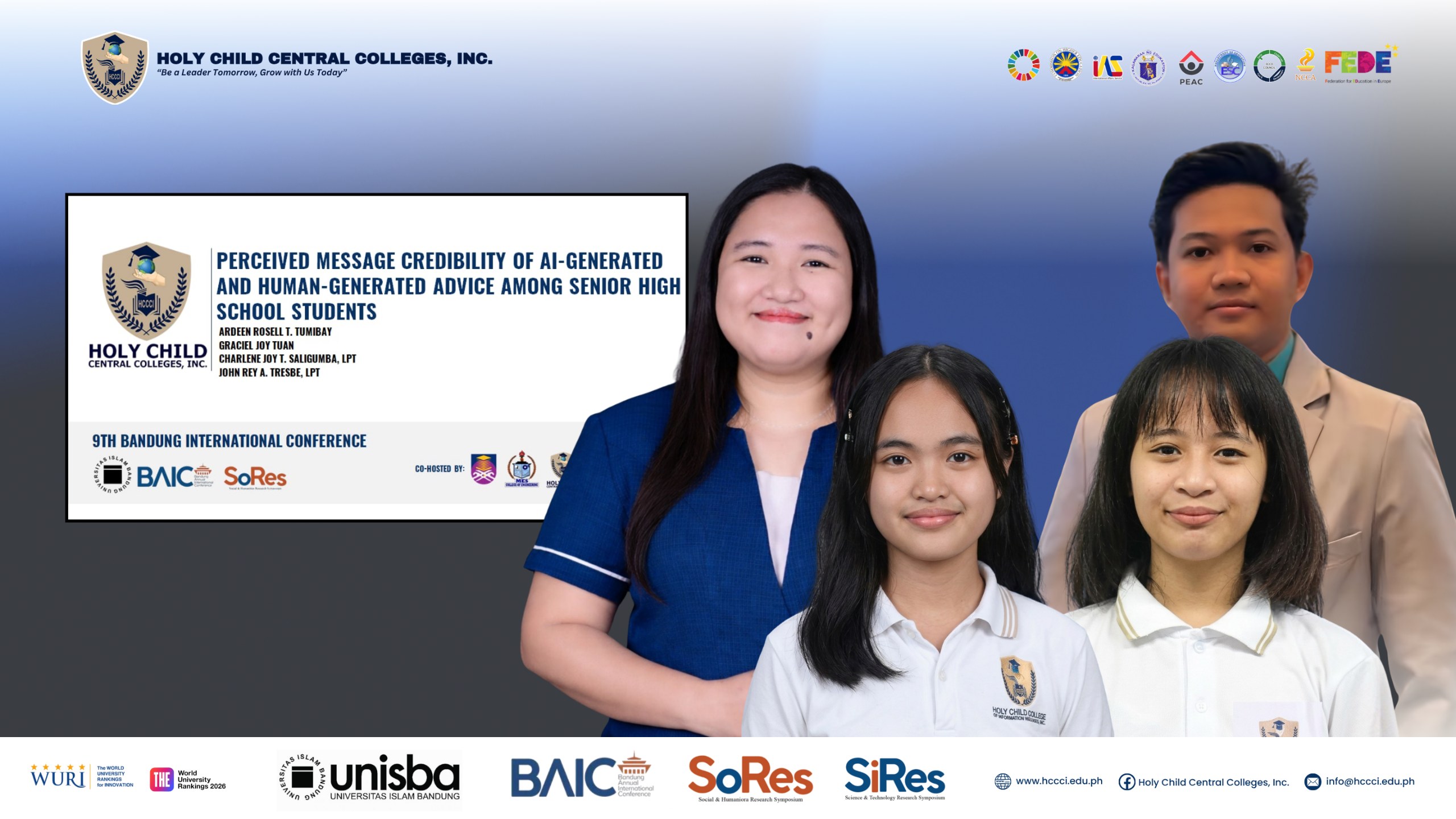
Rounding out the lineup was "Perceived Message Credibility of AI-Generated and Human-Generated Advice Among Senior High School Students," conducted by student researchers Ardeen Rosell T. Tumibay, Grade 11 STEM, and Graciel Joy Tuan, Grade 11 STEM, together with faculty researchers Charlene Joy T. Saligumba, LPT, and Johnrey A. Tresbe, LPT, Senior High School Academic Coordinator. The study investigated how Senior High School students perceive the credibility of advice depending on whether it is attributed to an AI system or a human source, using a comparative within-subjects design with 30 SHS participants to measure accuracy, authenticity, and believability. The research provides preliminary evidence on how source attribution shapes students' trust in digitally mediated messages, offering a timely contribution to discussions on AI literacy in education. The study aligns with SDG 4 (Quality Education) through its relevance to AI literacy and critical evaluation skills, and SDG 9 (Industry, Innovation, and Infrastructure) through its engagement with AI-mediated communication technologies.
Together, these studies reflect the breadth of Holy Child Central Colleges' research agenda and the strength of its faculty-student research partnerships, spanning leadership and resilience, language and communication, and the evolving role of technology in education. As HCCCI continues to invest in the research development of both its faculty and students, this international recognition at BAIC 2026 stands as a testament to the institution's dedication to producing scholarship that informs practice and empowers the next generation of learners and leaders.