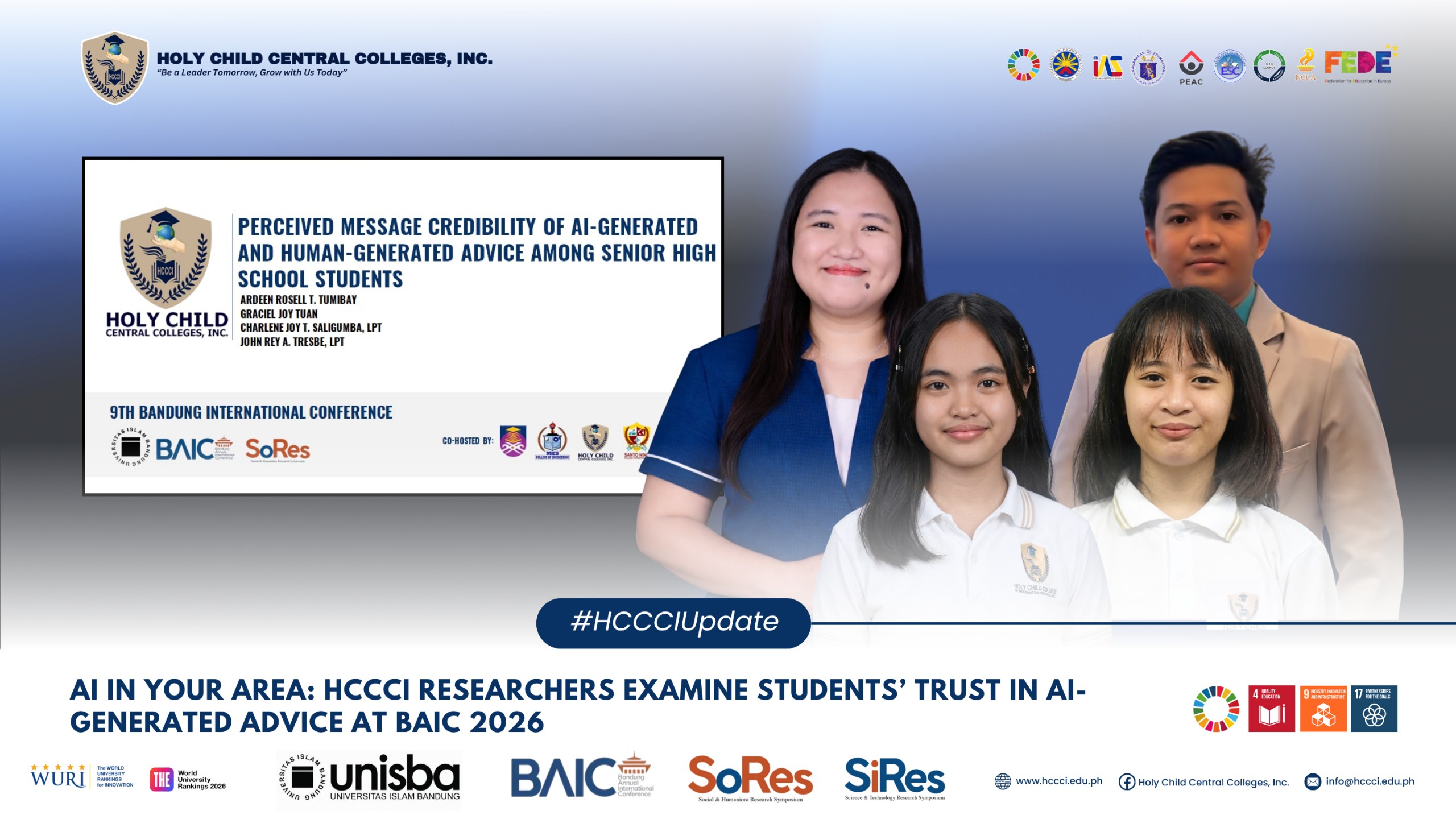
𝐀𝐈 𝐢𝐧 𝐘𝐨𝐮𝐫 𝐀𝐫𝐞𝐚: 𝐇𝐂𝐂𝐂𝐈 𝐑𝐞𝐬𝐞𝐚𝐫𝐜𝐡𝐞𝐫𝐬 𝐄𝐱𝐚𝐦𝐢𝐧𝐞 𝐒𝐭𝐮𝐝𝐞𝐧𝐭𝐬’ 𝐓𝐫𝐮𝐬𝐭 𝐢𝐧 𝐀𝐈-𝐆𝐞𝐧𝐞𝐫𝐚𝐭𝐞𝐝 𝐀𝐝𝐯𝐢𝐜𝐞 𝐚𝐭 𝐁𝐀𝐈𝐂 𝟐𝟎𝟐𝟔
The Senior High School Department of Holy Child Central Colleges, Inc. (HCCCI) brought the growing conversation on artificial intelligence and information credibility to the international research stage through a study presented at the 9th Bandung Annual International Conference (BAIC) 2026, hosted by Universitas Islam Bandung (UNISBA) in Indonesia on September 10, 2026.
Titled “Perceived Message Credibility of AI-Generated and Human-Generated Advice Among Senior High School Students,” the study examined how Senior High School students perceive the credibility of advice depending on whether it is attributed to an AI system or a human source. Using a comparative within-subjects design, the research involved 30 SHS participants who evaluated AI-generated and human-generated advice based on three dimensions of credibility: accuracy, authenticity, and believability.
The study explored whether the perceived source of a message influences how students evaluate the information presented to them. By placing AI-generated and human-generated advice side by side, the researchers examined how source attribution may shape students’ judgments of whether a message is accurate, authentic, and believable.
The research highlights the importance of developing critical evaluation skills as artificial intelligence becomes increasingly present in students’ academic and everyday communication. Rather than simply learning how to use AI tools, students are also expected to assess the information they encounter, question its credibility, and recognize the need to verify digitally generated content.
The study was conducted by student researchers Ardeen Rosell T. Tumibay, Grade 11 STEM, and Graciel Joy Tuan, Grade 11 STEM, together with faculty researchers Charlene Joy T. Saligumba, LPT, and Johnrey A. Tresbe, LPT, Senior High School Academic Coordinator. Their collaboration reflects HCCCI’s continuing effort to involve students in meaningful research alongside faculty members and to examine issues that are increasingly relevant to learners.
The study aligns with Sustainable Development Goal 4 (Quality Education) through its focus on AI literacy, critical evaluation, and responsible engagement with information. It also contributes to SDG 9 (Industry, Innovation, and Infrastructure) through its examination of AI-mediated communication and the role of emerging technologies in education and SDG 17 (Partnerships for the Goals).
The research formed part of HCCCI’s participation in BAIC 2026, which brought together approximately 90 research presenters from the Philippines, India, and Malaysia under the theme “Green Halal Economy and Innovation: Advancing Circularity and Community Resilience.” The international conference provided an avenue for researchers and educators to present studies, exchange perspectives, and contribute to wider academic discussions.
Through this study, HCCCI researchers brought an increasingly familiar part of students’ digital experiences into the research conversation. As AI-generated messages become more common in education and everyday communication, the study underscores the continuing need for learners to engage with technology thoughtfully, evaluate information critically, and make informed judgments about the messages they encounter.