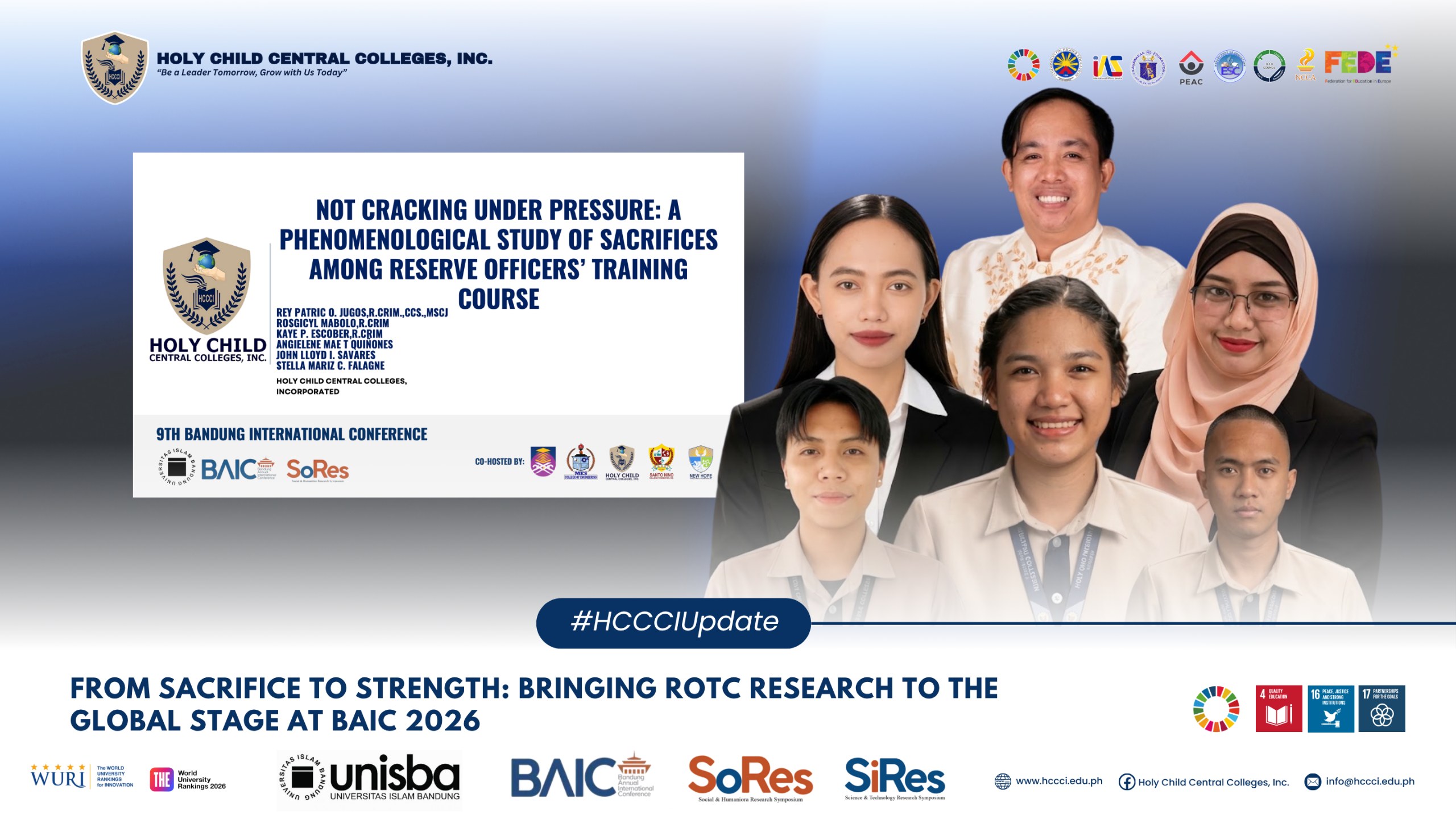
𝐅𝐫𝐨𝐦 𝐒𝐚𝐜𝐫𝐢𝐟𝐢𝐜𝐞 𝐭𝐨 𝐒𝐭𝐫𝐞𝐧𝐠𝐭𝐡: 𝐁𝐫𝐢𝐧𝐠𝐢𝐧𝐠 𝐑𝐎𝐓𝐂 𝐑𝐞𝐬𝐞𝐚𝐫𝐜𝐡 𝐭𝐨 𝐭𝐡𝐞 𝐆𝐥𝐨𝐛𝐚𝐥 𝐒𝐭𝐚𝐠𝐞 𝐚𝐭 𝐁𝐀𝐈𝐂 𝟐𝟎𝟐𝟔
Holy Child Central Colleges, Inc. (HCCCI) brought another meaningful study to the international research stage through “Not Cracking Under Pressure: A Phenomenological Study of Sacrifices Among ROTC Cadet Officers,” a collaborative research undertaking of faculty and students from the College of Criminal Justice Education presented at the 9th Bandung Annual International Conference (BAIC) 2026 on September 10, 2026.
The study was led by Rey Patric O. Jugos, RCrim, MSCJ, the Program Head of the College of Criminal Justice Education, together with faculty members Kaye S. Escober, RCrim, and Rosegicyl M. Mabolo, RCrim, alongside student researchers Angielene Mae T. Quiñones, John Lloyd I. Savares, and Stella Mariz C. Falagne. The research explored the lived experiences, forms of sacrifice, and resilience of twelve HCCCI ROTC cadet officers, providing a closer look at the realities behind the discipline and responsibilities of cadet leadership.
Anchored on Transcendental Phenomenology and complemented by Identity Fusion Theory and Quest for Significance Theory, the study revealed that sacrifice among cadet officers is a multifaceted and purpose-driven journey. Participants experienced trade-offs involving time, finances, personal well-being, and comfort while fulfilling their responsibilities as ROTC cadets.
Rather than being viewed simply as burdens, these sacrifices emerged as transformative experiences that contributed to the development of character, competence, discipline, resilience, and commitment. The findings highlight how the challenges encountered by cadet officers can shape their personal growth and strengthen their sense of purpose as young leaders.
The research further offered evidence-based recommendations toward more responsive ROTC program policies and practices, particularly those that address the experiences and needs of cadet officers. Its findings contribute to Sustainable Development Goal 16 (Peace, Justice, and Strong Institutions), as recognized in the study, while also supporting SDG 4 (Quality Education) through its contribution to youth leadership formation and holistic student development and SDG 17 (Partnerships for the Goals).
The presentation provided the HCCCI researchers with an opportunity to bring the voices and experiences of local ROTC cadet officers to an international academic audience. It also demonstrated the value of faculty-student collaboration in producing research that connects institutional experiences with broader discussions on leadership, resilience, discipline, and youth development.
The 9th BAIC 2026, hosted by Universitas Islam Bandung (UNISBA) in Indonesia, brought together approximately 90 research presenters from participating institutions in the Philippines, India, and Malaysia. With SoRes (Social and Humaniora Research Symposium) and SiRes (Science and Technology Research Symposium) as co-organizing tracks, the conference carried the theme “Green Halal Economy and Innovation: Advancing Circularity and Community Resilience.”
Through this research, HCCCI's College of Criminal Justice Education continues to demonstrate how the experiences of its students can become valuable sources of knowledge. From the training ground to the global research stage, the study turns the sacrifices of cadet officers into insights that can contribute to stronger programs, meaningful education, and the formation of resilient future leaders