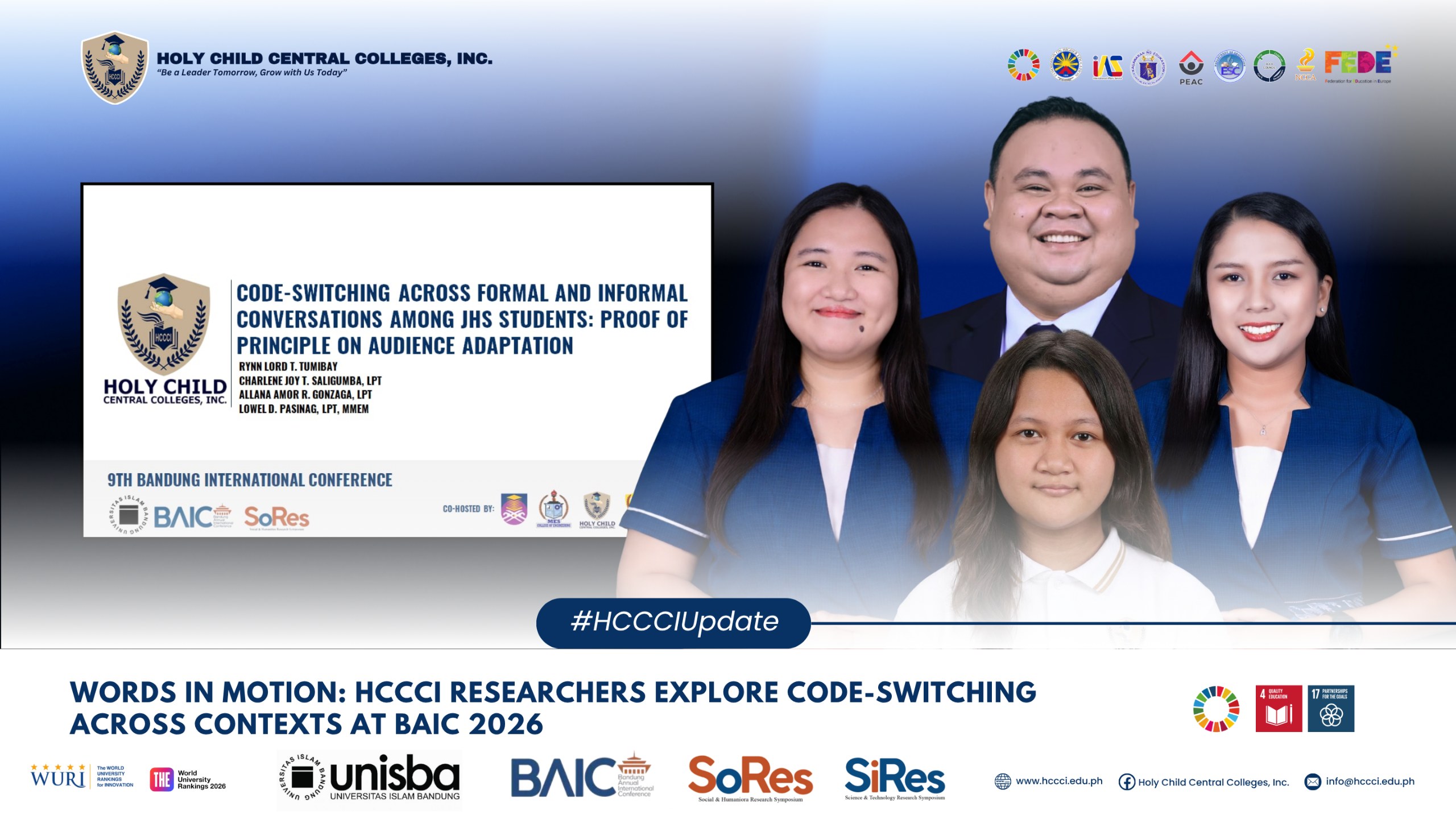
𝐖𝐨𝐫𝐝𝐬 𝐢𝐧 𝐌𝐨𝐭𝐢𝐨𝐧: 𝐇𝐂𝐂𝐂𝐈 𝐑𝐞𝐬𝐞𝐚𝐫𝐜𝐡𝐞𝐫𝐬 𝐄𝐱𝐩𝐥𝐨𝐫𝐞 𝐂𝐨𝐝𝐞-𝐒𝐰𝐢𝐭𝐜𝐡𝐢𝐧𝐠 𝐀𝐜𝐫𝐨𝐬𝐬 𝐂𝐨𝐧𝐭𝐞𝐱𝐭𝐬 𝐚𝐭 𝐁𝐀𝐈𝐂 𝟐𝟎𝟐𝟔
The Basic Education Department of Holy Child Central Colleges, Inc. (HCCCI) brought the language practices of Junior High School students to the international research stage through a study presented at the 9th Bandung Annual International Conference (BAIC) 2026, hosted by Universitas Islam Bandung (UNISBA) in Indonesia on September 10, 2026.
Titled “Code-Switching Across Formal and Informal Conversations Among JHS Students: Proof of Principle on Audience Adaptation,” the study examined how Junior High School students shift between Filipino and English depending on their conversational context and audience. The research involved 30 purposively selected JHS students who participated in structured communication tasks representing teacher-student and peer-to-peer interactions.
The findings revealed clear differences in students’ use of Filipino-English code-switching across social contexts. In conversations with peers, students tended to code-switch more frequently and playfully, reflecting the relaxed nature of informal interaction. In conversations with teachers, however, students adopted more formal language, demonstrating their awareness of social roles, audience expectations, and appropriate communication practices.
The study highlights code-switching as more than simply mixing two languages. It serves as an adaptive communication strategy that allows students to adjust their language choices according to the person they are speaking with and the situation in which communication takes place. This adaptability demonstrates students’ developing communicative competence and their ability to navigate different social and academic settings.
The research was conducted by Rynn Lord T. Tumibay, Allana Amor R. Gonzaga, LPT, Charlene Joy T. Saligumba, LPT, and Lowel D. Pasinag, LPT, MMEM. Their work offers valuable insight into the relationship between language use, audience awareness, and social interaction among young learners.
The study aligns with Sustainable Development Goal 4 (Quality Education) and contributes to SDG 10 (Reduced Inequalities) by emphasizing language awareness, communicative competence, and inclusive communication across different social contexts and SDG 17 (Partnerships for the Goals). By understanding how students naturally adapt their language to different audiences, educators can better support diverse communication practices and create learning environments where students can communicate confidently and effectively.
The research formed part of HCCCI’s participation in BAIC 2026, which brought together approximately 90 research presenters from the Philippines, India, and Malaysia under the theme “Green Halal Economy and Innovation: Advancing Circularity and Community Resilience.” The international conference provided an avenue for scholars to present research, exchange perspectives, and contribute to broader academic conversations.
Through this study, the HCCCI Basic Education Department showcased how an everyday feature of Filipino communication can offer meaningful insights into students’ language development, social awareness, and ability to adapt to different audiences and contexts.