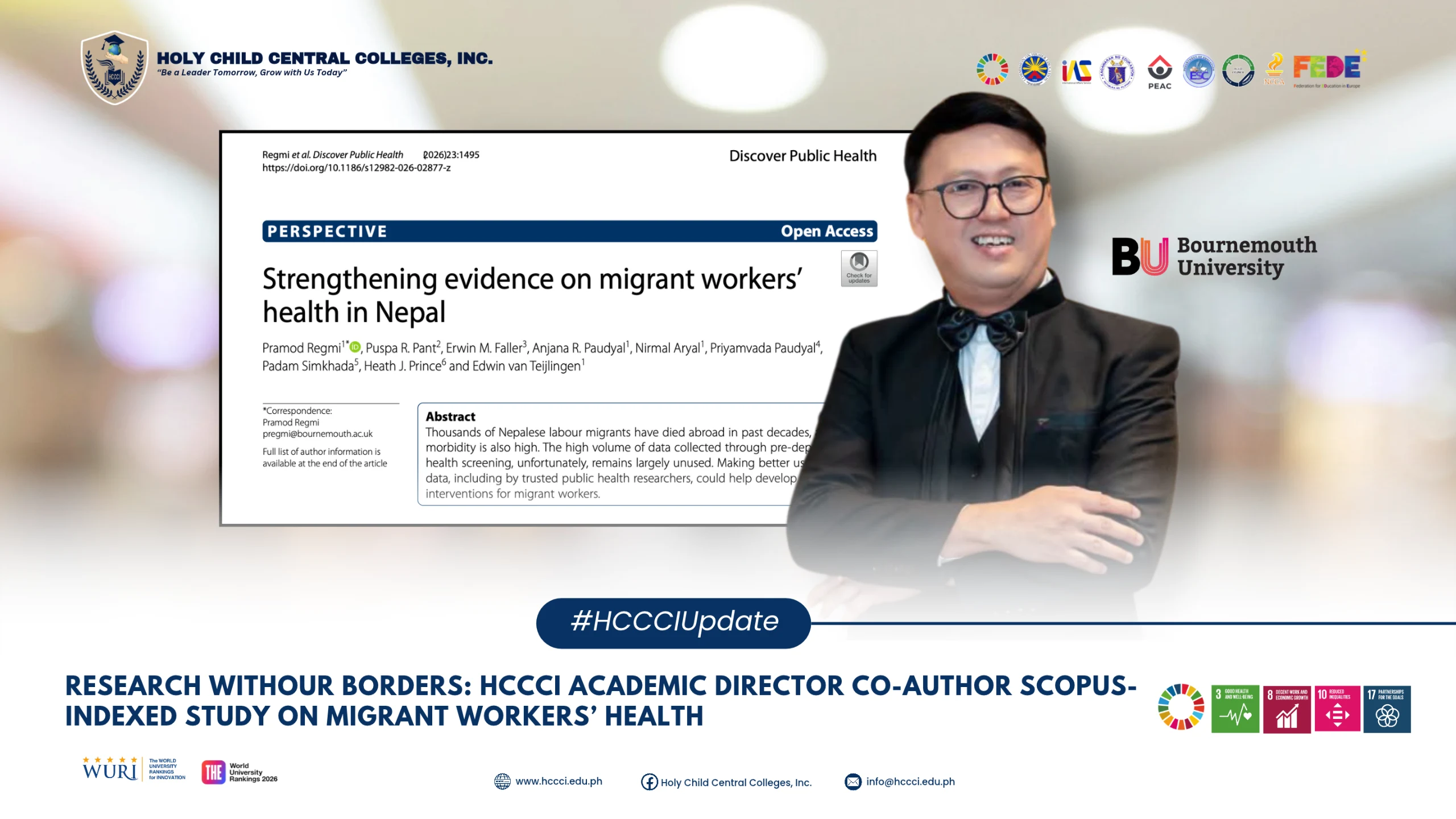
𝐑𝐞𝐬𝐞𝐚𝐫𝐜𝐡 𝐖𝐢𝐭𝐡𝐨𝐮𝐭 𝐁𝐨𝐫𝐝𝐞𝐫𝐬: 𝐇𝐂𝐂𝐂𝐈 𝐀𝐜𝐚𝐝𝐞𝐦𝐢𝐜 𝐃𝐢𝐫𝐞𝐜𝐭𝐨𝐫 𝐂𝐨-𝐀𝐮𝐭𝐡𝐨𝐫𝐬 𝐒𝐜𝐨𝐩𝐮𝐬-𝐈𝐧𝐝𝐞𝐱𝐞𝐝 𝐒𝐭𝐮𝐝𝐲 𝐨𝐧 𝐌𝐢𝐠𝐫𝐚𝐧𝐭 𝐖𝐨𝐫𝐤𝐞𝐫𝐬’ 𝐇𝐞𝐚𝐥𝐭𝐡
Dr. Erwin M. Faller, Academic Director of Holy Child Central Colleges, Inc. (HCCCI), has further strengthened the institution’s research engagement through his contribution to an international scholarly publication examining the need to improve evidence and health data systems for migrant workers in Nepal.
Published on September 22, 2026, in Discover Public Health, the article titled “Strengthening evidence on migrant workers’ health in Nepal” brings together researchers from Nepal, the Philippines, the United Kingdom, and the United States. Dr. Faller is among the nine co-authors of the perspective article published by Springer Nature/BioMed Central.
Discover Public Health is an open-access, peer-reviewed journal indexed in Scopus and Web of Science, providing an international platform for research addressing contemporary public health concerns. The publication adds to Dr. Faller’s research engagement while also highlighting the participation of HCCCI in an international scholarly collaboration focused on a significant public health concern.
The research was developed through collaboration among Dr. Pramod Regmi, Dr. Puspa R. Pant, Dr. Anjana R. Paudyal, Dr. Nirmal Aryal, Dr. Priyamvada Paudyal, Dr. Padam Simkhada, Dr. Heath J. Prince, Edwin van Teijlingen, and Dr. Erwin M. Faller. Their institutional affiliations span academic and research organizations in different countries, including the Faculty of Health, Environment and Medical Sciences, Bournemouth University, Bournemouth, United Kingdom; College of Health, Science and Society, University of the West of England, Bristol, United Kingdom; College of Allied Health Sciences, Holy Child Central Colleges, Surallah, Philippines; Institute for Global Health and Wellbeing, School of Medicine, Keele University, Keele, United Kingdom; Research and Innovation Office, University of Chester, Chester, United Kingdom; and La Isla Network, Washington, United States. This diverse institutional representation reflects the international and multidisciplinary nature of the research.
The publication focuses on the health challenges associated with labour migration in Nepal, where large numbers of workers leave the country for employment abroad. The authors emphasize that substantial health information is already collected through pre-departure medical examinations and assessments of returning migrant workers, but much of this information remains underutilized for research and public health planning.
At the center of the authors’ perspective is the need for a more systematic approach to transforming existing health records into meaningful evidence. The publication advocates for the development of an integrated electronic migrant health database that could connect information collected at different stages of the migration process.
Such an approach could help researchers and policymakers better understand health risks among migrant workers and develop interventions that respond to their needs before departure, during employment abroad, and upon their return.
The article also discusses health concerns that may affect migrant workers, including chronic illnesses, occupational injuries, mental health concerns, and other conditions associated with working and living environments abroad. Better use of available health information, the authors emphasize, can help identify patterns and emerging concerns that may otherwise remain difficult to assess.
A key perspective presented in the publication is the importance of viewing migrant health across the entire migration cycle. Linking information from pre-departure screening, employment abroad, and returnee assessments could provide a more comprehensive understanding of workers’ health experiences and support more responsive health interventions.
The authors further highlight the importance of collaboration among government agencies, academic institutions, researchers, and other stakeholders. Strengthening research partnerships and technical capacity can contribute to more evidence-based approaches to migrant health policy and practice.
The publication also draws attention to experiences from other migrant-sending countries, including the Philippines, as potential sources of lessons for Nepal. The discussion considers mechanisms related to returnee health assessments, social protection, and reintegration support that may provide useful points for comparison and further research. Through the involvement of HCCCI’s College of Allied Health Sciences, the Philippines is also represented within this international academic collaboration.
For HCCCI, Dr. Faller’s participation in the publication represents another contribution to the institution’s growing research and international academic engagement. His involvement places HCCCI within a scholarly collaboration addressing a public health concern that extends across national borders and affects migrant workers and their communities. It also reflects the institution’s continuing efforts to connect its academic community with international research networks and knowledge-sharing initiatives.
The publication aligns with several United Nations Sustainable Development Goals (SDGs). It directly contributes to SDG 3: Good Health and Well-Being by emphasizing the importance of evidence-based health interventions and stronger health information systems for migrant workers. It is likewise relevant to SDG 8: Decent Work and Economic Growth, particularly through its attention to the health and safety concerns associated with migrant employment. Protecting workers’ health is an important component of creating safer and more sustainable working environments.
Its focus on the health needs of migrant workers also supports SDG 10: Reduced Inequalities, as the research calls for stronger systems to address health concerns among workers who may experience different risks and vulnerabilities throughout the migration process. Meanwhile, the international collaboration represented by the publication reflects SDG 17: Partnerships for the Goals, demonstrating how academic and research partnerships across countries can contribute to addressing complex global health and social concerns.
Through Dr. Faller’s research engagement and collaboration with scholars and institutions from different parts of the world, HCCCI continues to strengthen its commitment to knowledge generation, international collaboration, and research that connects academic work with issues of broader social significance.
The publication further demonstrates the role of academic institutions in contributing to global conversations on health, migration, decent work, and social development. Through research that crosses institutional and national boundaries, HCCCI continues to encourage scholarly work that can contribute to evidence-based discussions and potentially inform communities, practitioners, researchers, and policymakers.