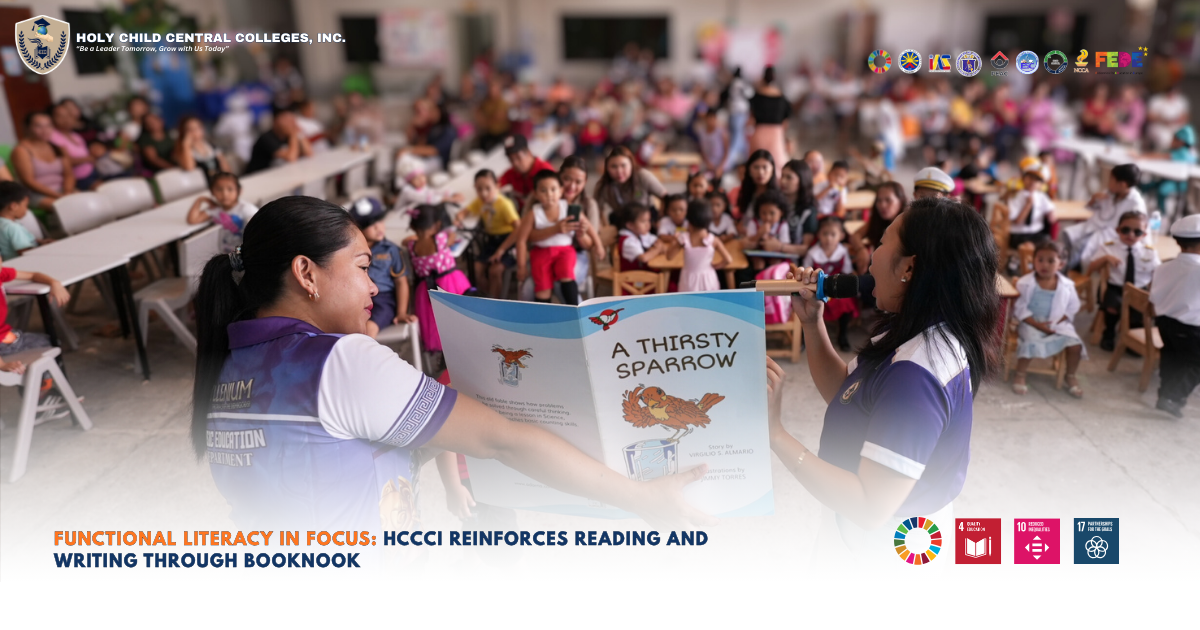
𝐅𝐮𝐧𝐜𝐭𝐢𝐨𝐧𝐚𝐥 𝐋𝐢𝐭𝐞𝐫𝐚𝐜𝐲 𝐢𝐧 𝐅𝐨𝐜𝐮𝐬: 𝐇𝐂𝐂𝐂𝐈 𝐒𝐭𝐫𝐞𝐧𝐠𝐭𝐡𝐞𝐧𝐬 𝐑𝐞𝐚𝐝𝐢𝐧𝐠 𝐚𝐧𝐝 𝐂𝐨𝐦𝐩𝐫𝐞𝐡𝐞𝐧𝐬𝐢𝐨𝐧 𝐭𝐡𝐫𝐨𝐮𝐠𝐡 𝐁𝐨𝐨𝐤 𝐍𝐨𝐨𝐤 𝐢𝐧 𝐒𝐮𝐩𝐩𝐨𝐫𝐭 𝐨𝐟 𝐂𝐇𝐄𝐃’𝐬 𝐋𝐢𝐭𝐞𝐫𝐚𝐜𝐲 𝐈𝐧𝐢𝐭𝐢𝐚𝐭𝐢𝐯𝐞
Across the Philippines, conversations about literacy continue to surface an important concern. Many learners can read words and write sentences but struggle to truly understand what they read. This challenge, known as functional illiteracy, affects not only academic performance but also a learner’s confidence, opportunities, and future.
In response, the Commission on Higher Education (CHED), under the mandate of its Chairperson, Dr. Shirley C. Agrupis, has encouraged higher education institutions to actively support the literacy initiatives of the Department of Education (DepEd). This directive reinforces stronger collaboration across all levels of education to improve reading comprehension nationwide and address functional illiteracy at its roots. For Holy Child Central Colleges, Inc. (HCCCI), this call resonates deeply.
Lowel D. Pasinag, LPT, MMEM, Principal of the HCCCI Basic Education Department, emphasized the need to return to strong foundations: “It's the functional illiteracy. They can read, they can write, but they cannot comprehend. They cannot comprehend what they read and what they write. So let's start from teaching, proper way of teaching. At the same time, let's start proper way of identifying those core things to teach to the students. Let's go back to the basic. For me, let's go back to the basic. Because able to write, able to read is not just that, because he needs to understand what he's reading.”

Dr. Erwin M Faller, Academic Director of HCCCI, likewise affirmed the institution’s commitment. “Holy Child Central Colleges, Inc. expresses its full support for the Commission on Higher Education’s call for higher education institutions to actively assist the Department of Education in strengthening literacy initiatives nationwide. As an institution committed to academic excellence and community engagement, we recognize that literacy is the cornerstone of educational success and national development. We affirm our readiness to collaborate with local schools and stakeholders through outreach programs, service-learning activities, and academic support initiatives that promote reading and functional literacy. In fact, we initiated the Book Nook Program in partnership with the National Commission for Culture and the Arts (NCCA) and the National Book Development Board (NBDB), making reading programs more accessible to communities.

Through its partnership with Book Nook Surallah, an open and welcoming community library, HCCCI continues to turn advocacy into action. The space offers free access to Filipino-authored books and provides children, students, and families with a safe environment where reading becomes enjoyable and meaningful.
Over the past years, Book Nook Surallah has served an average of 100 to 150 readers daily, including young learners discovering stories for the first time, parents reading alongside their children, and students strengthening their comprehension skills. The growing number of readers reflects the community’s positive response. From May to December 2023, the Book Nook recorded 5,277 readers. In 2024, the number increased to 7,779. By the end of 2025, the figure had significantly risen to 19,904 readers served, showing a remarkable expansion in reach and engagement. In January 2026 alone, 1,331 individuals had already benefited from the program, signaling sustained interest and impact.
The initiative is further strengthened through a Memorandum of Agreement among Book Nook, HCCCI, and the Local Government Unit of Surallah under the Early Childhood Care and Development (ECCD) Program, ensuring that literacy development begins at the earliest stages of a child’s life.
According to Melona Barrientos, ECCD Program Focal Person of Surallah under the Municipal Social Welfare and Development Office: “Through our Early Childhood Care and Development (ECCD) Program, we are actively promoting literacy initiatives, especially by encouraging access to books. With the partnership of Holy Child Central Colleges, we have established a Memorandum of Agreement among Book Nook, Holy Child, and the LGU of Surallah. Our focus is on early childhood programs. It is not only the LGU that promotes literacy; the partnership between Book Nook and the LGU of Surallah greatly contributes to our efforts by exposing children to books. Books, in themselves, are one of the most effective ways to cultivate a love for reading at an early age.”

Meanwhile, Rhoda Leaf G. Catoto, RSW, MSWDO of Surallah, shared her appreciation for the institution’s role in shaping the community’s future: “We have child development workers who graduated from Holy Child, and we are truly grateful for the opportunity you have given them to be part of the institution’s growth and achievements. I sincerely appreciate that Holy Child continues to prioritize the education of children and the preparation of future educators. Your contributions have a significant impact on our community because Holy Child plays an essential role in shaping what our future community will become.”

These collaborative efforts contribute to the United Nations Sustainable Development Goals, particularly SDG 4 Quality Education, by promoting inclusive and equitable access to foundational learning. They also support SDG 10 Reduced Inequalities and SDG 17 Partnerships for the Goals, demonstrating how strong collaboration between higher education institutions and local government units can create sustainable and community based impact.

As HCCCI moves forward, it remains guided by a clear belief that literacy is more than a skill. It is empowerment. Guided by national leadership and strengthened by local partnerships, the institution continues to ensure that every learner not only learns how to read and write, but truly understands and is prepared to build a better future for the community.
