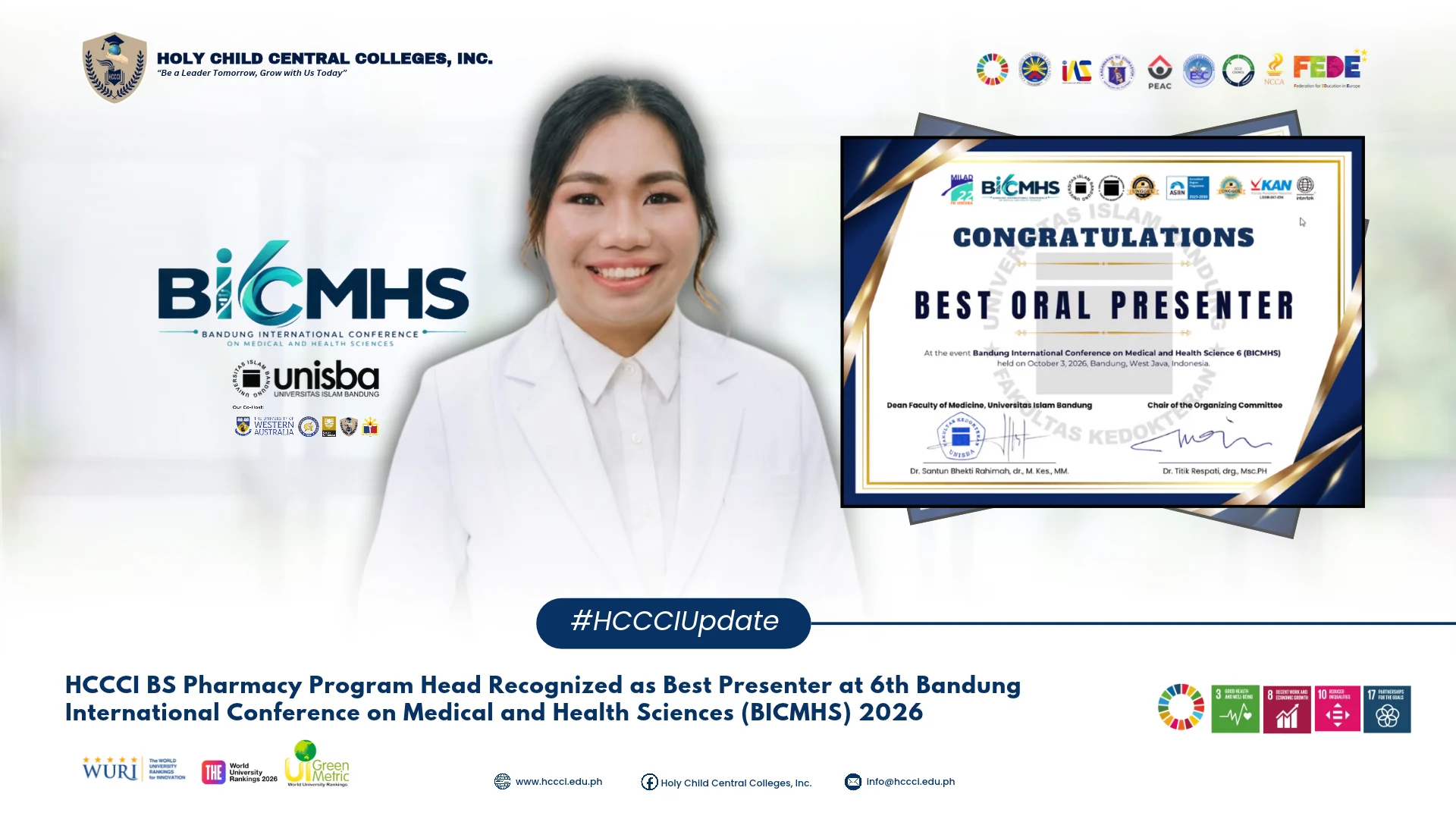
𝐇𝐂𝐂𝐂𝐈 𝐁𝐒 𝐏𝐡𝐚𝐫𝐦𝐚𝐜𝐲 𝐏𝐫𝐨𝐠𝐫𝐚𝐦 𝐇𝐞𝐚𝐝 𝐑𝐞𝐜𝐨𝐠𝐧𝐢𝐳𝐞𝐝 𝐚𝐬 𝐁𝐞𝐬𝐭 𝐏𝐫𝐞𝐬𝐞𝐧𝐭𝐞𝐫 𝐚𝐭 𝟔𝐭𝐡 𝐁𝐚𝐧𝐝𝐮𝐧𝐠 𝐈𝐧𝐭𝐞𝐫𝐧𝐚𝐭𝐢𝐨𝐧𝐚𝐥 𝐂𝐨𝐧𝐟𝐞𝐫𝐞𝐧𝐜𝐞 𝐨𝐧 𝐌𝐞𝐝𝐢𝐜𝐚𝐥 𝐚𝐧𝐝 𝐇𝐞𝐚𝐥𝐭𝐡 𝐒𝐜𝐢𝐞𝐧𝐜𝐞𝐬 𝟐𝟎𝟐𝟔
Holy Child Central Colleges, Inc. (HCCCI) celebrates another academic achievement as Kimberly Jean B. Surmion, RPh., MSPh., Program Head of the Bachelor of Science in Pharmacy, was recognized as one of the Best Presenters at the 6th Bandung International Conference on Medical and Health Sciences (BICMHS 2026), held on October 3, 2026, in Bandung, Indonesia.
The international conference, hosted by the Faculty of Medicine of Universitas Islam Bandung (UNISBA), brought together researchers, healthcare professionals, educators, and students to present research findings and exchange knowledge in medical and health sciences. With more than 31 research studies presented by participants from Philippine and international academic institutions, the event provided a platform for scholarly exchange, research dissemination, and international academic engagement.
Surmion presented the research study titled “Exploring the Traditional Healing Method of the T’boli Tribe in Lake Sebu, South Cotabato: An Ethnographic Study,” co-authored by Hannah Faith Bansawan, Iris Calvo, John Dexter Campanero, and Kimberly Salomeo. The study, conducted under the Bachelor of Science in Pharmacy program through HCCCI’s PIVOT Research Center, examined the diagnostic procedures, traditional healing practices, and challenges experienced by T’boli traditional healers in Lake Sebu, South Cotabato.
Using a qualitative ethnographic design, the researchers gathered data from four recognized T’boli traditional healers through participant observation and semi-structured, in-depth interviews conducted in the participants’ native language. The study received ethical and community approval from the National Commission on Indigenous Peoples (NCIP), and the collected data were analyzed thematically to identify recurring patterns in indigenous healthcare practices.
The findings revealed that locally available medicinal plants serve as a primary foundation of T’boli traditional healing, with three of the four participants emphasizing the use of herbal remedies. The study also found that traditional healers rely on accumulated experience and careful observation of physical signs and symptoms to assess patients’ conditions. Their practices reflect a holistic understanding of health that considers physical, mental, and spiritual well-being. However, environmental changes, habitat degradation, and the declining availability of medicinal plants threaten the continuity of these traditional practices.
The researchers emphasized the importance of preserving indigenous knowledge and strengthening collaborative efforts among indigenous communities, government agencies, researchers, and the Philippine Institute of Traditional and Alternative Health Care (PITAHC). Such initiatives can support the documentation of traditional healing practices while promoting biodiversity conservation and recognizing the contribution of indigenous healthcare knowledge to community well-being.
Surmion’s recognition highlights the value of research that bridges pharmacy education, cultural heritage, and public health. It also reflects HCCCI’s continuing commitment to strengthening research engagement and integrating scholarly inquiry into academic instruction and professional practice. By examining indigenous healing systems through a scientific and culturally informed approach, the study contributes to broader discussions on traditional medicine, medicinal plant conservation, and the responsible preservation of community-based healthcare knowledge.
Anchored on the theme, “Academic Synergy for Sustainable Health: Bridging Social Impact, Environmental Awareness, and Scientific Progress,” BICMHS 2026 emphasized the role of academic collaboration in advancing sustainable health outcomes. The study supports the United Nations Sustainable Development Goals (SDGs), particularly SDG 3: Good Health and Well-Being, through its examination of traditional healthcare practices; SDG 4: Quality Education, by advancing research-based learning and scholarly engagement; SDG 11: Sustainable Cities and Communities, through the recognition and preservation of indigenous cultural knowledge; SDG 15: Life on Land, through its emphasis on medicinal plant conservation and biodiversity protection; and SDG 17: Partnerships for the Goals, by encouraging collaboration among indigenous communities, researchers, and relevant institutions. Surmion’s recognition reflects HCCCI’s commitment to research excellence and international academic engagement. Through the dissemination of the study at BICMHS 2026, the institution strengthens its contribution to scholarly discussions on traditional medicine and the role of indigenous knowledge in contemporary healthcare.