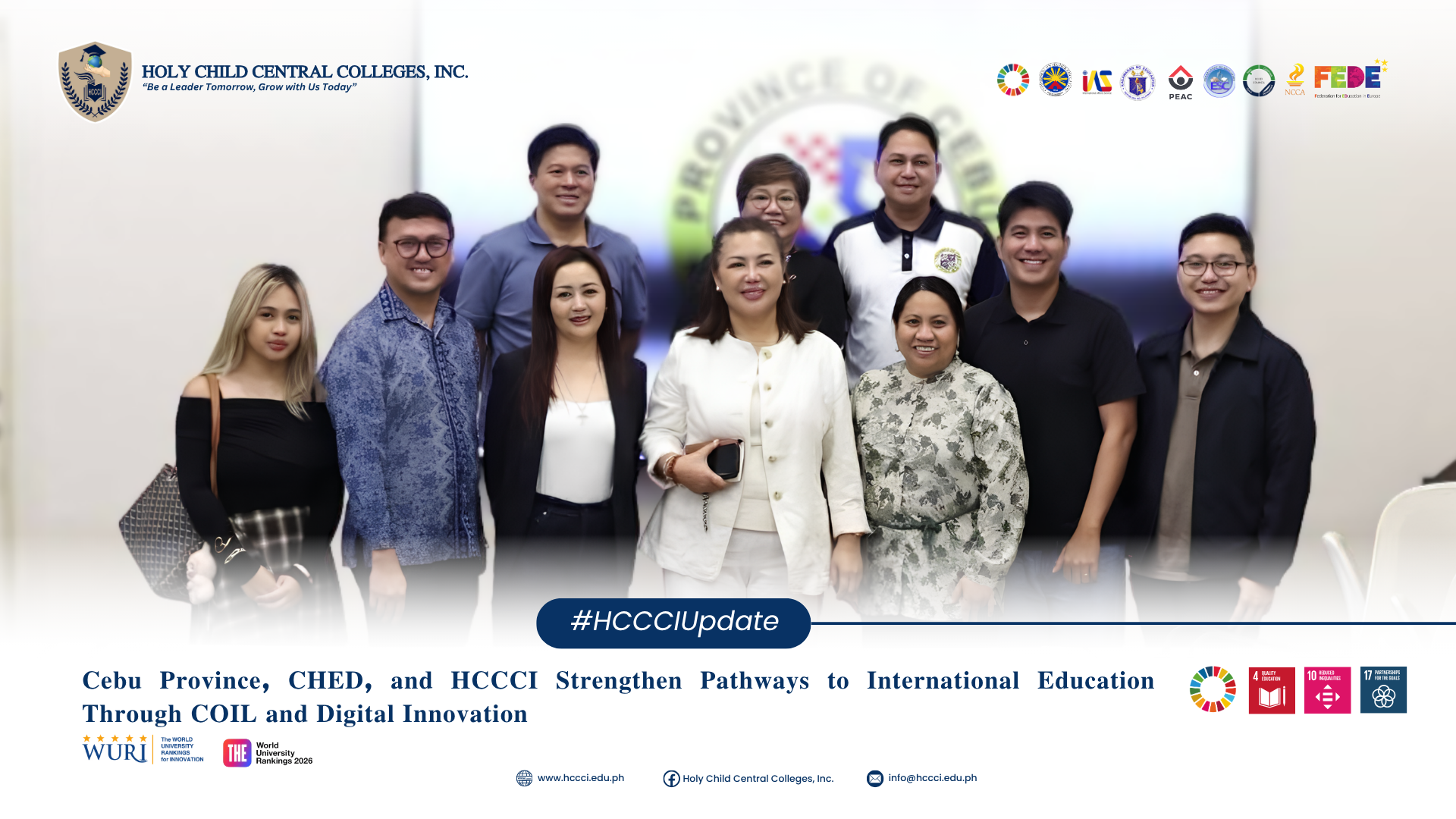
𝐂𝐞𝐛𝐮 𝐏𝐫𝐨𝐯𝐢𝐧𝐜𝐞, 𝐂𝐇𝐄𝐃, 𝐚𝐧𝐝 𝐇𝐂𝐂𝐂𝐈 𝐒𝐭𝐫𝐞𝐧𝐠𝐭𝐡𝐞𝐧 𝐏𝐚𝐭𝐡𝐰𝐚𝐲𝐬 𝐭𝐨 𝐈𝐧𝐭𝐞𝐫𝐧𝐚𝐭𝐢𝐨𝐧𝐚𝐥 𝐄𝐝𝐮𝐜𝐚𝐭𝐢𝐨𝐧 𝐓𝐡𝐫𝐨𝐮𝐠𝐡 𝐂𝐎𝐈𝐋 𝐚𝐧𝐝 𝐃𝐢𝐠𝐢𝐭𝐚𝐥 𝐈𝐧𝐧𝐨𝐯𝐚𝐭𝐢𝐨𝐧
Holy Child Central Colleges, Inc. (HCCCI), together with the Cebu Provincial Government and the Commission on Higher Education (CHED), strengthened discussions on internationalization, Collaborative Online International Learning (COIL), and digital education during a courtesy visit to Cebu Governor Pamela Baricuatro on August 14, 2026, at the Cebu Provincial Capitol. The engagement brought together government and higher education leaders to explore opportunities that can expand access to international learning while strengthening collaboration among institutions and stakeholders.

The meeting highlighted the potential of Collaborative Online International Learning (COIL) as a practical pathway for bringing international and intercultural experiences directly into the classroom. Through digital platforms, COIL connects students and educators from different institutions and countries, allowing them to collaborate on academic activities, exchange perspectives, and develop intercultural competencies without requiring students to travel abroad.

The engagement was attended by CHED National Director Christine Ferrer of the International Affairs Service, Dr. Johnny Yao, Regional Director of CHED Region VII, and Eldrin P. Delgado, Project Technical Staff of the International Affairs Service. Representing HCCCI were Vanessa Marie L. Antiquin, MMEM, Executive Vice President, and Dr. Erwin M. Faller, Academic Director. Their participation reflected a shared commitment to strengthening Philippine higher education through international collaboration, digital innovation, and accessible global learning opportunities.

A key focus of the discussion was the upcoming International COIL Conference (ICC) 2026, which Cebu is set to host on October 22–23, 2026, at the Cebu Provincial Capitol. The conference serves as a continuation of the momentum established during ICC 2025, building on the growing national interest in COIL and creating a stronger platform for institutions to move from initial engagement toward sustained implementation.

As part of this continuing effort, HCCCI will spearhead the active partnership among CHED’s International Affairs Service, the Cebu Provincial Government, and participating higher education institutions through the Bayanihan COIL Network. The network is envisioned as a collaborative platform that will bring together CHED iLab grantees and other HEIs interested in pioneering COIL within their respective institutions and local school communities.

Through this initiative, ICC 2026 will go beyond serving as a conventional conference. It will provide a venue for institutions to connect, share experiences, exchange good practices, develop institutional capacity, and establish practical pathways for implementing COIL. By bringing together institutions at different stages of COIL development, the initiative seeks to create a stronger community of practice where experienced implementers can support emerging institutions in establishing their own internationalization initiatives.
The Bayanihan COIL Network likewise reflects the principle that internationalization can be strengthened through collective action. Rather than having institutions work independently, the network will encourage HEIs to share expertise, resources, international connections, and implementation strategies, allowing more institutions to benefit from the experiences of those already engaged in COIL.
Among the planned components of ICC 2026 are smart classroom training and discussions on international education pathways, including opportunities related to foreign scholarships and potential dual-diploma programs. These activities aim to help institutions better understand emerging approaches to international education while identifying practical opportunities that can benefit both faculty members and students.
The discussions also underscored the growing importance of making international education more inclusive. While traditional mobility programs provide valuable opportunities, not all students have the resources or circumstances to participate in physical exchanges. COIL offers an alternative pathway by allowing students to experience international collaboration from their own classrooms, making global learning more accessible to a wider and more diverse student population.
For HCCCI, this approach is closely aligned with its continuing internationalization agenda. Through its International Relations and External Linkages Office, the institution has continued to develop COIL initiatives, international partnerships, intercultural learning opportunities, and other programs that connect students and faculty with the global academic community. Its experience in developing COIL initiatives and serving as a CHED iLab grantee provides a foundation for contributing to a broader national movement toward technology-enabled international education.
The initiative also reflects the importance of collaboration among national government, local government, and higher education institutions in creating sustainable pathways for educational innovation. The involvement of the Cebu Provincial Government provides a local platform for advancing international education, while CHED’s participation strengthens alignment with national higher education priorities. HCCCI, as the institution spearheading the collaborative effort through the Bayanihan COIL Network, contributes its institutional experience and internationalization expertise to help translate these shared priorities into concrete programs and partnerships.
The collaboration advances Sustainable Development Goal (SDG) 4: Quality Education by promoting innovative, inclusive, and technology-enabled learning opportunities. It also supports SDG 10: Reduced Inequalities by expanding access to international academic experiences for students who may not have the opportunity to participate in physical mobility programs. Furthermore, the initiative directly contributes to SDG 17: Partnerships for the Goals by bringing together government agencies, higher education institutions, and international partners in pursuit of shared educational objectives.
Beyond technology and international mobility, ICC 2026 represents a broader vision for a Philippine higher education system that is increasingly connected, inclusive, and future-ready. Through COIL and related digital initiatives, students can develop communication skills, intercultural competence, collaboration skills, digital literacy, and global perspectives that are increasingly relevant in both academic and professional environments.
More importantly, the conference provides an opportunity to strengthen the growing community of institutions pioneering COIL across the country. By gathering CHED iLab grantees alongside HEIs that are interested in introducing COIL within their own local school communities, the initiative can help create a more coordinated and sustainable movement for internationalization at the grassroots level.
For HCCCI, this represents a significant opportunity to translate its experience in COIL into a broader institutional and national contribution. Through the Bayanihan COIL Network, the institution seeks to help build stronger connections among HEIs, encourage knowledge-sharing, and support institutions that are beginning their own journey toward internationalization.
As Cebu, CHED, and HCCCI continue preparations for ICC 2026, the collaboration demonstrates how internationalization can be advanced through shared responsibility, strategic partnerships, and collective innovation. With HCCCI spearheading the Bayanihan COIL Network and bringing together CHED iLab grantees and interested HEIs, ICC 2026 aims to strengthen a community of institutions committed to making global learning more accessible within their own classrooms and communities.
The initiative ultimately reinforces a shared vision: that international education should not be limited by geography, financial capacity, or physical mobility. Through COIL, digital innovation, and the spirit of bayanihan, Philippine higher education institutions can connect their learners to the world while remaining deeply rooted in and responsive to their local communities.