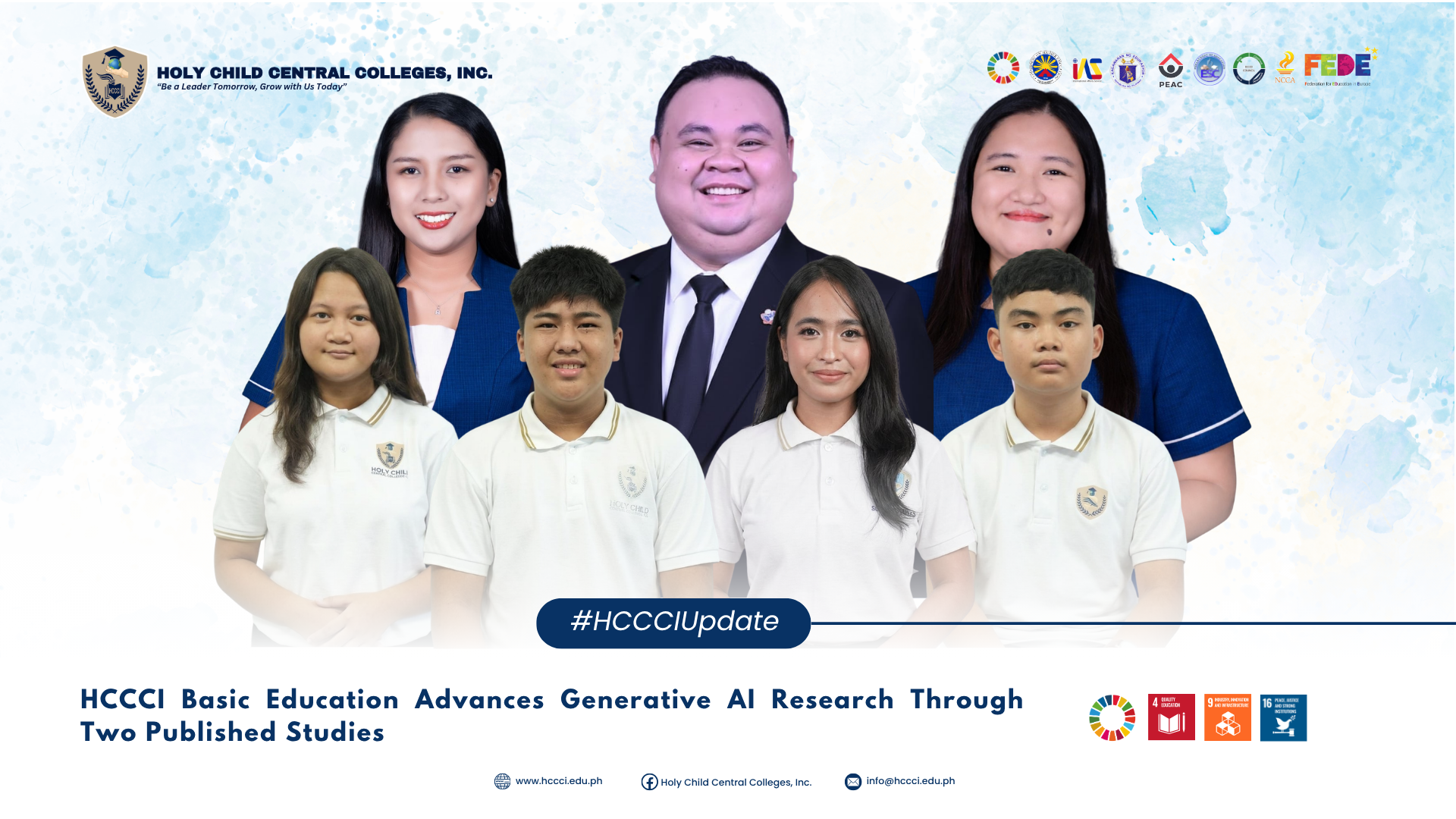
𝐇𝐂𝐂𝐂𝐈 𝐁𝐚𝐬𝐢𝐜 𝐄𝐝𝐮𝐜𝐚𝐭𝐢𝐨𝐧 𝐀𝐝𝐯𝐚𝐧𝐜𝐞𝐬 𝐆𝐞𝐧𝐞𝐫𝐚𝐭𝐢𝐯𝐞 𝐀𝐈 𝐑𝐞𝐬𝐞𝐚𝐫𝐜𝐡 𝐓𝐡𝐫𝐨𝐮𝐠𝐡 𝐓𝐰𝐨 𝐏𝐮𝐛𝐥𝐢𝐬𝐡𝐞𝐝 𝐒𝐭𝐮𝐝𝐢𝐞𝐬
Holy Child Central Colleges, Inc. (HCCCI) Basic Education continues to strengthen its culture of research, innovation, and responsible technology use with the publication of two studies in the Bandung Conference Series: Science and Technology, Vol. 1 No. 2 (2026). Published on August 6, 2026, the studies examine the growing role of Generative Artificial Intelligence (GenAI) in secondary education, particularly its influence on students’ learning experiences, academic integrity, and critical-thinking skills. The published works are “Beyond the Prompt: Grade 11 Students’ Lived Experiences with Generative Artificial Intelligence in Academic Learning” and “Generative Artificial Intelligence in Secondary Education: Implications for Academic Integrity and Critical Thinking.” These accomplishments highlight the active participation of HCCCI Basic Education teachers, students, and administrators in producing research that responds to emerging issues in education.
The first study, “Beyond the Prompt: Grade 11 Students’ Lived Experiences with Generative Artificial Intelligence in Academic Learning,” was authored by Ma. Alexandria C. Candel, Allana Amor Gonzaga, Charlene Joy Saligumba, and Lowel Pasinag, Principal of the Basic Education Department of Holy Child Central Colleges, Inc. The study explored the lived experiences of Grade 11 students in using Generative AI platforms such as ChatGPT, Claude, and Gemini as learning companions.
The second study, “Generative Artificial Intelligence in Secondary Education: Implications for Academic Integrity and Critical Thinking,” brought together the perspectives of Rynn Lord T. Tumibay, Charlene Joy Saligumba, and Allana Amor Gonzaga, along with Basic Education students Rieghn Mathew Baratas and Ramchel Angelo Rabaca, under the leadership of Lowel Pasinag, Principal of the Basic Education Department of Holy Child Central Colleges, Inc. The researchers examined both the opportunities and challenges associated with GenAI in secondary education, particularly its implications for academic integrity and critical thinking.
These research accomplishments also contribute to the United Nations Sustainable Development Goals (SDGs). The studies strongly align with SDG 4: Quality Education by promoting digital literacy, critical thinking, innovative learning approaches, and responsible use of educational technologies. They also support SDG 9: Industry, Innovation and Infrastructure through the exploration of emerging technologies and their meaningful application in education, while contributing to SDG 16: Peace, Justice and Strong Institutions through their emphasis on academic integrity, ethical practices, accountability, and responsible decision-making.
Through research on GenAI, HCCCI Basic Education demonstrates how educational innovation can be pursued while ensuring that technological advancement remains anchored in ethical and academic values. Through the publication of these two studies, HCCCI Basic Education reaffirms its commitment to research-driven education and responsible innovation. The accomplishment strengthens the institution’s research culture while providing valuable insights that can help guide educators, students, parents, and the wider community in understanding the opportunities and challenges presented by Generative AI. More importantly, the participation of teachers, students, and school leadership in these scholarly works reflects HCCCI Basic Education’s commitment to creating an environment where research is not only produced but also translated into meaningful educational practice. As AI continues to reshape the learning landscape, HCCCI Basic Education remains committed to preparing learners who are critical thinkers, responsible technology users, ethical scholars, and globally prepared individuals.