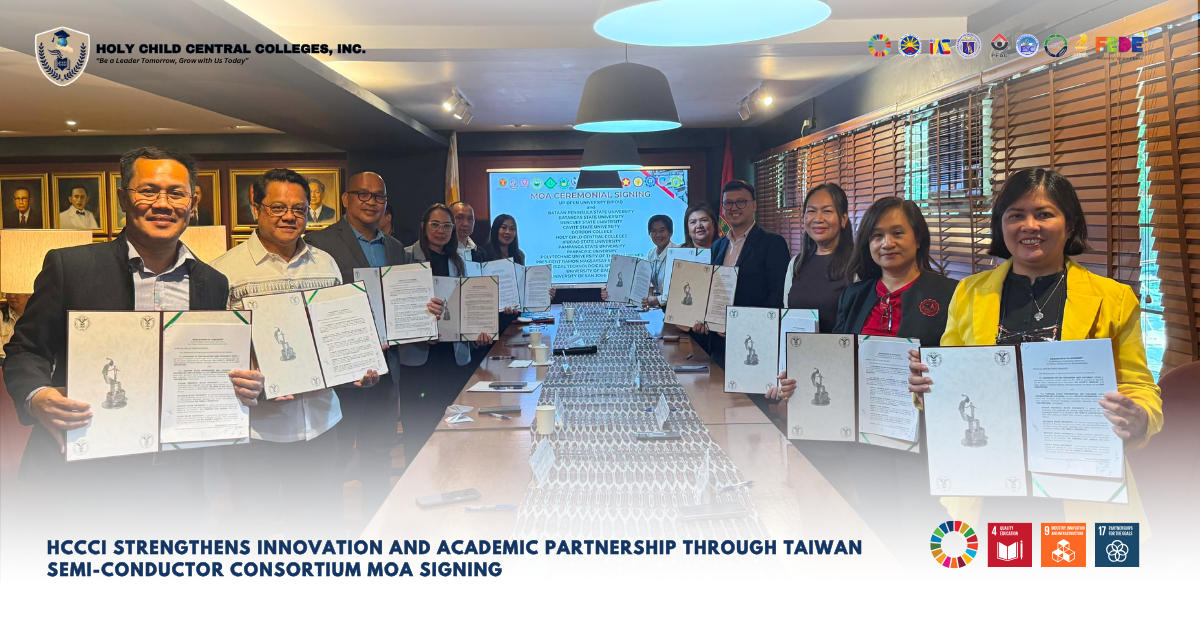
𝐇𝐂𝐂𝐂𝐈 𝐞𝐧𝐭𝐞𝐫𝐬 𝐏𝐚𝐫𝐭𝐧𝐞𝐫𝐬𝐡𝐢𝐩 𝐰𝐢𝐭𝐡 𝐔𝐏𝐎𝐔 𝐭𝐡𝐫𝐨𝐮𝐠𝐡 𝐓𝐚𝐢𝐰𝐚𝐧 𝐒𝐞𝐦𝐢-𝐂𝐨𝐧𝐝𝐮𝐜𝐭𝐨𝐫 𝐂𝐨𝐧𝐬𝐨𝐫𝐭𝐢𝐮𝐦 𝐌𝐎𝐀 𝐒𝐢𝐠𝐧𝐢𝐧𝐠
Holy Child Central Colleges, Inc. (HCCCI), through the participation of Academic Director Dr. Erwin M. Faller, took part in the Memorandum of Agreement (MOA) Signing Ceremony establishing the Consortium Agreement for Taiwan Semiconductor Microcredentials on May 12, 2026, at Ang Bahay ng Alumni, University of the Philippines Diliman, Quezon City. The event was organized by the University of the Philippines Open University (UPOU) and gathered partner institutions, educational leaders, and stakeholders committed to advancing semiconductor education and innovation.

The program centered on the formal establishment of a consortium that promotes collaboration in semiconductor education through microcredential programs, research initiatives, and workforce development opportunities. The event also served as a platform for participating institutions to express their support for initiatives that prepare learners for emerging industries and technological advancements. HCCCI’s participation came after receiving the second call for institutions to become part of the consortium, further strengthening the institution’s commitment to innovation-driven education.

Among the individuals recognized during the event were Dr. Erwin M. Faller, Academic Director of HCCCI; Hon. Marivet S. Caballero, President of Holy Child Central Colleges; and Dr. Joane V. Serrano, Chancellor of the University of the Philippines Open University. Their involvement reflects the collaborative efforts of educational leaders in promoting quality education and academic partnerships.

The consortium agreement aims to connect academic institutions with industry and government sectors to support specialized learning in semiconductor technology. Through the implementation of microcredential programs, institutions are expected to provide learners with practical and industry-relevant competencies that address the growing demands of the technology sector. The initiative also encourages collaborative research, faculty development, and innovation-centered learning experiences that will benefit both educators and students.

For HCCCI, joining the consortium represents another significant step forward in opening more pathways for students, faculty members, and the entire academic community toward microcredentialing and industry-relevant programs. Through this initiative, the institution seeks to expand opportunities that will equip learners with specialized competencies, strengthen career readiness, and provide exposure to emerging fields aligned with the needs of modern industries. The partnership also supports HCCCI’s ongoing efforts to enhance its academic offerings through innovative and future-focused educational opportunities that bridge classroom learning with real-world applications.

This initiative aligns with Sustainable Development Goal 4: Quality Education by creating accessible and future-ready learning opportunities focused on technology and innovation. It also supports Sustainable Development Goal 9: Industry, Innovation, and Infrastructure by encouraging research, technological advancement, and workforce preparedness in the semiconductor field. Furthermore, the collaboration strengthens Sustainable Development Goal 17: Partnerships for the Goals through meaningful cooperation among educational institutions and stakeholders from different sectors.
By engaging in programs such as this, HCCCI contributes to the advancement of education and innovation that can create long-term opportunities for learners and professionals alike. Partnerships focused on technology and research help build stronger educational systems, encourage knowledge-sharing, and prepare individuals to become competent contributors to society and the workforce.
As HCCCI continues to participate in initiatives that promote innovation and collaboration, the institution stands as a proactive advocate of transformative education, helping shape future-ready learners equipped with the knowledge, skills, and values needed in an increasingly technology-driven society.