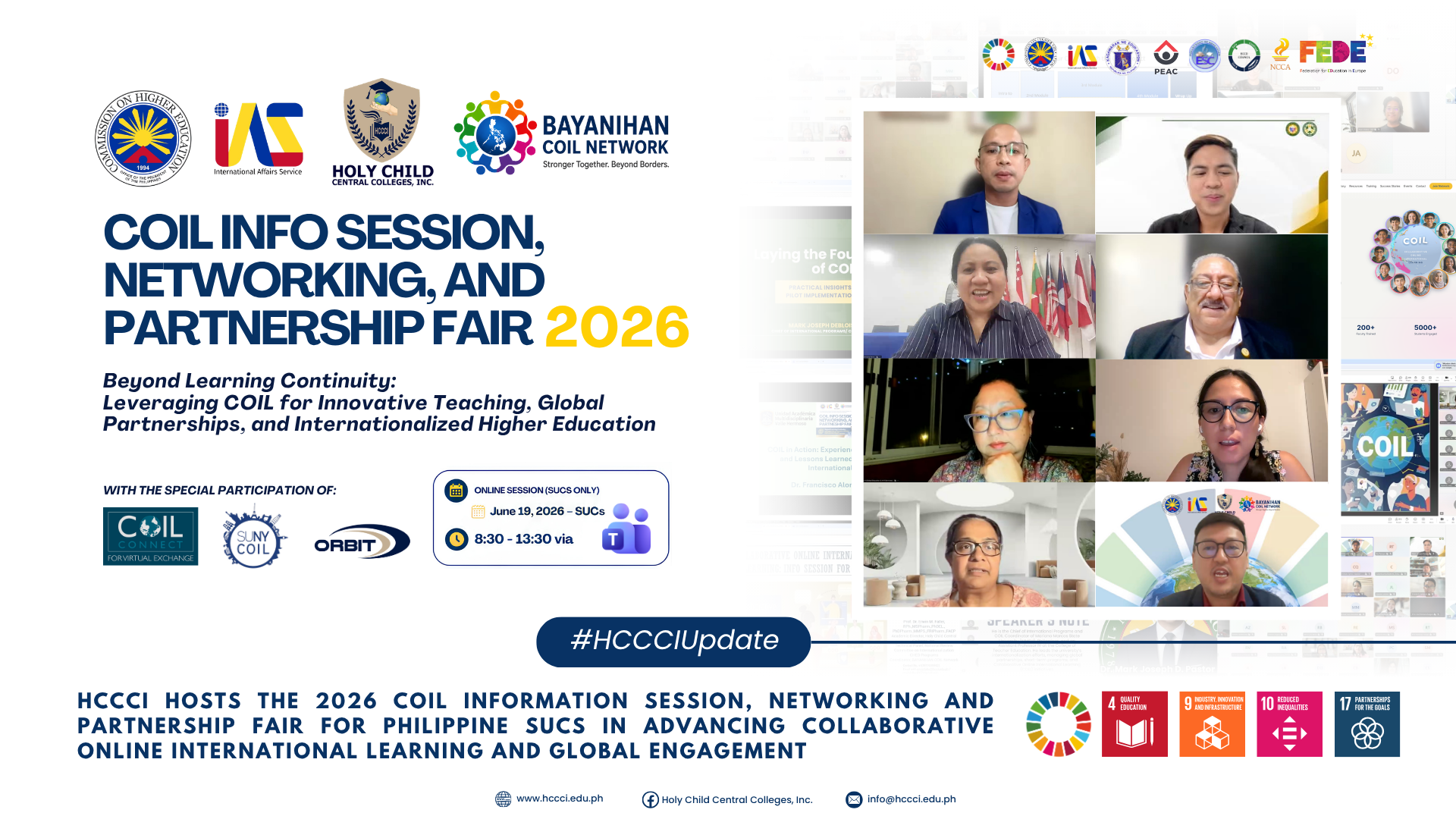
𝐇𝐂𝐂𝐂𝐈 𝐇𝐨𝐬𝐭𝐬 𝐭𝐡𝐞 𝟐𝟎𝟐𝟔 𝐂𝐎𝐈𝐋 𝐈𝐧𝐟𝐨𝐫𝐦𝐚𝐭𝐢𝐨𝐧 𝐒𝐞𝐬𝐬𝐢𝐨𝐧, 𝐍𝐞𝐭𝐰𝐨𝐫𝐤𝐢𝐧𝐠 𝐚𝐧𝐝 𝐏𝐚𝐫𝐭𝐧𝐞𝐫𝐬𝐡𝐢𝐩 𝐅𝐚𝐢𝐫 𝐟𝐨𝐫 𝐏𝐡𝐢𝐥𝐢𝐩𝐩𝐢𝐧𝐞 𝐒𝐔𝐂𝐬 𝐢𝐧 𝐀𝐝𝐯𝐚𝐧𝐜𝐢𝐧𝐠 𝐂𝐨𝐥𝐥𝐚𝐛𝐨𝐫𝐚𝐭𝐢𝐯𝐞 𝐎𝐧𝐥𝐢𝐧𝐞 𝐈𝐧𝐭𝐞𝐫𝐧𝐚𝐭𝐢𝐨𝐧𝐚𝐥 𝐋𝐞𝐚𝐫𝐧𝐢𝐧𝐠 𝐚𝐧𝐝 𝐆𝐥𝐨𝐛𝐚𝐥 𝐄𝐧𝐠𝐚𝐠𝐞𝐦𝐞𝐧𝐭
In collaboration with the Commission on Higher Education–International Affairs Service (CHED-IAS), Holy Child Central Colleges, Inc. (HCCCI), through its International Relations and External Linkages Office, successfully hosted the 2026 COIL Information Session, Networking, and Partnership Fair on June 19, 2026 via Microsoft Teams. The event gathered 238 participants from State Universities and Colleges (SUCs) across the Philippines, reaffirming a shared commitment to advancing internationalization and expanding global learning opportunities within the Philippine public higher education sector.

Carrying the theme, “Beyond Learning Continuity: Leveraging COIL for Innovative Teaching, Global Partnerships, and Internationalized Higher Education,” the event served as a strategic platform for promoting Collaborative Online International Learning (COIL) as an innovative and sustainable approach to internationalization. The session highlighted how technology-enabled academic collaboration can connect classrooms across borders, foster intercultural understanding, strengthen institutional partnerships, and provide students with meaningful international learning experiences regardless of geographic or financial limitations.

The theme also reflected the growing realities faced by higher education institutions worldwide, including rising operational costs, resource constraints, and the continuing global energy crisis. As universities seek more sustainable and resilient approaches to international engagement, COIL offers an innovative alternative that reduces dependence on resource-intensive mobility while preserving meaningful academic exchange and global collaboration. By leveraging digital technologies and virtual partnerships, institutions can continue advancing internationalization goals while contributing to more environmentally responsible and cost-effective educational practices.

The program formally opened with a message from Dr. Christine Nabor-Ferrer, Director IV and Officer-in-Charge of the CHED-International Affairs Service. As one of the leading advocates of higher education internationalization in the Philippines, Dr. Ferrer emphasized the important role of State Universities and Colleges in ensuring that global engagement becomes accessible, inclusive, and responsive to contemporary educational challenges. She underscored how COIL complements the country's flexible learning initiatives and supports CHED's broader vision of producing globally competent graduates through innovative teaching, digital transformation, and international academic collaboration. Her message reaffirmed CHED-IAS' continuing commitment to empowering Philippine State Universities and Colleges to engage meaningfully in the global higher education landscape.

Providing the foundation for the discussions, Dr. Erwin M. Faller, Academic Director of Holy Child Central Colleges, Inc., introduced the principles and significance of Collaborative Online International Learning. He explained how COIL serves as a transformative teaching and learning strategy that enables faculty and students from different countries to collaborate through shared academic experiences, projects, and discussions. He highlighted how COIL not only strengthens academic engagement but also develops intercultural competence, global awareness, and critical thinking skills among students. His presentation positioned COIL as a practical pathway for institutions seeking to advance internationalization while maintaining accessibility, equity, and sustainability.

The international speaker series began with Dr. Gayathri Banavara, Business Leadership Program Coordinator and Assistant Professor at the Community College of Philadelphia in the United States and a Fulbright Specialist. Drawing from her extensive experience in leadership education, workforce development, and international engagement, Dr. Banavara discussed how virtual exchange and global classrooms are reshaping higher education in the United States. She highlighted the growing role of community colleges in promoting equitable access to international learning opportunities and demonstrated how COIL enables students from diverse cultural, economic, and educational backgrounds to engage in meaningful global collaboration. Her presentation emphasized the development of intercultural competence, collaborative problem-solving, global citizenship, and workforce readiness—skills increasingly demanded in today's interconnected world. She further encouraged institutions to view technology not merely as a tool for instruction but as a bridge for fostering authentic international engagement and inclusive learning environments.

Representing Mexico, Francisco Alonso Esquivel of Universidad Autónoma de Tamaulipas shared valuable insights into the practical implementation of COIL within a public university context. Situated in a region that actively promotes international cooperation and cross-border academic engagement, Universidad Autónoma de Tamaulipas has embraced COIL as a means of strengthening internationalization while expanding educational opportunities for students. Mr. Esquivel presented real-world experiences and lessons learned from implementing virtual exchange initiatives, highlighting both the challenges and opportunities institutions may encounter. He discussed faculty preparation, curriculum integration, partnership sustainability, and institutional readiness, offering practical strategies that Philippine State Universities and Colleges can adopt as they begin or expand their own COIL initiatives. His presentation demonstrated how international collaboration can thrive even in resource-conscious environments when supported by strong institutional commitment and faculty engagement.

Providing a Philippine public higher education perspective, Dr. Mark Joseph D. Pastor, Chief of International Programs, COIL Coordinator, and Assistant Professor IV of Mariano Marcos State University (MMSU), shared his institution's journey in integrating COIL into academic practice. As one of the active State Universities in Northern Luzon advancing internationalization, MMSU's experience provided a relevant model for fellow Philippine State Universities and Colleges. Dr. Pastor discussed how strategic leadership, faculty empowerment, and sustained institutional support enabled COIL to evolve from pilot projects into a continuing academic practice. He highlighted the importance of cultivating faculty champions, developing international partnerships, and embedding COIL into institutional internationalization frameworks. His presentation demonstrated that successful COIL implementation requires not only technological readiness but also a culture of collaboration, innovation, and shared ownership among academic stakeholders.

Further enriching the discussion was Dr. Oscar Sherlo S. Reyes, Director of the Center for External Linkages and Chief Ambassador for Global Partnerships at De La Salle–College of Saint Benilde. Drawing from Saint Benilde's extensive experience in international networking and partnership development, Dr. Reyes explored the strategic value of COIL in creating globally connected classrooms and expanding opportunities for collaborative learning. He emphasized that COIL extends beyond virtual interaction by enabling students and faculty to engage with diverse perspectives, address global challenges, and develop competencies necessary for international citizenship. His presentation highlighted how State Universities and Colleges can leverage COIL to strengthen existing partnerships, establish new international collaborations, and contribute to a more globally engaged higher education ecosystem.
Recognizing the importance of institutional support systems and international communities of practice, the event also introduced participants to two globally recognized COIL networks that provide resources, training, and partnership opportunities for institutions worldwide.

Representing the State University of New York's globally recognized COIL Center, Dr. Christina Heyon Lee, Director of Global Education and International Services under the Division of Diversity, Equity, and Belonging, introduced the SUNY COIL Network. Widely acknowledged as a pioneer in the development and global expansion of the COIL model, SUNY has played a significant role in helping universities establish sustainable virtual exchange programs and international collaborations. Dr. Lee discussed how the network supports member universities through faculty development, partnership matching, curriculum innovation, and global engagement initiatives. She also highlighted the network's commitment to diversity, equity, belonging, and inclusive internationalization, demonstrating how COIL can create transformative learning experiences that reach students regardless of geographic location.

Complementing this perspective was Daysi Rueda Cordones, Associate Director of COIL Connect in Spain. As part of one of Europe's growing virtual exchange communities, Ms. Rueda Cordones introduced participants to the opportunities available through COIL Connect, including faculty matchmaking, institutional partnerships, professional development programs, and collaborative project opportunities. She emphasized the importance of structured international networks in helping universities move beyond isolated projects toward sustainable and long-term international engagement. Her presentation demonstrated how global communities of practice can accelerate COIL adoption and strengthen collaboration among institutions across different regions of the world.

A major highlight of the event was the official launch of the COIL Bayanihan Network Website, presented by Jack Robin A. Lacerna, MMEM, Director, International Relations and External Linkages Office of HCCCI. Inspired by the Filipino spirit of bayanihan, the platform was developed to serve as a collaborative digital hub for Philippine Universities and Colleges engaged in COIL and internationalization initiatives. The website aims to facilitate faculty networking, partner matching, resource sharing, project development, and knowledge exchange among participating State Universities and Colleges. More importantly, it reflects the collective aspiration of Philippine educators and State Universities and Colleges to build a supportive national community dedicated to expanding global learning opportunities for Filipino students.

The event concluded with a Networking and Partnership Fair where participating SUCs explored potential collaborations, identified COIL-ready courses, discussed faculty engagement strategies, and connected with prospective international partners. Through structured networking activities and an open forum, participants exchanged ideas, raised implementation concerns, and discussed practical approaches to launching pilot COIL projects within their respective institutions.

Overall, the 2026 COIL Information Session, Networking, and Partnership Fair for Philippine SUCs highlighted the growing momentum of Collaborative Online International Learning within Philippine higher education. Through the collective efforts of CHED-IAS, HCCCI, international experts, global COIL networks, and participating SUCs, the event demonstrated that meaningful internationalization can be achieved through innovative, inclusive, accessible, and sustainable approaches to teaching and learning.

The initiative strongly supports the attainment of the United Nations Sustainable Development Goals (SDGs), particularly SDG 4 (Quality Education), SDG 10 (Reduced Inequalities), SDG 13 (Climate Action), and SDG 17 (Partnerships for the Goals), by expanding access to international learning opportunities, promoting sustainable educational practices, and fostering collaborative solutions across borders.

As Philippine State Universities and Colleges continue to strengthen their internationalization agendas, COIL presents a practical and transformative pathway toward developing globally connected classrooms, empowering faculty innovation, strengthening institutional partnerships, and preparing students to thrive in an increasingly interconnected world. Through sustained collaboration among CHED-IAS, Philippine SUCs, and international partners, COIL is poised to become a cornerstone of future-ready, globally engaged, resilient, and internationally connected higher education in the Philippines.