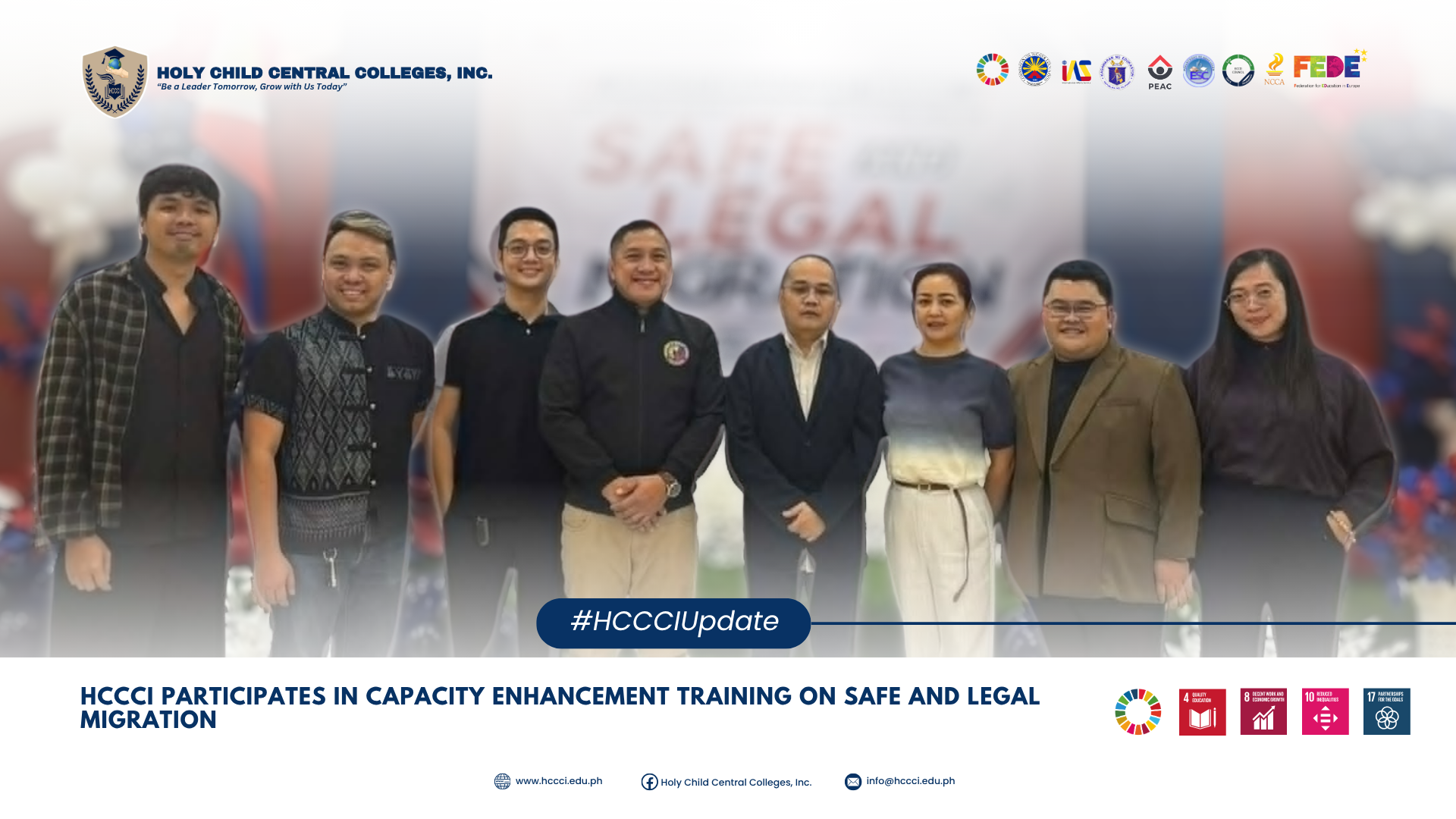
𝐇𝐂𝐂𝐂𝐈 𝐏𝐚𝐫𝐭𝐢𝐜𝐢𝐩𝐚𝐭𝐞𝐬 𝐢𝐧 𝐂𝐚𝐩𝐚𝐜𝐢𝐭𝐲 𝐓𝐫𝐚𝐢𝐧𝐢𝐧𝐠 𝐨𝐧 𝐒𝐚𝐟𝐞 𝐚𝐧𝐝 𝐋𝐞𝐠𝐚𝐥 𝐌𝐢𝐠𝐫𝐚𝐭𝐢𝐨𝐧
Holy Child Central Colleges, Inc. (HCCCI) participated in the Capacity Training on Safe and Legal Migration for various Higher Education Institutions (HEIs) on Safe and Legal Migration, conducted by the Department of Migrant Workers (DMW) Regional Office XII in partnership with the Commission on Higher Education (CHED) Regional Office XII on July 17, 2026, at HABI Hotel, Koronadal City. The activity gathered representatives from Higher Education Institutions across Region XII to strengthen institutional capacity in promoting safe and legal migration and to prepare participating institutions to cascade this knowledge to their graduating students.
The training aimed to equip HEIs with accurate, relevant, and up-to-date information on responsible migration practices, enabling them to guide graduating students who may pursue employment opportunities overseas. It highlighted the importance of informed decision-making, legal migration pathways, migrant workers’ rights, government support services, and preventive measures against illegal recruitment and human trafficking. Through the initiative, participating institutions were encouraged to become active partners in promoting safe, ethical, and informed migration within their respective academic communities.
Among the resource speakers was Atty. Eric D. Dollete, Director III of the Migrant Workers Protection Bureau of the Department of Migrant Workers, who delivered a session on “Anti-Illegal Recruitment and Trafficking in Persons: Strengthening Awareness for Safe and Legal Migration.” Representing HCCCI were Vanessa Marie L. Antiquin, MMEM, Executive Vice President, and Mark Laurence J. Fano, LPT, MALT, CHRA, Director of the Department for Student Affairs Services. Their participation reflected the institution’s commitment to continuous professional development and its support for government-led initiatives that promote learner welfare, responsible citizenship, and informed career pathways.
Throughout the training, participants engaged in discussions on pre-employment orientation, legal migration processes, anti-illegal recruitment measures, and the protection of migrant workers’ rights. The sessions underscored the vital role of Higher Education Institutions in providing graduating students with reliable, timely, and evidence-based information before they pursue employment opportunities abroad. By strengthening institutional awareness and capacity, the activity sought to ensure that future graduates are better equipped to make informed, responsible, and legally compliant decisions.
The initiative likewise advanced the United Nations Sustainable Development Goals (SDGs), particularly SDG 4: Quality Education, by expanding access to practical and relevant learning opportunities; SDG 8: Decent Work and Economic Growth, by promoting safe, orderly, and productive labor mobility; SDG 10: Reduced Inequalities, by advocating for the protection of migrant workers’ rights and equitable access to legal migration pathways; and SDG 17: Partnerships for the Goals, by strengthening collaboration among government agencies, Higher Education Institutions, and other stakeholders in advancing migrant welfare.
Beyond the training itself, the initiative reinforced the important role of educational institutions in empowering learners with knowledge that supports informed life decisions. By equipping educators and student affairs practitioners with accurate and reliable information, the activity contributed to raising awareness, protecting aspiring migrant workers from exploitation, and fostering a culture of preparedness, responsibility, and respect for human dignity.
Through its participation in initiatives such as this, Holy Child Central Colleges, Inc. reaffirmed its commitment to extending education beyond the classroom by supporting collaborative efforts that empower learners through knowledge, awareness, and responsible citizenship. By working alongside government agencies and partner institutions, HCCCI continued to help prepare its students not only for employment opportunities but also for informed decisions that safeguard their rights, welfare, and future.