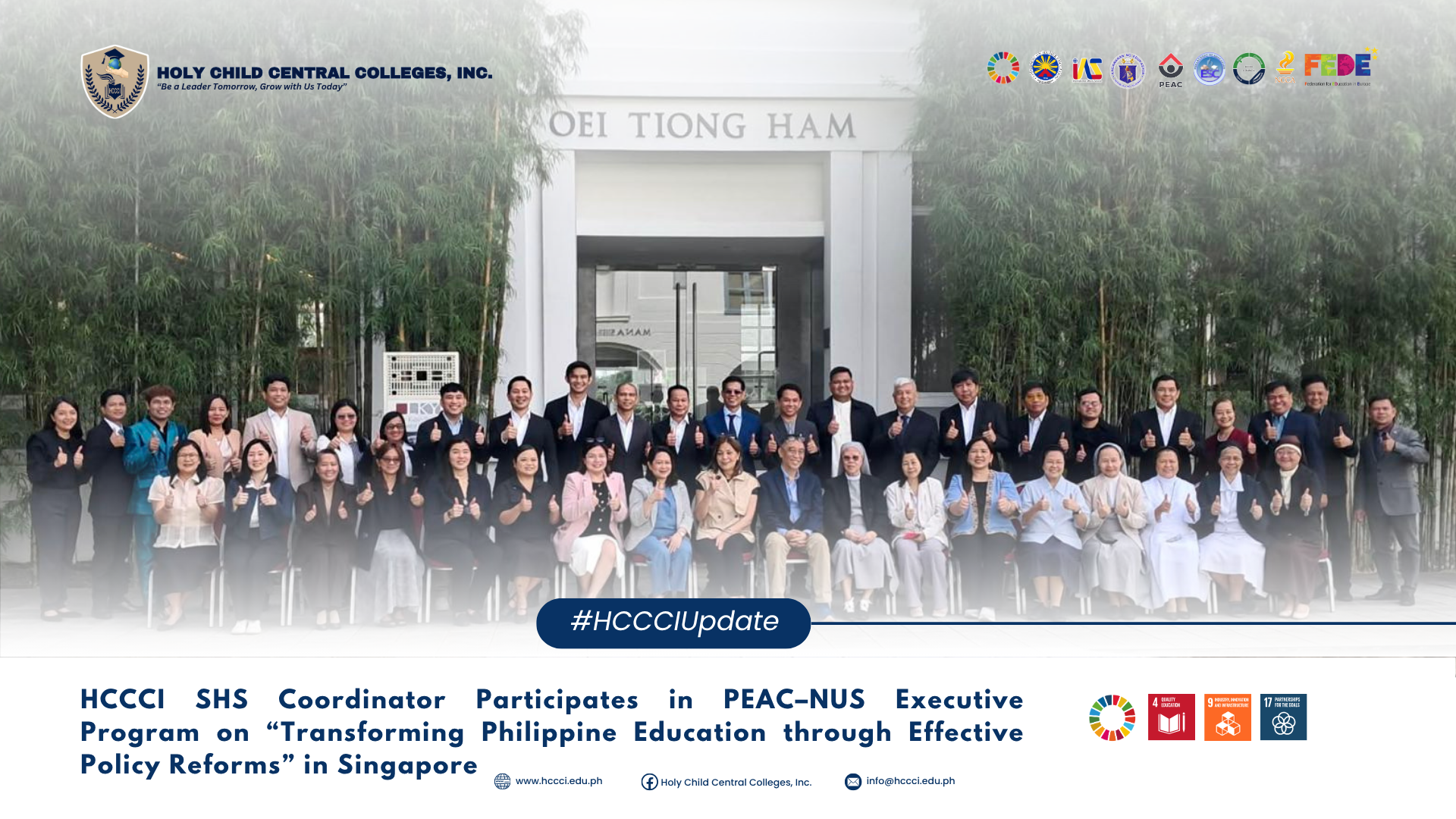
𝐇𝐂𝐂𝐂𝐈 𝐒𝐇𝐒 𝐂𝐨𝐨𝐫𝐝𝐢𝐧𝐚𝐭𝐨𝐫 𝐉𝐨𝐢𝐧𝐬 𝐏𝐄𝐀𝐂–𝐍𝐔𝐒 𝐄𝐱𝐞𝐜𝐮𝐭𝐢𝐯𝐞 𝐏𝐫𝐨𝐠𝐫𝐚𝐦 𝐨𝐧 “𝐓𝐫𝐚𝐧𝐬𝐟𝐨𝐫𝐦𝐢𝐧𝐠 𝐏𝐡𝐢𝐥𝐢𝐩𝐩𝐢𝐧𝐞 𝐄𝐝𝐮𝐜𝐚𝐭𝐢𝐨𝐧 𝐭𝐡𝐫𝐨𝐮𝐠𝐡 𝐄𝐟𝐟𝐞𝐜𝐭𝐢𝐯𝐞 𝐏𝐨𝐥𝐢𝐜𝐲 𝐑𝐞𝐟𝐨𝐫𝐦𝐬” 𝐢𝐧 𝐒𝐢𝐧𝐠𝐚𝐩𝐨𝐫𝐞
Holy Child Central Colleges, Inc. (HCCCI) reaffirmed its commitment to educational excellence and international engagement as John Rey A. Tresbe, LPT, Senior High School (SHS) Academic Coordinator of the Basic Education Department, represented the institution in the executive leadership program, “Transforming Philippine Education through Effective Policy Reforms,” held from July 8–10, 2026, in Singapore.

Organized by the Private Education Assistance Committee (PEAC) in partnership with the Lee Kuan Yew School of Public Policy, the three-day executive program brought together education leaders, school administrators, and academic practitioners from across the Philippines to examine innovative approaches to education governance, policy reforms, and institutional transformation. Hosted at the National University of Singapore, the program was designed to strengthen leadership competencies and equip participants with strategic perspectives for building future-ready educational institutions.
Throughout the program, delegates participated in expert-led lectures, interactive workshops, and institutional learning sessions covering key areas that shape contemporary education systems. Discussions focused on the future of university curricula, Singapore’s education policy framework, technology-enhanced teaching and learning, the application of big data in public policy, and the advancement of Technical and Vocational Education and Training (TVET). The sessions highlighted evidence-based policymaking, digital transformation, and adaptive leadership as critical drivers of sustainable educational reform.

One of the program’s highlights was an educational learning visit to Temasek Polytechnic, where participants explored Singapore’s innovative approaches to applied learning, industry-academe collaboration, smart campus technologies, and student-centered education. The visit provided valuable insights into how higher education institutions successfully integrate technology, curriculum innovation, and workforce development to prepare graduates for the demands of an evolving global economy.

Participants also completed intensive workshops on Scenario Planning and Future Thinking, where they developed strategic approaches to anticipating emerging educational trends, addressing policy challenges, and strengthening institutional resilience. These sessions emphasized long-term planning, innovation management, and strategic decision-making as essential competencies for educational leaders navigating an increasingly dynamic educational landscape.

Mr. Tresbe’s participation reflects HCCCI’s continuing investment in faculty and academic leadership development as part of the institution’s broader internationalization and quality assurance agenda. The knowledge, leadership strategies, and global best practices gained from the program are expected to contribute to enhancing the College’s educational policies, instructional leadership, curriculum innovation, and institutional planning, further strengthening the delivery of quality education for HCCCI learners and stakeholders.

Complementing Mr. Tresbe's participation in the executive leadership program, he was joined by Mark Laurence J. Fano, LPT, CHRA, MALT, Director of the Department of Student Affairs Services, in undertaking benchmarking visits to leading educational institutions across Singapore. Together, they examined best practices in educational leadership, institutional governance, curriculum innovation, student affairs management, and technology-enhanced learning. The benchmarking initiative provided valuable insights into innovative educational strategies and institutional practices that will further strengthen HCCCI's academic programs, student services, and continuing efforts toward excellence, quality assurance, and internationalization.

The executive program likewise advances the United Nations Sustainable Development Goals (SDGs), particularly SDG 4: Quality Education, by strengthening the competencies of educational leaders and promoting innovative, inclusive, and technology-enabled learning environments. It also supports SDG 9: Industry, Innovation and Infrastructure through discussions on digital transformation, data-informed policymaking, and future-ready education systems that foster innovation in teaching and institutional governance. Furthermore, the program contributes to SDG 17: Partnerships for the Goals by bringing together education leaders from diverse institutions to exchange best practices, strengthen international networks, and cultivate collaborative solutions that advance educational policy reforms and sustainable development across the region.
Through sustained participation in internationally recognized executive leadership programs and international benchmarking initiatives, HCCCI continues to expand the global competencies of its academic and administrative leaders while reinforcing its vision of delivering transformative, innovative, and globally relevant education. By investing in international professional development, institutional benchmarking, and strategic partnerships, the College remains steadfast in its mission to contribute meaningfully to the continuous advancement of Philippine education and the development of future-ready educational leaders.