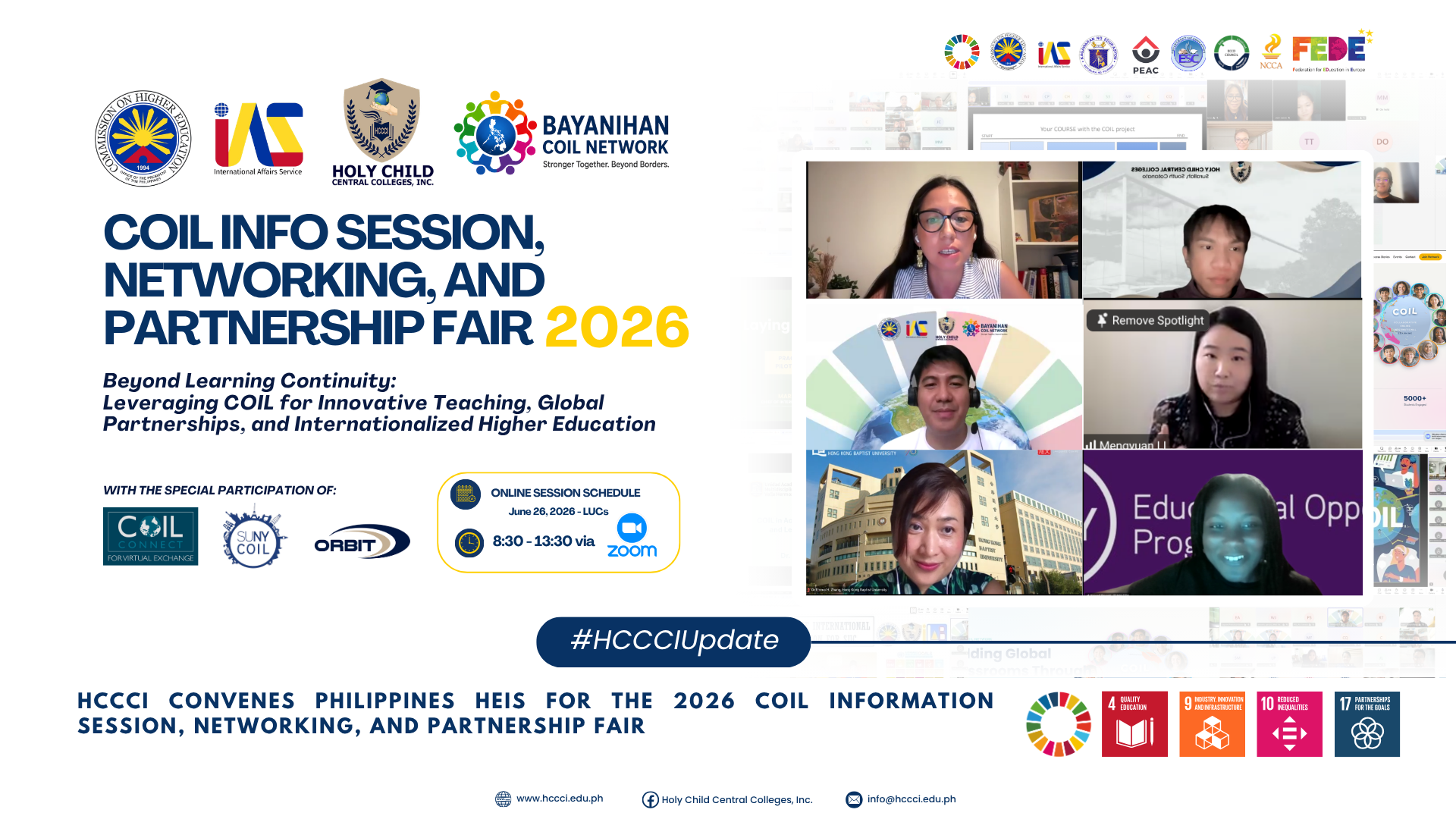
𝐇𝐂𝐂𝐂𝐈 𝐂𝐨𝐧𝐯𝐞𝐧𝐞𝐬 𝐏𝐡𝐢𝐥𝐢𝐩𝐩𝐢𝐧𝐞 𝐇𝐄𝐈𝐬 𝐟𝐨𝐫 𝐭𝐡𝐞 𝟐𝟎𝟐𝟔 𝐂𝐎𝐈𝐋 𝐈𝐧𝐟𝐨𝐫𝐦𝐚𝐭𝐢𝐨𝐧 𝐒𝐞𝐬𝐬𝐢𝐨𝐧, 𝐍𝐞𝐭𝐰𝐨𝐫𝐤𝐢𝐧𝐠, 𝐚𝐧𝐝 𝐏𝐚𝐫𝐭𝐧𝐞𝐫𝐬𝐡𝐢𝐩 𝐅𝐚𝐢𝐫
Holy Child Central Colleges, Inc. (HCCCI), through its International Relations and External Linkages Office and in partnership with the Commission on Higher Education–International Affairs Service (CHED-IAS), successfully convened the 2026 COIL Information Session, Networking, and Partnership Fair on June 30, 2026 via Zoom. Gathering 140 educators, internationalization practitioners, academic leaders, and faculty representatives from Higher Education Institutions (HEIs) across the Philippines, the national event served as a dynamic platform for strengthening Collaborative Online International Learning (COIL), fostering institutional partnerships, and advancing internationalization through innovative and technology-enabled global learning.

Carrying the theme, "Beyond Learning Continuity: Leveraging COIL for Innovative Teaching, Global Partnerships, and Internationalized Higher Education," the event underscored the transformative role of Collaborative Online International Learning as a strategic approach to expanding international education beyond traditional mobility programs. Through COIL, institutions were able to integrate global learning directly into the curriculum, thereby enabling students and faculty from different countries to collaborate on shared academic experiences while promoting intercultural understanding, innovation, and inclusive international engagement.

As higher education institutions continued to respond to evolving global challenges, increasing mobility costs, and the growing demand for accessible international experiences, the discussions highlighted COIL as a sustainable model for internationalization at home. Participants explored how virtual exchange enabled institutions to provide meaningful global learning opportunities while reducing financial, geographical, and environmental barriers that often limited participation in conventional study-abroad programs.

The program formally opened with welcome remarks from Eldrin P. Delgado Project Technical Staff II of the Commission on Higher Education–International Affairs Service (CHED-IAS), who reaffirmed CHED's commitment to strengthening the internationalization of Philippine higher education through innovative and inclusive approaches. He encouraged Higher Education Institutions to embrace Collaborative Online International Learning as a strategic mechanism for expanding global engagement, cultivating international partnerships, and creating transformative learning opportunities for students and faculty alike.

Providing the academic foundation of the program, Dr. Erwin M. Faller, Academic Director of Holy Child Central Colleges, Inc., introduced the principles and strategic value of Collaborative Online International Learning. He discussed how COIL enabled faculty members from institutions across different countries to collaboratively design and deliver course activities that promoted intercultural dialogue, collaborative problem-solving, and experiential global learning. Beyond academic collaboration, Dr. Faller emphasized that COIL helped develop essential twenty-first-century competencies, including intercultural communication, critical thinking, digital collaboration, and global citizenship.

The event featured distinguished international speakers who shared diverse institutional experiences and global perspectives on virtual exchange and international education. Abigail Bryant, Director of EOP Student Success at the State University of New York (SUNY) System Administration, presented SUNY's successful implementation of Collaborative Online International Learning and discussed how virtual exchange expanded access to international education for students who might not otherwise have participated in physical mobility programs. She highlighted COIL's role in promoting educational equity, strengthening institutional partnerships, and preparing graduates to thrive in an increasingly interconnected world.

Representing Hong Kong Baptist University, Dr. Emma H. Zhang, Virtual Exchange and COIL Practitioner and advocate for Global Citizenship Education, together with Betty Mengyuan Li, Lecturer at the University's Language Centre, shared practical models of integrating COIL into classroom instruction. Their presentation demonstrated how carefully designed virtual exchange activities cultivated intercultural competence, collaborative learning, and meaningful engagement among students from diverse cultural backgrounds while providing practical strategies for implementing sustainable and impactful COIL initiatives.

Another highlight of the program was the presentation of Daysi Rueda Cordones, Associate Director of COIL Connect, Spain, who introduced participants to one of the world's leading international COIL networks. She presented the benefits of institutional membership, including faculty matchmaking, professional development, international networking opportunities, and access to a growing global community committed to advancing Collaborative Online International Learning. She also shared that the COIL Connect network comprised 140 Higher Education Institutions worldwide, reflecting the rapid global expansion of virtual exchange as a catalyst for international collaboration.

Closing the plenary sessions, Jack Robin A. Lacerna, MMEM, Director of the International Relations and External Linkages Office of HCCCI, emphasized the strategic role of Collaborative Online International Learning in advancing institutional internationalization. He highlighted how sustained faculty collaboration, curriculum internationalization, and cross-border academic partnerships empowered Higher Education Institutions to deliver globally relevant education while cultivating graduates equipped with intercultural competence, collaborative skills, and a global mindset.

A defining milestone of the event was the official launch of the COIL Bayanihan Network Website, an initiative spearheaded by HCCCI to strengthen collaboration among Philippine and international Higher Education Institutions. Inspired by the Filipino spirit of bayanihan, the platform was designed to serve as a collaborative digital hub where institutions could identify potential COIL partners, facilitate faculty matchmaking, share instructional resources, showcase successful COIL initiatives, and explore opportunities for international academic collaboration. The launch reinforced HCCCI's commitment to creating an inclusive, sustainable, and technology-driven ecosystem that supported the continued growth of Collaborative Online International Learning in the Philippines and beyond.
The initiative likewise advanced the United Nations Sustainable Development Goals (SDGs), particularly SDG 4: Quality Education, by expanding access to inclusive, equitable, and globally connected learning opportunities through virtual exchange. It contributed to SDG 9: Industry, Innovation and Infrastructure by leveraging digital technologies to foster academic innovation and institutional collaboration, while supporting SDG 10: Reduced Inequalities by making international learning more accessible regardless of financial or geographical constraints. Furthermore, the initiative strengthened SDG 17: Partnerships for the Goals by cultivating sustainable collaborations among Philippine and international Higher Education Institutions committed to advancing quality education through internationalization.
As HCCCI continued to expand its internationalization agenda, the launch of the COIL Bayanihan Network Website marked another significant milestone in strengthening Collaborative Online International Learning in the Philippines. The platform was envisioned to become a national hub that would connect Philippine Higher Education Institutions with global partners through collaborative teaching, research, innovation, and faculty engagement. By fostering strategic partnerships, empowering educators, and promoting accessible international learning opportunities, HCCCI reaffirmed its leadership in advancing internationalization at home and remained steadfast in its mission to deliver transformative, globally relevant, and future-ready education for the benefit of learners, educators, and communities in the Philippines and around the world.