𝐀 𝐒𝐡𝐚𝐫𝐞𝐝 𝐂𝐨𝐦𝐦𝐢𝐭𝐦𝐞𝐧𝐭 𝐭𝐨 𝐚 𝐆𝐫𝐞𝐞𝐧𝐞𝐫 𝐅𝐮𝐭𝐮𝐫𝐞
Holy Child Central Colleges, Inc. (HCCCI) demonstrates its commitment to sustainability through institutional policies, operational guidelines, and contractual agreements that promote ethical sourcing, responsible procurement, and proper waste management. Through its Exclusive Food Supply Agreement with VF Vet Farm, the institution establishes shared commitments to locally sourced and responsibly produced goods, fair business practices, compliance with labor and environmental standards, and sustainable supply chain operations. These commitments also extend to outsourced providers and relevant suppliers.
HCCCI also implements established procedures for hazardous waste management through the Chemistry Laboratory's Standard Operating Procedure (SOP), which guides the safe handling, segregation, storage, and disposal of chemical waste. Complementing these measures, the institution enforces its Campus Guidelines on the Use of Disposable Materials and Waste Management, which provide for waste monitoring, documentation, recycling, and the measurement of materials diverted from landfill.
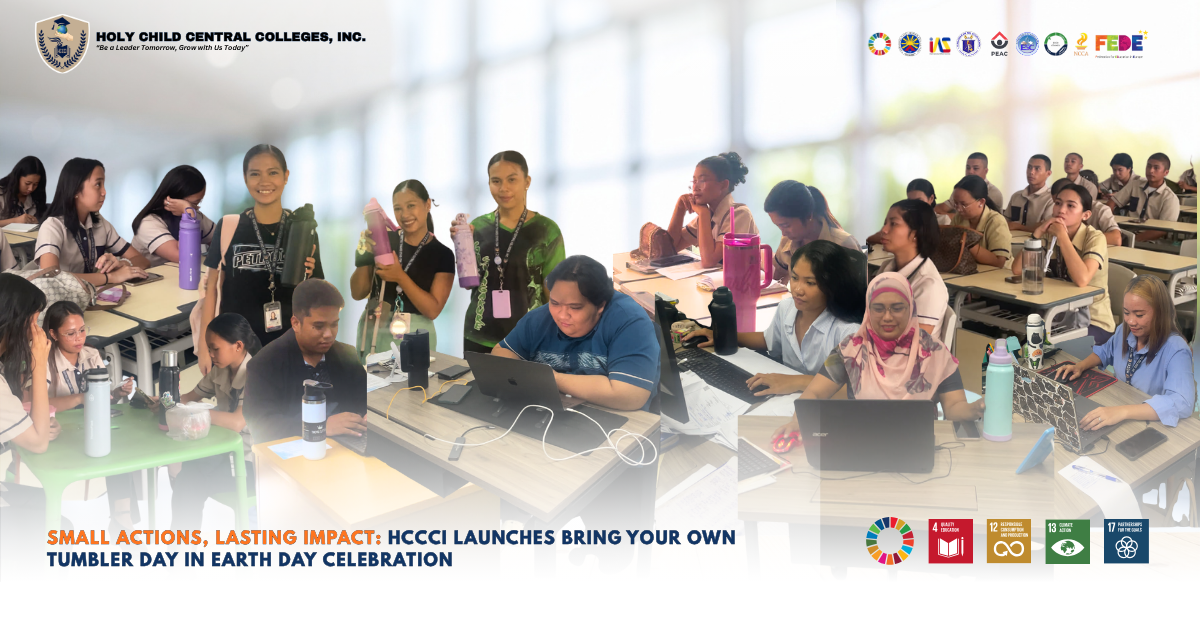
Furthermore, through its Policy on the Minimization of Disposable Items, Plastic Bags, and Single-Use Plastics, HCCCI promotes the use of reusable alternatives across campus operations. The campus canteen supports this initiative by serving dine-in meals using reusable plates and utensils rather than disposable alternatives. The institution also encourages students and employees to bring reusable containers and personal tumblers.
Collectively, these policies, agreements, and practices demonstrate HCCCI's integrated approach to environmental responsibility, ethical procurement, resource conservation, waste reduction, and sustainable campus operations.
𝐒𝐮𝐬𝐭𝐚𝐢𝐧𝐚𝐛𝐢𝐥𝐢𝐭𝐲 𝐁𝐞𝐠𝐢𝐧𝐬 𝐚𝐭 𝐭𝐡𝐞 𝐒𝐨𝐮𝐫𝐜𝐞
Holy Child Central Colleges, Inc. (HCCCI) has established a commitment to ethical sourcing of food and supplies through its Exclusive Food Supply Agreement with VF Vet Farm. The agreement includes a dedicated provision on Shared Sustainability and Ethical Sourcing Commitment, which recognizes sustainability as a shared responsibility of both parties.
Under this provision, HCCCI and VF Vet Farm commit to prioritizing locally sourced, sustainable, and responsibly produced products and materials whenever practicable. Both parties also agree to work with suppliers that observe fair business practices, responsible production methods, and applicable labor and environmental standards.
Furthermore, the agreement encourages responsible resource utilization, waste reduction, and environmentally sound practices in the handling, packaging, storage, and delivery of products. It also extends these sustainability and ethical sourcing commitments to suppliers, outsourced providers, and relevant supply chain partners.
Through this agreement, HCCCI ensures that its food procurement activities are guided by principles of ethical sourcing, environmental responsibility, support for local producers, and sustainable community development.
𝐒𝐚𝐟𝐞 𝐒𝐜𝐢𝐞𝐧𝐜𝐞, 𝐒𝐮𝐬𝐭𝐚𝐢𝐧𝐚𝐛𝐥𝐞 𝐏𝐫𝐚𝐜𝐭𝐢𝐜𝐞𝐬
Holy Child Central Colleges, Inc. (HCCCI) implements procedures for the proper handling, segregation, storage, and disposal of hazardous materials generated through its laboratory activities. The Chemistry Laboratory follows an established Standard Operating Procedure (SOP) that provides guidelines for the safe management and disposal of chemical substances and hazardous waste used during experiments, demonstrations, and other academic activities.
The SOP emphasizes proper waste segregation, the use of appropriate protective equipment, safe temporary storage, and responsible disposal practices to prevent accidental exposure, chemical spills, and environmental contamination. Through these procedures, HCCCI promotes laboratory safety, protects the health of students and personnel, and ensures responsible management of hazardous waste in accordance with applicable safety and environmental regulations.
𝐆𝐢𝐯𝐢𝐧𝐠 𝐖𝐚𝐬𝐭𝐞 𝐚 𝐒𝐞𝐜𝐨𝐧𝐝 𝐋𝐢𝐟𝐞: 𝐇𝐂𝐂𝐂𝐈'𝐬 𝐒𝐮𝐬𝐭𝐚𝐢𝐧𝐚𝐛𝐥𝐞 𝐈𝐧𝐢𝐭𝐢𝐚𝐭𝐢𝐯𝐞𝐬
Holy Child Central Colleges, Inc. (HCCCI) has established institutional guidelines on waste disposal through its Campus Guidelines on the Use of Disposable Materials and Waste Management. Section 5.7, Awareness, Monitoring, and Documentation, outlines the responsibilities of concerned offices and canteen management in monitoring, documenting, and evaluating waste management practices.
Under this provision, the institution requires the dissemination of waste management guidelines, the maintenance of records and photographic evidence of reusable dining utensils, packaging practices, and waste segregation arrangements, and the periodic monitoring of disposable material use and compliance with waste segregation requirements.
In addition to regular waste management practices, HCCCI promotes the reuse and recycling of materials by transforming some recyclable waste into decorative materials for the institution's participation in the Christmas Festival of Surallah, South Cotabato, particularly during the Municipality's Christmas Festival Competition. Through this initiative, materials that would otherwise be discarded are given a new purpose, demonstrating how waste can be creatively repurposed while supporting community celebrations.
Furthermore, the policy requires the maintenance of monitoring records, photographs, and reports as supporting evidence for institutional evaluation and reporting. These records help HCCCI monitor its waste management performance, including the volume of waste recycled and the amount sent to landfill. Through these guidelines and initiatives, HCCCI reinforces its commitment to responsible waste disposal, resource recovery, recycling, and environmental sustainability within the campus and the wider community.
𝐀 𝐆𝐫𝐞𝐞𝐧𝐞𝐫 𝐇𝐚𝐛𝐢𝐭: 𝐌𝐢𝐧𝐢𝐦𝐢𝐳𝐢𝐧𝐠 𝐏𝐥𝐚𝐬𝐭𝐢𝐜𝐬, 𝐌𝐚𝐱𝐢𝐦𝐢𝐳𝐢𝐧𝐠 𝐑𝐞𝐮𝐬𝐞
Holy Child Central Colleges, Inc. (HCCCI) has an institutional Policy on the Minimization of Disposable Items, Plastic Bags, and Single-Use Plastics, which establishes guidelines for reducing plastic consumption and minimizing the use of disposable materials across campus operations.
Under Sections 5.1, 5.2, and 5.3, all HCCCI offices, departments, campus establishments, and stakeholders are required to minimize unnecessary disposable items and prioritize reusable alternatives whenever practical. Students and employees are encouraged to bring personal tumblers, water bottles, and reusable food containers.
The policy also requires the campus canteen, concessionaires, and suppliers to comply with the applicable Plastic Bag Regulation Ordinance of the Municipality of Surallah. Plastic bags and packaging materials prohibited under the municipal ordinance are not allowed within campus operations, while biodegradable and other permitted packaging alternatives are encouraged.
Furthermore, the policy promotes the use of reusable plates, bowls, spoons, forks, and drinking glasses for dine-in services. The routine provision of disposable utensils, unnecessary food wrappers, excessive packaging, disposable cups, and straws is discouraged. Customers are also encouraged to bring reusable containers for takeaway orders. Through this policy, HCCCI institutionalizes measures to minimize plastic use, encourage reusable alternatives, and promote responsible consumption and environmentally sustainable practices among the campus community and its suppliers.
𝐃𝐢𝐧𝐢𝐧𝐠 𝐒𝐮𝐬𝐭𝐚𝐢𝐧𝐚𝐛𝐥𝐲: 𝐌𝐚𝐤𝐢𝐧𝐠 𝐑𝐞𝐮𝐬𝐚𝐛𝐥𝐞𝐬 𝐭𝐡𝐞 𝐂𝐚𝐦𝐩𝐮𝐬 𝐒𝐭𝐚𝐧𝐝𝐚𝐫𝐝
Holy Child Central Colleges, Inc. (HCCCI) has an institutional Policy on the Minimization of Disposable Items, Plastic Bags, and Single-Use Plastics, which establishes measures to reduce unnecessary disposable materials across campus operations. Under Sections 5.1 and 5.3, the policy requires campus offices, departments, establishments, and stakeholders to minimize disposable items and prioritize reusable alternatives whenever practical.
In practice, the HCCCI campus canteen serves dine-in meals using reusable plates, bowls, spoons, forks, and drinking glasses instead of disposable dining utensils. The canteen also does not use disposable packed lunches as part of its regular food service operations, helping minimize single-use packaging and unnecessary food containers.
Additionally, students and employees are encouraged to bring personal tumblers, water bottles, and reusable food containers. The policy also discourages unnecessary food wrappers, excessive packaging, disposable cups, and straws. Through these guidelines and actual canteen practices, HCCCI demonstrates its commitment to reducing disposable items, minimizing plastic consumption, and promoting sustainable practices within the campus community.
𝐄𝐱𝐭𝐞𝐧𝐝𝐢𝐧𝐠 𝐑𝐞𝐬𝐩𝐨𝐧𝐬𝐢𝐛𝐢𝐥𝐢𝐭𝐲 𝐀𝐜𝐫𝐨𝐬𝐬 𝐭𝐡𝐞 𝐒𝐮𝐩𝐩𝐥𝐲 𝐂𝐡𝐚𝐢𝐧
Under the Exclusive Food Supply Agreement between Holy Child Central Colleges, Inc. (HCCCI) and VF Vet Farm, Section 6, Shared Sustainability and Ethical Sourcing Commitment, explicitly extends the institution's sustainability and ethical sourcing commitments to suppliers, outsourced providers, and relevant supply chain partners.
The agreement requires both parties to prioritize locally sourced, sustainable, and responsibly produced products and materials whenever practicable. It also promotes ethical sourcing by ensuring that suppliers observe fair business practices, responsible production methods, and applicable labor and environmental standards. Furthermore, both parties commit to responsible resource utilization, waste reduction, and environmentally sound practices in the handling, packaging, storage, and delivery of products.
𝐒𝐡𝐚𝐫𝐞𝐝 𝐕𝐚𝐥𝐮𝐞𝐬, 𝐑𝐞𝐬𝐩𝐨𝐧𝐬𝐢𝐛𝐥𝐞 𝐂𝐡𝐨𝐢𝐜𝐞𝐬, 𝐒𝐮𝐬𝐭𝐚𝐢𝐧𝐚𝐛𝐥𝐞 𝐏𝐚𝐫𝐭𝐧𝐞𝐫𝐬𝐡𝐢𝐩𝐬
Holy Child Central Colleges, Inc. (HCCCI) extends its commitment to sustainability and ethical sourcing to its suppliers and relevant supply chain partners. The institution prioritizes working with suppliers and service providers who share its commitment to environmental responsibility, ethical business practices, and sustainable development. In procuring goods and services, HCCCI considers responsible sourcing, compliance with applicable standards, and the environmental implications of the products and materials being acquired.
This commitment is reflected in Section 6 (Shared Sustainability and Ethical Sourcing Commitment) of the Exclusive Food Supply Agreement between HCCCI and VF Vet Farm. The agreement explicitly requires both parties to prioritize locally sourced, sustainable, and responsibly produced products whenever practicable. It also requires ethical sourcing from suppliers who observe fair business practices, responsible production methods, and applicable labor and environmental standards.
Furthermore, the agreement extends these commitments to suppliers, outsourced providers, and relevant supply chain partners, encouraging them to adopt similar responsible practices. It also promotes responsible resource utilization, waste reduction, and environmentally sound practices in product handling, packaging, storage, and delivery.
Through these procurement principles and contractual provisions, HCCCI demonstrates its commitment to extending sustainability beyond its campus operations and into its supply chain, including its relationships with suppliers of food, equipment, office and school supplies, and other institutional goods and services.
𝐓𝐫𝐚𝐜𝐤𝐢𝐧𝐠 𝐎𝐮𝐫 𝐖𝐚𝐬𝐭𝐞 𝐅𝐨𝐨𝐭𝐩𝐫𝐢𝐧𝐭: 𝐌𝐞𝐚𝐬𝐮𝐫𝐢𝐧𝐠, 𝐑𝐞𝐜𝐲𝐜𝐥𝐢𝐧𝐠, 𝐚𝐧𝐝 𝐑𝐞𝐬𝐩𝐨𝐧𝐬𝐢𝐛𝐥𝐞 𝐃𝐢𝐬𝐩𝐨𝐬𝐚𝐥
Holy Child Central Colleges, Inc. (HCCCI) monitors and measures the amount of waste generated, recycled, and disposed of through its campus waste management monitoring practices. This initiative allows the institution to assess its waste generation, evaluate recycling efforts, and determine the volume of residual waste sent to landfill.
Based on the recorded waste management data, HCCCI generated a total of 32.88 tons of waste, of which 7.56 tons were recycled, while 25.32 tons were sent to landfill. This represents approximately 23% of the total waste being diverted through recycling, while the remaining 77% was disposed of through landfill.
The collected data serves as a basis for evaluating the institution's waste management performance and identifying opportunities to strengthen waste segregation, recycling, and resource recovery initiatives. Through regular monitoring and documentation, HCCCI continues to promote responsible waste disposal and improve its campus-wide environmental management practices.