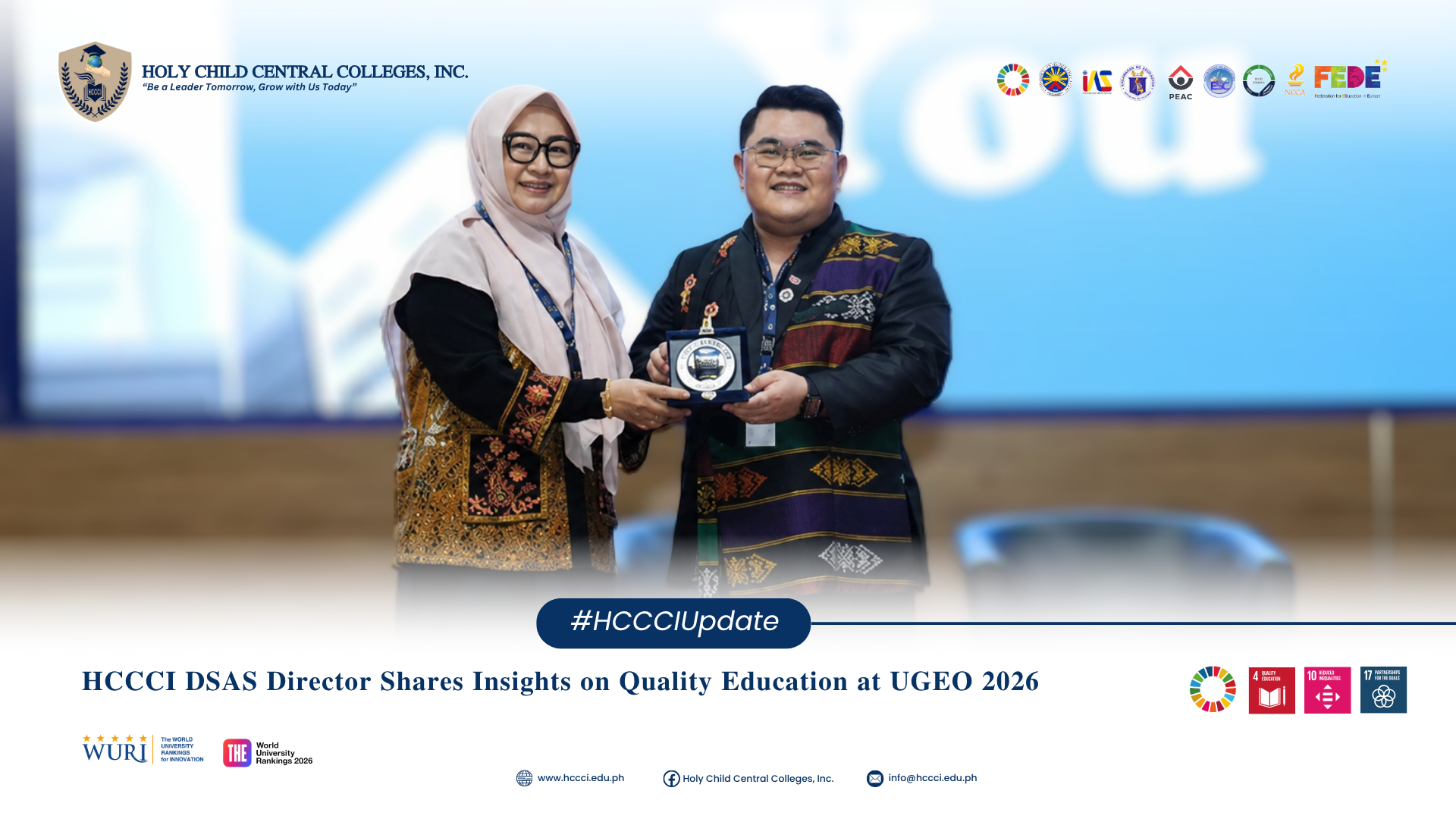
𝐇𝐂𝐂𝐂𝐈 𝐃𝐒𝐀𝐒 𝐃𝐢𝐫𝐞𝐜𝐭𝐨𝐫 𝐒𝐡𝐚𝐫𝐞𝐬 𝐈𝐧𝐬𝐢𝐠𝐡𝐭𝐬 𝐨𝐧 𝐐𝐮𝐚𝐥𝐢𝐭𝐲 𝐄𝐝𝐮𝐜𝐚𝐭𝐢𝐨𝐧 𝐚𝐭 𝐔𝐆𝐄𝐎 𝟐𝟎𝟐𝟔
BANDUNG, INDONESIA — Mark Laurence J. Fano, LPT, MALT, CHRA, Director of the Department of Student Affairs and Services (DSAS) of Holy Child Central Colleges, Inc. (HCCCI), shared a student-centered perspective on quality education as one of the guest lecturers during the 4th UNISBA Global Student Motion (UGEO) 2026 held at Universitas Islam Bandung (UNISBA) in Bandung, Indonesia.

Fano served as one of the featured speakers during the UGEO Guest Lecturer: Quality Education session on August 24, 2026, where he delivered his presentation, “Abot-Malay, Abot-Dama, Abot-Kaya: From Access to Quality.” The presentation explored the importance of moving beyond educational access toward learning environments that provide students with meaningful opportunities, appropriate support, and pathways for personal and academic development.

In his discussion, Fano emphasized that access to education is only the starting point. While providing learners with opportunities to enter educational institutions remains essential, quality education also requires systems that enable students to participate, develop their potential, overcome barriers, and successfully complete their educational journey.

Drawing from his work in student affairs and services, Fano highlighted the importance of a student-centered approach to education. He emphasized that students have different backgrounds, circumstances, aspirations, and developmental needs, requiring institutions to establish support mechanisms that respond to learners not only as students but as individuals.
The discussion also underscored the role of student affairs and services in contributing to educational quality. Student welfare, engagement, leadership development, inclusion, participation, and personal growth complement academic instruction and contribute to creating a learning environment where students can thrive.
Through the presentation, participants were encouraged to consider how educational institutions can create conditions where students feel supported and empowered to become active members of their communities. Beyond academic achievement, quality education involves developing learners who are confident, socially aware, capable of collaboration, and prepared to contribute meaningfully to society.
The session also featured Ms. Karen Anne E. San Pedro, MEd, MAEd, who presented “The Mover: How Youth Action Drives Inclusive Education,” and M. Imam Pamungkas, S.Pd.I., M.Ag., Ph.D., who discussed “Beyond Knowledge: Educating for Humanity.” The presentations were followed by an open discussion and question-and-answer session, allowing participants to exchange perspectives on inclusive education, youth participation, and the broader purpose of learning.
The international setting of UGEO 2026 provided an important dimension to the discussion. Students and academic representatives from different countries gathered to share experiences and perspectives, creating an environment where participants could better understand the diverse educational realities of young people across different communities.
Anchored on the theme “Next-Gen Changemaker: Youth Action for Inclusive Learning and Sustainable Cities,” UGEO 2026 positioned young people as important contributors to addressing contemporary educational and social challenges. The program encouraged participants to engage in meaningful dialogue, develop intercultural understanding, and explore ways education can contribute to sustainable and inclusive communities.
For Fano, the engagement provided an opportunity to share perspectives from the Philippine educational context while learning from international participants and fellow speakers. His presentation demonstrated how student affairs and services can contribute to broader conversations on quality education and how institutions can strengthen student support as part of their overall educational strategy.
Fano’s participation also reflects HCCCI’s continuing efforts to provide its academic and student affairs leaders with opportunities to engage in international knowledge exchange and professional collaboration. By participating in global academic platforms, HCCCI contributes its own experiences while gaining perspectives that can inform institutional practices and student development initiatives.
The engagement advances Sustainable Development Goal 4: Quality Education by promoting inclusive, meaningful, and learner-centered educational experiences. It also supports SDG 10: Reduced Inequalities by emphasizing responsive educational support for learners with diverse circumstances and needs, while contributing to SDG 17: Partnerships for the Goals through international exchange and collaboration among educational institutions, educators, and students.
For HCCCI, quality education means more than opening the doors of an institution to learners. It means creating an environment where students are given the support, opportunities, and confidence to succeed once they enter those doors.
Fano’s presentation in Bandung reinforced this perspective by connecting access, student support, inclusion, and empowerment as important elements of a meaningful educational experience. His participation likewise demonstrated how student affairs leadership can contribute to international conversations on the future of education and the development of globally aware and socially responsible learners.
Through its participation in the 4th UNISBA Global Student Motion 2026, HCCCI continues to strengthen its commitment to internationalization, quality education, and holistic student development. By bringing its people and perspectives into international spaces, the institution continues to build meaningful connections that enrich learning and contribute to a broader vision of education—one that is accessible, inclusive, student-centered, and empowering.
Ultimately, the message shared by Fano at UGEO 2026 reflects a simple but important principle: education should not end with access. It should create the conditions for every learner to learn, participate, grow, and thrive.