𝐇𝐂𝐂𝐂𝐈 𝐑𝐞𝐬𝐞𝐚𝐫𝐜𝐡 𝐀𝐝𝐯𝐚𝐧𝐜𝐞𝐬 𝐒𝐭𝐫𝐚𝐭𝐞𝐠𝐢𝐜 𝐅𝐚𝐜𝐮𝐥𝐭𝐲 𝐃𝐞𝐯𝐞𝐥𝐨𝐩𝐦𝐞𝐧𝐭 𝐚𝐧𝐝 𝐓𝐞𝐚𝐜𝐡𝐞𝐫 𝐑𝐞𝐭𝐞𝐧𝐭𝐢𝐨𝐧
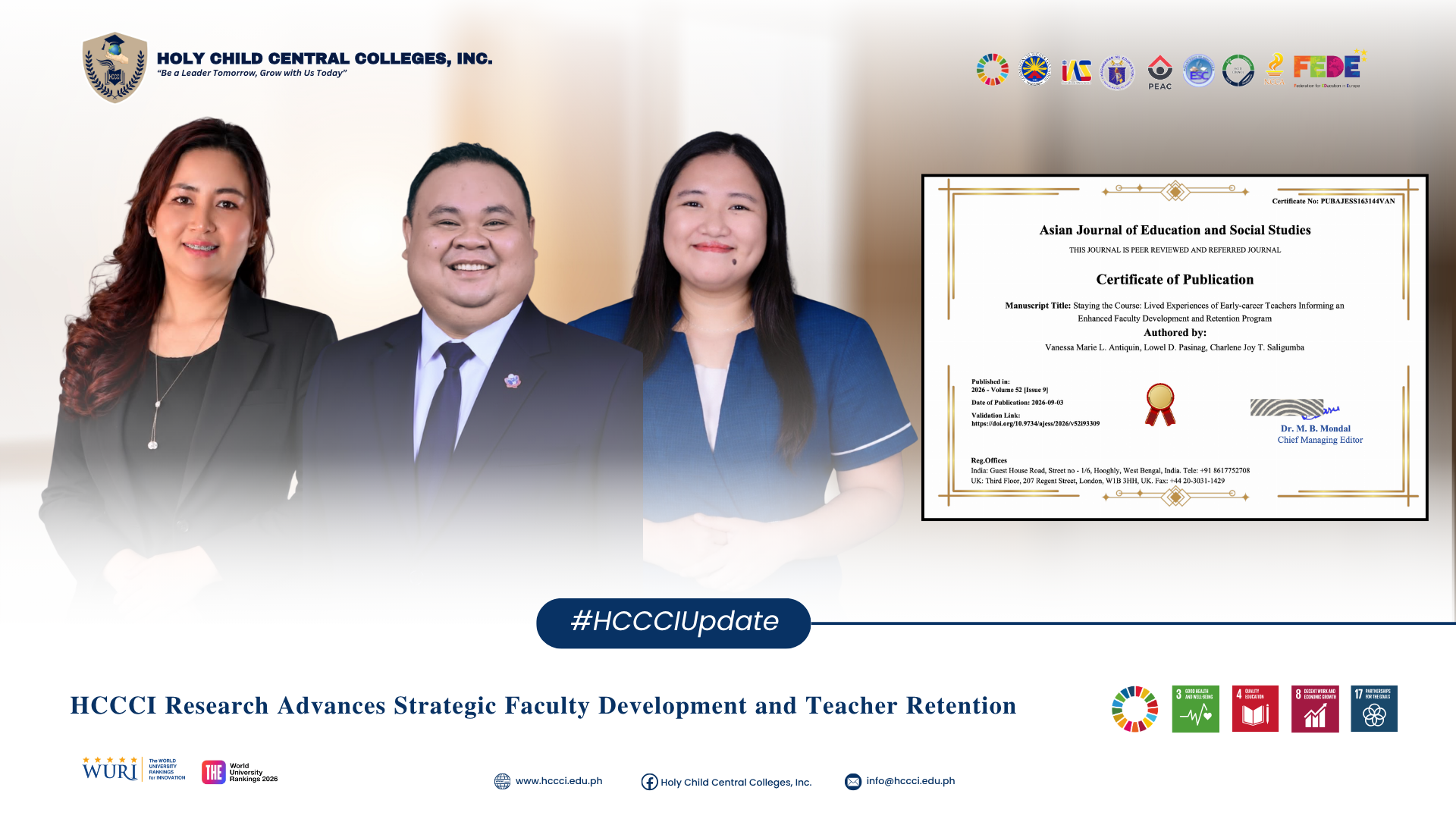
Holy Child Central Colleges, Inc. (HCCCI) strengthened its research-driven approach to faculty development with the September 3, 2026 publication of the study “Staying the Course: Lived Experiences of Early-career Teachers Informing an Enhanced Faculty Development and Retention Program” in the Asian Journal of Education and Social Studies.
Authored by Vanessa Marie L. Antiquin, MMEM; Lowel D. Pasinag, LPT, MMEM; and Charlene Joy T. Saligumba, LPT, the study examines the lived experiences of early-career teachers and the personal, professional, and organizational factors that influence their decision to remain in or leave the teaching profession.
The research identifies several factors affecting teacher retention, including role overload, mentoring needs, emotional demands, professional isolation, administrative support, and professional purpose. Its findings point to an important institutional lesson: retaining teachers requires more than recruitment. It requires systems that support educators as they transition into the profession, develop their practice, and build sustainable careers.
One of the study’s key outputs is the Enhanced Faculty Development and Retention Program (EFDRP), an evidence-informed framework designed to translate the research findings into practical institutional strategies. The framework focuses on teacher mentoring and coaching, workload management and role clarification, responsive instructional leadership, and faculty recognition and wellness.
For HCCCI, the significance of the research lies in its movement from evidence to action. Rather than treating research as an academic output alone, the study provides a framework that can inform institutional planning, strengthen faculty support systems, and guide initiatives that promote professional growth, well-being, and long-term teacher retention.
The implications extend directly to students. Teachers who are adequately supported, professionally developed, and equipped to manage the demands of their roles are better positioned to provide consistent and responsive learning experiences. Strengthening the teaching workforce therefore contributes not only to employee well-being but also to the quality, continuity, and sustainability of student learning.
The study also contributes to the wider conversation on teacher retention, particularly among private basic education institutions. Its findings and proposed framework may provide useful reference points for education leaders, researchers, and schools seeking practical approaches to faculty development, workplace support, and teacher sustainability.
The publication further strengthens HCCCI’s emerging culture of research, innovation, and evidence-informed decision-making. By generating research from institutional realities and translating findings into actionable frameworks, the institution demonstrates how academic inquiry can contribute directly to organizational improvement and educational practice.
The study aligns with the United Nations Sustainable Development Goals, particularly SDG 4: Quality Education through stronger faculty development and teaching practice; SDG 8: Decent Work and Economic Growth through more sustainable and supportive working conditions for educators; SDG 3: Good Health and Well-being through its emphasis on faculty wellness and recognition; and SDG 17: Partnerships for the Goals through knowledge-sharing and opportunities for collaboration among schools, researchers, and education stakeholders.
Through the EFDRP, HCCCI demonstrates a research-to-practice approach in which evidence informs action, action strengthens people, and stronger educators contribute to stronger learning environments.
The publication marks another step in HCCCI’s continuing effort to build an institution where research is not confined to academic journals, but becomes a practical tool for improving systems, supporting educators, and creating better learning experiences for students.