𝐔𝐩𝐡𝐨𝐥𝐝𝐢𝐧𝐠 𝐅𝐚𝐢𝐫 𝐂𝐨𝐦𝐩𝐞𝐧𝐬𝐚𝐭𝐢𝐨𝐧 𝐓𝐡𝐫𝐨𝐮𝐠𝐡 𝐈𝐧𝐭𝐞𝐠𝐫𝐢𝐭𝐲 𝐚𝐧𝐝 𝐂𝐨𝐦𝐩𝐥𝐢𝐚𝐧𝐜𝐞
Holy Child Central Colleges, Inc. (HCCCI) upholds its commitment to fair, lawful, and equitable compensation by ensuring that employee salaries are established and adjusted in accordance with applicable labor laws, government-mandated wage orders, and institutional policies. Guided by its commitment to integrity, HCCCI implements its School Policy Manual as the primary reference for salary administration, ensuring that compensation policies are consistently observed and properly implemented.
Under Sections 2.1 and 2.8 of the HCCCI School Policy Manual, salaries are determined based on employees' qualifications, training, experience, responsibilities, and position, while adjustments are made in accordance with government-mandated wage orders, changes in employment status, performance evaluations, ranking and promotion, and appointment to higher positions. Furthermore, the institution's Salary Scale Committee, composed of representatives from the Academic, Administrative, Finance, Human Resource, and Quality Assurance offices, is responsible for reviewing and recommending improvements to salary rates in consideration of prevailing economic conditions and the concerns of relevant stakeholders. To reinforce accountability and institutional integrity, HCCCI regularly evaluates its policies and strictly implements the provisions of its School Policy Manual to promote consistency, transparency, and compliance with applicable regulations. In addition to salaries, the institution provides legally mandated benefits, including 13th-month pay, maternity and paternity leave, SSS, PhilHealth, and Pag-IBIG membership, as well as retirement benefits and other institutional benefits that support employee welfare and financial security.
Through these established policies, review mechanisms, and implementation practices, HCCCI demonstrates its commitment to protecting employee welfare, upholding fair compensation practices, and ensuring that its salary administration remains responsive to legal requirements and prevailing economic conditions.
𝐈𝐧𝐬𝐭𝐢𝐭𝐮𝐭𝐢𝐨𝐧𝐚𝐥 𝐂𝐨𝐦𝐦𝐢𝐭𝐦𝐞𝐧𝐭 𝐭𝐨 𝐄𝐦𝐩𝐥𝐨𝐲𝐞𝐞𝐬’ 𝐅𝐫𝐞𝐞𝐝𝐨𝐦 𝐨𝐟 𝐀𝐬𝐬𝐨𝐜𝐢𝐚𝐭𝐢𝐨𝐧, 𝐑𝐞𝐩𝐫𝐞𝐬𝐞𝐧𝐭𝐚𝐭𝐢𝐨𝐧, 𝐚𝐧𝐝 𝐅𝐚𝐢𝐫 𝐓𝐫𝐞𝐚𝐭𝐦𝐞𝐧𝐭
At Holy Child Central Colleges, Inc. (HCCCI), integrity, trust, and accountability serve as guiding principles in promoting a fair, inclusive, and respectful working environment. Anchored in its STAIRS Core Values, particularly Integrity and Trust and Accountability and Discipline, HCCCI upholds the consistent and transparent implementation of its School Policy Manual to protect employees’ rights, promote fair representation, and ensure that personnel policies and workplace practices are applied equitably across the institution.
HCCCI upholds every employee’s right to self-organization, representation, and fair treatment, as guaranteed by the Philippine Constitution and the Labor Code. This right extends equally to all personnel, including women and international staff, regardless of position, sex, or nationality. We believe a just workplace begins with the freedom of every employee to associate and to be represented.
This commitment is built into our leadership structure. The Administrative Director is formally mandated to plan, organize, and direct employment practices and matters relating to labor laws and social legislation. The Director must also ensure that policies on personnel welfare are observed across the institution, so that compliance is a defined responsibility of the institution’s leadership.
HCCCI also gives employees clear channels to be heard. A dedicated Grievance Committee, composed of the Administrative/Academic Director, the Quality Assurance Officer, and the Unit Head concerned, provides a formal and impartial process for settling complaints and ensures that employees are heard on matters affecting their welfare and working relationships. Faculty representatives take part in the Faculty Ranking Committee, both teaching and non-teaching personnel may appeal ranking decisions, and the Administrative Council serves as a consultative body on personnel affairs and welfare. Through these structures, HCCCI fosters a workplace where every employee can organize, speak up, and take part in shaping the institution. By holding firmly to its Policy Manual and its core values, HCCCI keeps every voice within its community respected, protected, and heard.
𝐂𝐨𝐦𝐦𝐢𝐭𝐦𝐞𝐧𝐭 𝐭𝐨 𝐄𝐪𝐮𝐚𝐥 𝐎𝐩𝐩𝐨𝐫𝐭𝐮𝐧𝐢𝐭𝐲, 𝐍𝐨𝐧-𝐃𝐢𝐬𝐜𝐫𝐢𝐦𝐢𝐧𝐚𝐭𝐢𝐨𝐧, 𝐚𝐧𝐝 𝐅𝐚𝐢𝐫 𝐄𝐦𝐩𝐥𝐨𝐲𝐦𝐞𝐧𝐭 𝐏𝐫𝐚𝐜𝐭𝐢𝐜𝐞𝐬
At Holy Child Central Colleges, Inc. (HCCCI), integrity, fairness, and respect guide the institution’s employment practices and its commitment to providing equal opportunities for all personnel. Anchored in its STAIRS Core Values, particularly Integrity and Trust, HCCCI ensures that its Policy Manual is regularly evaluated and consistently implemented to uphold transparent, equitable, and non-discriminatory standards throughout the employment process. The institution prohibits discrimination based on religion, sex, gender, sexuality, age, or background, in accordance with the Philippine Constitution, the Labor Code, the Magna Carta of Women, the Anti-Age Discrimination in Employment Act, and the Safe Spaces Act. The Administrative Director is responsible for ensuring that employment practices comply with applicable labor laws and social legislation, that established hiring procedures are properly observed, and that policies promoting personnel welfare are upheld.
fairness is built into every stage of employment. HCCCI follows a structured hiring process in which applicants go through a second interview and a panel interview conducted by the Academic and Administrative Directors. These steps assess work values, professional ethics, attitudes toward peers and superiors, and commitment to the institution’s vision and mission. Once hired, all personnel take part in the same induction program and have equal access to development programs. The HCCCI Code of Ethics further requires personnel to acknowledge the competence and good work of colleagues, to avoid remarks that create intrigue or ill feeling, and to keep confidential any information entrusted to them.
When concerns arise, employees are encouraged to raise them with the persons concerned through the proper channels. If open dialogue does not resolve the issue, a dedicated Grievance Committee, composed of the Administrative/Academic Director, the Quality Assurance Officer, and the Unit Head concerned, provides a formal process for settling complaints and ensures that every aggrieved employee is heard. Through these policies and structures, HCCCI fosters a safe, respectful, and inclusive workplace where every employee is valued for their competence and character.
𝐈𝐧𝐬𝐭𝐢𝐭𝐮𝐭𝐢𝐨𝐧𝐚𝐥 𝐂𝐨𝐦𝐦𝐢𝐭𝐦𝐞𝐧𝐭 𝐭𝐨 𝐄𝐭𝐡𝐢𝐜𝐚𝐥 𝐄𝐦𝐩𝐥𝐨𝐲𝐦𝐞𝐧𝐭 𝐚𝐧𝐝 𝐭𝐡𝐞 𝐏𝐫𝐞𝐯𝐞𝐧𝐭𝐢𝐨𝐧 𝐨𝐟 𝐅𝐨𝐫𝐜𝐞𝐝 𝐋𝐚𝐛𝐨𝐫, 𝐌𝐨𝐝𝐞𝐫𝐧 𝐒𝐥𝐚𝐯𝐞𝐫𝐲, 𝐚𝐧𝐝 𝐂𝐡𝐢𝐥𝐝 𝐋𝐚𝐛𝐨𝐫
Upholding the rights and dignity of every worker is central to Holy Child Central Colleges, Inc.’s (HCCCI) employment standards. Through the consistent implementation and regular evaluation of its Policy Manual, the institution ensures that recruitment, appointment, and employment arrangements are lawful, voluntary, and free from exploitation. HCCCI strictly prohibits forced labor, modern slavery, human trafficking, and child labor, in accordance with the Philippine Labor Code, the Expanded Anti-Trafficking in Persons Act, and the law providing special protection to children against child labor and exploitation. The Administrative Director oversees the implementation of these standards by directing employment practices in compliance with labor laws and social legislation, as well as supervising the preparation of faculty and administrator contracts and appointments.
This commitment begins with a transparent and documented recruitment process. Vacancies are openly advertised with wide dissemination, and every applicant goes through a structured process of paper screening and an initial interview by Human Resources. Human Resources reviews each applicant's scholastic records, special trainings, and background information, followed by interviews with the Academic and Administrative Directors. This open, step-by-step process ensures that every person who joins HCCCI does so freely, with qualifications properly verified, and under clearly defined terms of employment.
HCCCI also safeguards the rights of employees throughout their service. The Policy Manual incorporates the Labor Code's provisions on regular, casual, and probationary employment and on termination. Probationary periods are limited by law, and the standards for regularization are made known to the employee at the time of engagement, protecting every worker's right to security of tenure and fair treatment. Through these policies, HCCCI affirms its commitment to lawful, humane, and ethical employment, where every person works by free choice and with full respect for their dignity.
𝐄𝐧𝐬𝐮𝐫𝐢𝐧𝐠 𝐅𝐚𝐢𝐫 𝐓𝐫𝐞𝐚𝐭𝐦𝐞𝐧𝐭 𝐚𝐧𝐝 𝐋𝐚𝐛𝐨𝐫 𝐒𝐭𝐚𝐧𝐝𝐚𝐫𝐝𝐬 𝐟𝐨𝐫 𝐃𝐢𝐫𝐞𝐜𝐭𝐥𝐲 𝐇𝐢𝐫𝐞𝐝 𝐚𝐧𝐝 𝐂𝐨𝐧𝐭𝐫𝐚𝐜𝐭𝐞𝐝 𝐖𝐨𝐫𝐤𝐞𝐫𝐬
Fair labor practices at Holy Child Central Colleges, Inc. (HCCCI) extend beyond directly employed personnel to include workers engaged through third-party service providers. Through the consistent implementation of its Policy Manual and adherence to the Philippine Labor Code, the institution recognizes its responsibilities in ensuring that all workers on campus receive the wages, benefits, and protections due to them, regardless of their employment arrangement. In particular, HCCCI observes legal provisions on contracting and subcontracting, which establish the responsibilities of the principal and its contractors toward agency-employed workers. The Administrative Director oversees employment practices in accordance with applicable labor laws and social legislation and ensures that personnel welfare policies are observed throughout the institution.
Personnel engaged through agencies are not treated as outsiders to the institution. The Policy Manual formally includes agency-provided security guards in HCCCI's organizational structure, alongside directly hired support personnel such as utility and maintenance staff. Their duties are clearly defined, their work is coordinated by the Prefect of Discipline, and their assignments come from the Administrative Director, the same office that oversees the welfare of all personnel. This means every worker on campus, regardless of how they are engaged, operates within defined roles, under accountable supervision, and within the reach of the institution's policies.
HCCCI holds itself to clear standards of fair compensation, committing to provide salaries in keeping with training, experience, and responsibility, in accordance with existing laws. It also commits to keep them comparable to those of other private educational institutions in South Cotabato and nearby provinces. By applying these standards to its own workforce and upholding Philippine labor law in its dealings with service providers, HCCCI makes sure that outsourcing a service never means outsourcing its responsibility to the people who perform it.
𝐏𝐫𝐨𝐦𝐨𝐭𝐢𝐧𝐠 𝐄𝐪𝐮𝐚𝐥 𝐏𝐚𝐲 𝐓𝐡𝐫𝐨𝐮𝐠𝐡 𝐓𝐫𝐚𝐧𝐬𝐩𝐚𝐫𝐞𝐧𝐭 𝐚𝐧𝐝 𝐌𝐞𝐫𝐢𝐭-𝐁𝐚𝐬𝐞𝐝 𝐂𝐨𝐦𝐩𝐞𝐧𝐬𝐚𝐭𝐢𝐨𝐧 𝐏𝐫𝐚𝐜𝐭𝐢𝐜𝐞𝐬
Fair and equitable compensation is upheld through HCCCI’s commitment to ensuring that salary decisions are based on objective and consistently applied employment criteria. Its Policy Manual provides that salaries shall reflect an employee’s training, experience, and responsibilities, while remaining compliant with applicable laws and comparable to those offered by other private educational institutions in South Cotabato and nearby provinces, according to rank. By establishing compensation based on professional qualifications and position-related merit, rather than gender, age, or personal background, HCCCI promotes equal pay and non-discriminatory salary practices consistent with the Labor Code’s prohibition against wage discrimination and the Magna Carta of Women.
Pay structures at HCCCI are regularly reviewed by a dedicated Salary Scale Committee, chaired by the Administrative Director, with the Finance Officer, Human Resource Officer, and Quality Assurance Officer as members. The Committee reviews and proposes upgrades to salary rates in relation to the current economic situation. It also prepares revisions to the salary scale with due consultation of all concerned sectors and submits its recommendations to the School President. This keeps the salary scale transparent, consultative, and subject to periodic evaluation.
Fairness is reinforced through a structured ranking system that governs how employees advance in pay. The Faculty Ranking Committee, which includes a Faculty Representative, recommends the rank of new appointees and the promotion of faculty members only when they conform to the criteria in the approved school policy on rank and tenure. The Ranking Committee for Non-Teaching Personnel reviews and updates its own ranking norms and tools. Both committees hear appeals in cases of dissent, so that any employee who believes their rank does not reflect their merit has a clear avenue for review. Through these policies, HCCCI keeps salaries, promotions, and adjustments based on clear and consistent criteria that apply equally to all employees.
𝐄𝐧𝐬𝐮𝐫𝐢𝐧𝐠 𝐏𝐚𝐲 𝐄𝐪𝐮𝐢𝐭𝐲 𝐓𝐡𝐫𝐨𝐮𝐠𝐡 𝐑𝐞𝐠𝐮𝐥𝐚𝐫 𝐒𝐚𝐥𝐚𝐫𝐲 𝐑𝐞𝐯𝐢𝐞𝐰𝐬 𝐚𝐧𝐝 𝐓𝐫𝐚𝐧𝐬𝐩𝐚𝐫𝐞𝐧𝐭 𝐂𝐨𝐦𝐩𝐞𝐧𝐬𝐚𝐭𝐢𝐨𝐧 𝐎𝐯𝐞𝐫𝐬𝐢𝐠𝐡𝐭
Maintaining fairness in compensation requires more than establishing equitable salary standards; it also calls for regular evaluation and institutional oversight. Holy Child Central Colleges, Inc. (HCCCI) upholds this commitment through its Policy Manual, which establishes a rank-based salary structure that considers each employee’s training, experience, and responsibilities in accordance with applicable laws. By applying consistent compensation criteria to employees holding the same rank, the institution promotes transparency and helps ensure that salary differences are based on objective professional qualifications rather than personal circumstances. This approach supports the principles of equal pay and non-discrimination embodied in the Labor Code and the Magna Carta of Women.
Oversight of the salary scale rests with a dedicated Salary Scale Committee, chaired by the Administrative Director, with the Finance Officer, the Human Resource Officer, and the Quality Assurance Officer as members. The Committee reviews and proposes upgrades to salary rates in relation to the current economic situation. It also prepares revisions to the salary scale with due consultation of all concerned sectors and submits its recommendations to the School President. The participation of the Quality Assurance Officer and the Human Resource Officer means the institution’s pay structure is examined from the perspectives of both compliance and personnel management.
Movement within the pay scale is governed by formal ranking committees. The Faculty Ranking Committee, which includes a Faculty Representative, recommends the rank of new appointees and faculty promotions according to the criteria in the approved school policy on rank and tenure. The Ranking Committee for Non-Teaching Personnel regularly reviews, revises, and updates its norms and tools for personnel ranking. Both committees hear appeals in cases of dissent, giving every employee a clear avenue to question a rank or pay decision they believe is unfair. Through these mechanisms, HCCCI keeps its pay scale under consistent institutional review, applied by the same criteria to every employee.
𝐏𝐫𝐨𝐯𝐢𝐝𝐢𝐧𝐠 𝐓𝐫𝐚𝐧𝐬𝐩𝐚𝐫𝐞𝐧𝐭 𝐆𝐫𝐢𝐞𝐯𝐚𝐧𝐜𝐞, 𝐃𝐢𝐬𝐜𝐢𝐩𝐥𝐢𝐧𝐚𝐫𝐲, 𝐚𝐧𝐝 𝐀𝐩𝐩𝐞𝐚𝐥𝐬 𝐌𝐞𝐜𝐡𝐚𝐧𝐢𝐬𝐦𝐬 𝐟𝐨𝐫 𝐄𝐦𝐩𝐥𝐨𝐲𝐞𝐞𝐬
Accountability in the workplace is strengthened when employees have accessible and impartial mechanisms for expressing concerns and seeking redress. Holy Child Central Colleges, Inc. (HCCCI), through its Policy Manual, provides formal procedures for addressing matters involving employee rights, welfare, working relationships, and compensation. Employees are initially encouraged to resolve concerns through open communication with the parties involved. If these efforts do not lead to a resolution, employees may elevate their concerns to the Grievance Committee, composed of the Administrative/Academic Director, the Quality Assurance Officer, and the Unit Head concerned. The Committee follows an established process for handling complaints and ensures that employees are given an opportunity to present their concerns and be heard in matters affecting their welfare and relationship with the school administration.
Fairness is equally upheld when employees face disciplinary matters. The Ethics Committee is chaired by the Administrative Director, with the Academic Director, the Quality Assurance Officer, and the Human Resource Officer as members. It hears formal complaints on matters of employee discipline, studies, reviews, and deliberates on each case, and determines its merits before recommending any action to the School President. This keeps decisions affecting an employee’s standing based on a careful, collective review rather than the judgment of a single individual. The Committee also makes recommendations for the enhancement of employees’ professionalism.
Employees also have a direct avenue to appeal decisions affecting their rank and pay. Faculty members may seek reconsideration of rank promotion decisions through the Faculty Ranking Committee, which reviews the appeal and forwards its findings to the Office of the President. Non-teaching personnel may appeal through the Ranking Committee for Non-Teaching Personnel. Because salaries at HCCCI are tied to rank, these appeals give every employee a formal way to question pay-related decisions. Through these mechanisms, HCCCI ensures that concerns about employee rights and compensation are handled transparently, lawfully, and with respect.
𝐏𝐫𝐨𝐭𝐞𝐜𝐭𝐢𝐧𝐠 𝐄𝐦𝐩𝐥𝐨𝐲𝐞𝐞𝐬’ 𝐋𝐚𝐛𝐨𝐫 𝐑𝐢𝐠𝐡𝐭𝐬 𝐓𝐡𝐫𝐨𝐮𝐠𝐡 𝐅𝐫𝐞𝐞𝐝𝐨𝐦 𝐨𝐟 𝐀𝐬𝐬𝐨𝐜𝐢𝐚𝐭𝐢𝐨𝐧, 𝐆𝐫𝐢𝐞𝐯𝐚𝐧𝐜𝐞 𝐏𝐫𝐨𝐜𝐞𝐝𝐮𝐫𝐞𝐬, 𝐚𝐧𝐝 𝐃𝐮𝐞 𝐏𝐫𝐨𝐜𝐞𝐬𝐬
Respect for employees’ labor rights is fundamental to maintaining a fair, accountable, and secure working environment. Through the consistent implementation of its Policy Manual, Holy Child Central Colleges, Inc. (HCCCI) upholds the rights of all personnel to self-organization, freedom of association, and collective bargaining, as guaranteed by the Philippine Constitution and the Labor Code. These protections apply equally to employees regardless of their position, sex, or nationality, including women and international staff. The Administrative Director is responsible for overseeing employment practices in accordance with labor laws and social legislation and ensuring that institutional policies concerning employee rights and welfare are properly observed.
These rights are protected by clear procedures for being heard. Employees who raise concerns on matters affecting their welfare and their working relationship with the administration may bring them to the Grievance Committee. It is composed of the Administrative/Academic Director, the Quality Assurance Officer, and the Unit Head concerned, and it lays down a formal process for settling complaints and ensures that every aggrieved employee is heard. In disciplinary matters, the Ethics Committee, chaired by the Administrative Director with the Academic Director, the Quality Assurance Officer, and the Human Resource Officer as members, hears formal complaints and determines their merits before making any recommendation to the School President.
HCCCI also guarantees due process and security of tenure, in line with the Labor Code provisions incorporated in its Policy Manual. No employee may be dismissed for just cause without a written notice stating the grounds and a reasonable opportunity to explain. The employee is also entitled to a hearing or conference to respond to the charges, present evidence, and be assisted by counsel if they wish. For authorized causes, written notice must be served on both the employee and the Department of Labor and Employment at least thirty days in advance. Workers engaged through contracting arrangements are likewise protected from dismissal before their contract ends, except for cause and with due process. Through these safeguards, HCCCI ensures that every employee can exercise their labor rights with confidence and without fear.
𝐇𝐂𝐂𝐂𝐈'𝐬 𝐒𝐮𝐬𝐭𝐚𝐢𝐧𝐞𝐝 𝐈𝐧𝐯𝐞𝐬𝐭𝐦𝐞𝐧𝐭 𝐢𝐧 𝐄𝐦𝐩𝐥𝐨𝐲𝐞𝐞 𝐒𝐚𝐥𝐚𝐫𝐢𝐞𝐬 𝐚𝐧𝐝 𝐂𝐨𝐦𝐩𝐞𝐧𝐬𝐚𝐭𝐢𝐨𝐧
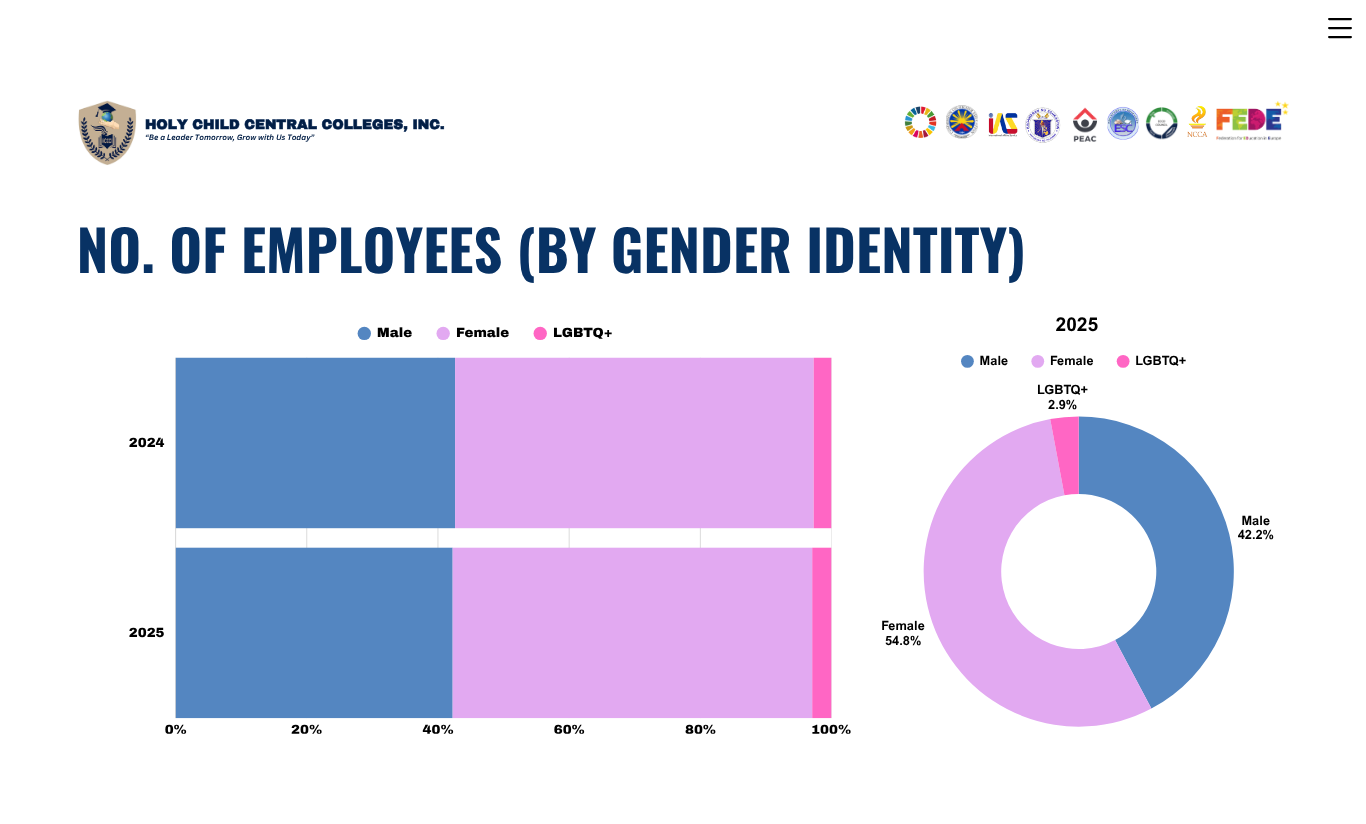
Providing employment opportunities and maintaining a diverse workforce remain important priorities of Holy Child Central Colleges, Inc. (HCCCI). Across Academic Years 2023–2024 to 2025–2026, the institution recorded a cumulative total of 509 employees, comprising 155 personnel in 2023–2024, 178 in 2024–2025, and 176 in 2025–2026 based on the consolidated unit figures. These employees are distributed across Basic Education, College, and Support Services, contributing to the delivery of quality education and the institution's essential administrative operations. Through continuous recruitment, workforce planning, and personnel development, HCCCI sustains employment opportunities for qualified professionals and support personnel while strengthening its organizational capacity. These efforts reflect the institution's commitment to productive employment, workforce development, and inclusive economic growth.
Beyond workforce expansion, HCCCI recognizes the importance of creating an environment where employees can develop their professional capabilities and contribute meaningfully to institutional progress. Through the engagement of qualified personnel across its academic and administrative departments, the institution supports the continuity of educational services, strengthens operational efficiency, and promotes opportunities for professional growth. By investing in human resources and maintaining employment opportunities across different sectors of its operations, HCCCI contributes to local economic activity and livelihood generation. These initiatives reinforce its commitment to building a productive, capable, and sustainable workforce while advancing decent work and inclusive economic development.
𝐖𝐨𝐫𝐤𝐟𝐨𝐫𝐜𝐞 𝐂𝐨𝐦𝐩𝐨𝐬𝐢𝐭𝐢𝐨𝐧 𝐚𝐧𝐝 𝐀𝐜𝐚𝐝𝐞𝐦𝐢𝐜 𝐄𝐦𝐩𝐥𝐨𝐲𝐦𝐞𝐧𝐭
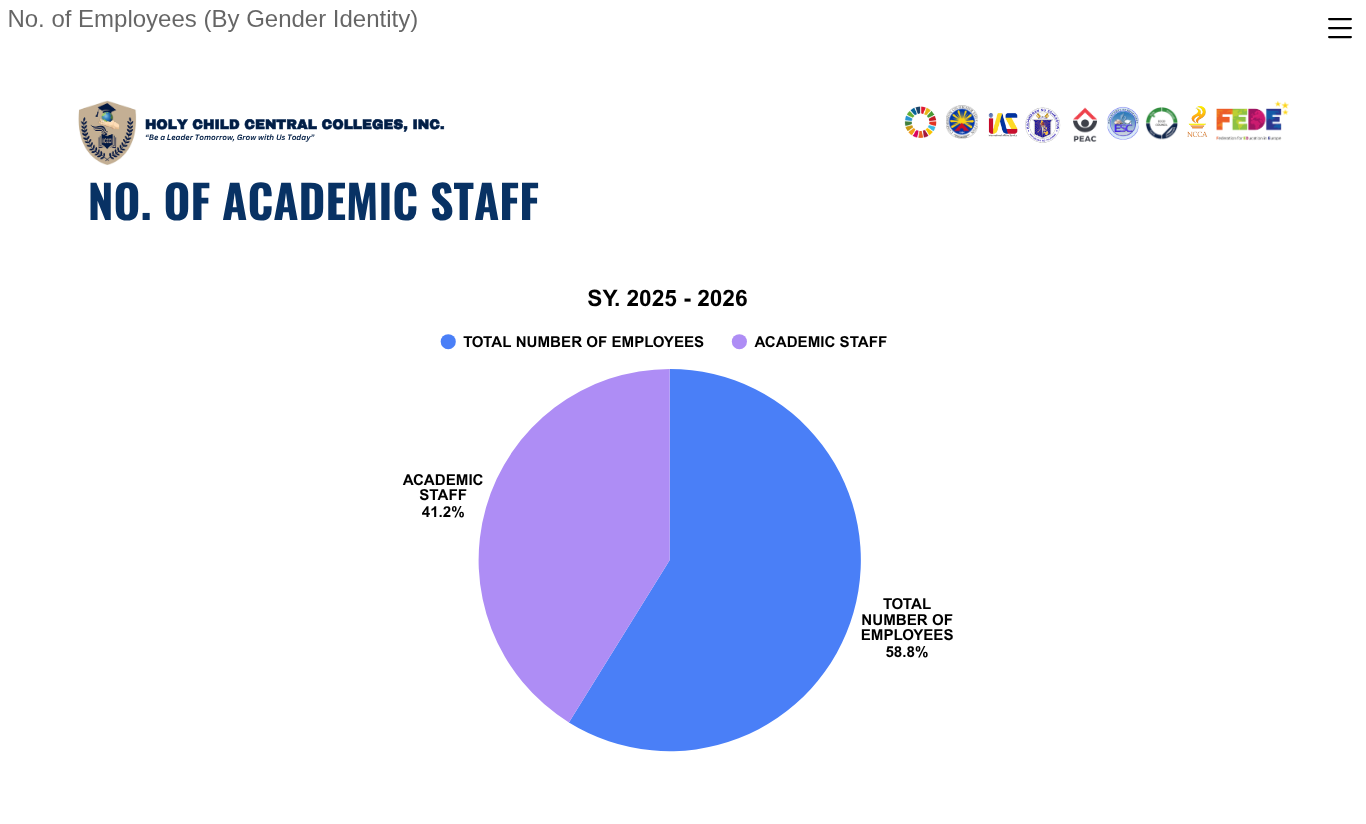
A well-structured workforce is essential to sustaining quality education and effective institutional operations. With a total of 509 employees, Holy Child Central Colleges, Inc. (HCCCI) maintains a diverse pool of academic and non-academic personnel who fulfill complementary roles in instruction, research, administration, and institutional support. This workforce composition demonstrates the institution's capacity to generate employment opportunities, strengthen its academic services, and sustain the personnel requirements necessary for continuous institutional development.
Of the total workforce, 356 are academic staff, representing approximately 69.94% of all employees. These personnel play a central role in delivering instruction, developing academic programs, conducting research, and supporting student learning and development. Their contributions help ensure the quality and continuity of educational services while strengthening the institution's academic capabilities. The remaining 153 employees, or approximately 30.06%, support administrative, technical, and other essential institutional operations.
Through its workforce structure and continued engagement of academic and support personnel, HCCCI promotes productive employment and strengthens its capacity to deliver sustainable educational services. By providing employment opportunities across different professional functions, the institution contributes to workforce development, livelihood generation, and local economic activity. These efforts align with SDG 8: Decent Work and Economic Growth, particularly Target 8.3, which encourages productive activities, entrepreneurship, innovation, and the growth of enterprises through policies that support decent job creation and sustainable economic development.
𝐄𝐦𝐩𝐥𝐨𝐲𝐞𝐞 𝐒𝐚𝐥𝐚𝐫𝐲 𝐄𝐱𝐩𝐞𝐧𝐝𝐢𝐭𝐮𝐫𝐞 𝐚𝐧𝐝 𝐈𝐧𝐬𝐭𝐢𝐭𝐮𝐭𝐢𝐨𝐧𝐚𝐥 𝐈𝐧𝐯𝐞𝐬𝐭𝐦𝐞𝐧𝐭 𝐩𝐞𝐫 𝐄𝐦𝐩𝐥𝐨𝐲𝐞𝐞
Investing in employee compensation is an essential part of maintaining a stable and productive workforce. From 2022 to 2025, Holy Child Central Colleges, Inc. (HCCCI) allocated a cumulative ₱131,828,202.04 for employee salaries, reflecting the institution's financial commitment to compensating its faculty members, administrative personnel, and support staff. The annual salary expenditures amounted to ₱18,842,512.00 in 2022, ₱39,769,449.51 in 2023, ₱37,459,595.28 in 2024, and ₱35,756,645.25 in 2025.
These financial allocations demonstrate the resources directed toward supporting the institution's workforce and sustaining its academic and administrative operations. By consistently allocating funds for employee salaries, HCCCI recognizes the contributions of its personnel and reinforces the importance of fair compensation, financial security, and a supportive working environment. Employee salary expenditure also reflects how institutional resources are invested in human capital to maintain operational efficiency and the continuity of educational services.
Through its annual compensation allocations, HCCCI demonstrates its commitment to SDG 8: Decent Work and Economic Growth, particularly the indicator on Expenditure per Employee. Monitoring salary expenditures in relation to the size of its workforce provides a basis for assessing the institution's financial investment in its employees. This approach highlights the importance of directing institutional resources toward workforce welfare, sustainable employment, and inclusive economic development.
𝐏𝐫𝐨𝐦𝐨𝐭𝐢𝐧𝐠 𝐒𝐭𝐮𝐝𝐞𝐧𝐭 𝐄𝐦𝐩𝐥𝐨𝐲𝐦𝐞𝐧𝐭 𝐚𝐧𝐝 𝐄𝐜𝐨𝐧𝐨𝐦𝐢𝐜 𝐄𝐦𝐩𝐨𝐰𝐞𝐫𝐦𝐞𝐧𝐭
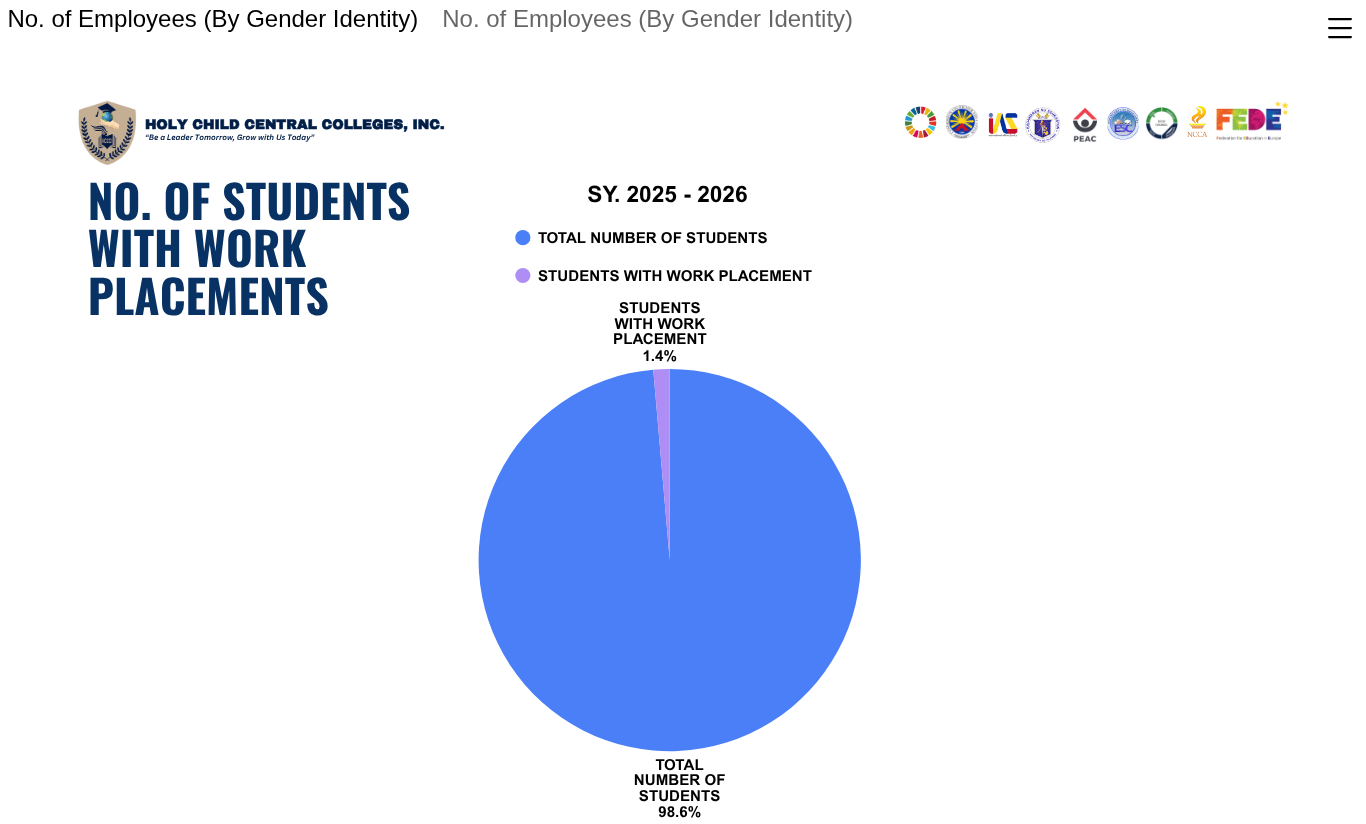
Providing students with opportunities to gain practical work experience while pursuing their education is an important part of Holy Child Central Colleges, Inc.'s (HCCCI) commitment to inclusive growth and workforce development. In 2025, out of 2,082 enrolled students, 29 were engaged in the Grant-in-Aid Student Assistantship Program, representing approximately 1.39% of the total student population. Through this initiative, qualified students were assigned to various offices and academic departments across the institution, including the Academic Office, College of Education, Library, IT Laboratory, Human Resources Office, Internationalization Office, Research Office, and TESDA Office.
Beyond providing financial assistance to help students meet their educational expenses, the program offers opportunities to develop practical workplace skills and professional competencies. Under the supervision of faculty members and designated office personnel, student assistants participate in administrative and academic support activities that strengthen their sense of responsibility, accountability, teamwork, and leadership. These experiences also help students develop time-management skills and learn to balance their academic responsibilities with workplace commitments.
The program supports SDG 8: Decent Work and Economic Growth, particularly the promotion of productive employment, skills development, and inclusive economic opportunities. By integrating supervised, campus-based work into student development, HCCCI provides a supportive environment where students can gain early employment experience while continuing their education. Through the Grant-in-Aid Student Assistantship Program, the institution helps reduce students' financial burdens, strengthens their work readiness, and prepares them to participate more effectively in the future labor market.
𝐒𝐞𝐜𝐮𝐫𝐞 𝐄𝐦𝐩𝐥𝐨𝐲𝐦𝐞𝐧𝐭 𝐏𝐫𝐚𝐜𝐭𝐢𝐜𝐞𝐬 𝐚𝐧𝐝 𝐖𝐨𝐫𝐤𝐟𝐨𝐫𝐜𝐞 𝐒𝐭𝐚𝐛𝐢𝐥𝐢𝐭𝐲
Maintaining secure employment and providing stable working arrangements are central to the workforce management practices of Holy Child Central Colleges, Inc. (HCCCI). Across Academic Years 2023–2024 to 2025–2026, the institution recorded a cumulative total of 509 employee records, comprising 155 employees in 2023–2024, 178 in 2024–2025, and 176 in 2025–2026. Based on the institution's employment classification, 100% of its reported workforce was covered by documented employment arrangements, including permanent, full-time, probationary, and fixed-term appointments. This reflects the institution's commitment to providing recognized employment status and maintaining an organized workforce structure.
These employment arrangements extend across HCCCI's major institutional units, namely Basic Education, College, and Support Services, ensuring that both academic and administrative operations are supported by qualified personnel. Faculty members contribute to instructional delivery, curriculum implementation, research, and student development, while administrative and support personnel facilitate the institution's daily operations and delivery of essential services. By maintaining personnel across these different functions, HCCCI sustains its institutional capacity while providing employment opportunities for professionals with diverse qualifications and areas of expertise.
To reinforce employment security, HCCCI implements established recruitment procedures, employment documentation, personnel evaluation, and institutional policies guided by applicable labor regulations and education-sector standards. These mechanisms promote transparency in employment arrangements, clarify employee responsibilities and entitlements, and support the protection of workers' rights. Through consistent workforce management and adherence to relevant employment requirements, HCCCI advances SDG 8: Decent Work and Economic Growth, particularly Target 8.5, which promotes full and productive employment, decent work, and equal opportunities for all. These practices demonstrate the institution's continuing commitment to workforce stability, employee welfare, and sustainable institutional development.