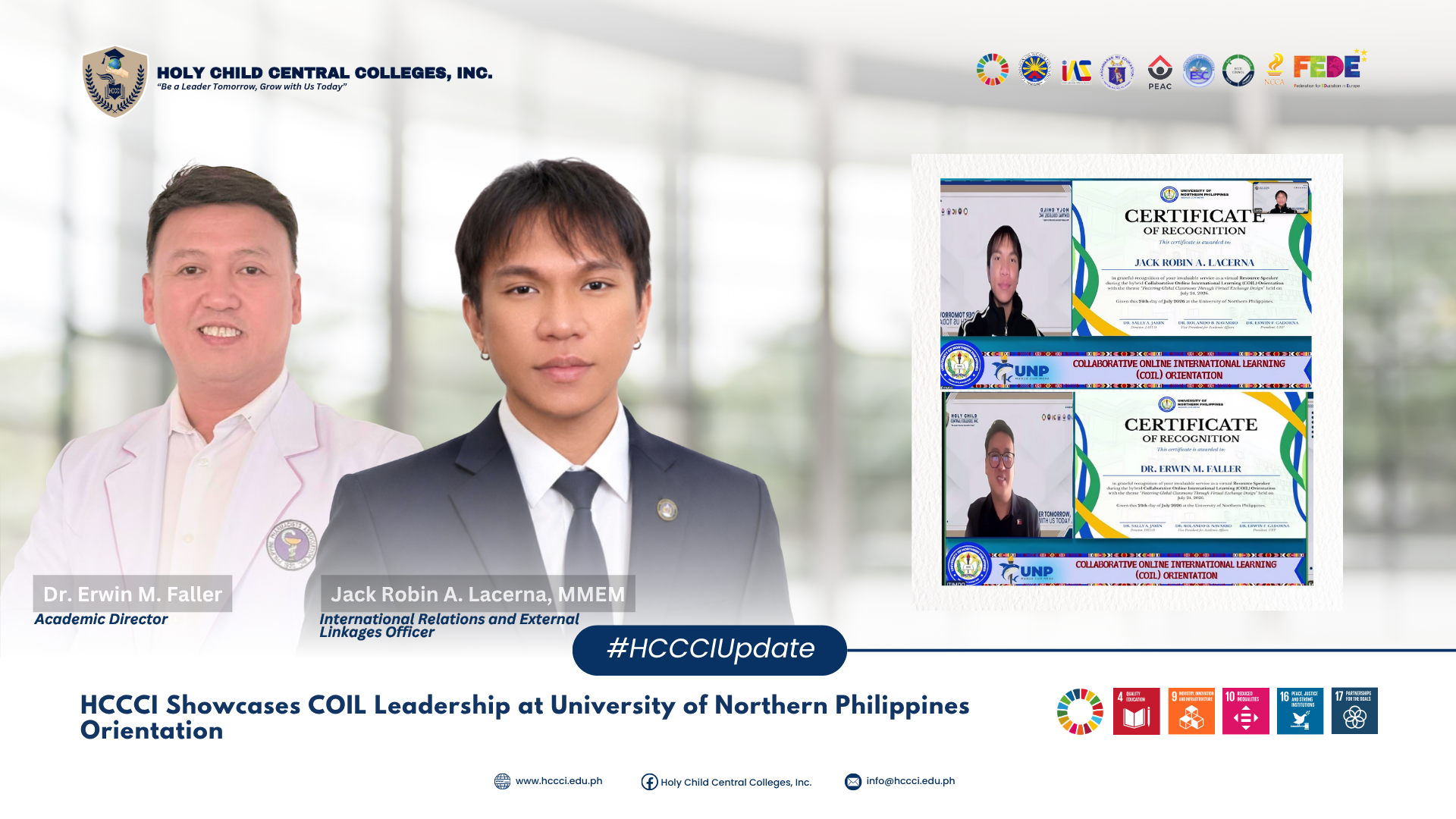
𝐇𝐂𝐂𝐂𝐈 𝐒𝐡𝐨𝐰𝐜𝐚𝐬𝐞𝐬 𝐂𝐎𝐈𝐋 𝐋𝐞𝐚𝐝𝐞𝐫𝐬𝐡𝐢𝐩 𝐚𝐭 𝐔𝐧𝐢𝐯𝐞𝐫𝐬𝐢𝐭𝐲 𝐨𝐟 𝐍𝐨𝐫𝐭𝐡𝐞𝐫𝐧 𝐏𝐡𝐢𝐥𝐢𝐩𝐩𝐢𝐧𝐞𝐬 𝐎𝐫𝐢𝐞𝐧𝐭𝐚𝐭𝐢𝐨𝐧
Holy Child Central Colleges, Inc. (HCCCI) reaffirmed its commitment to advancing internationalization as Dr. Erwin M. Faller, Academic Director, and Jack Robin Lacerna, MMEM, International Relations and External Linkages Officer, served as invited resource speakers during the "Fostering Global Classrooms through Virtual Exchange Design: COIL Orientation" hosted by the University of Northern Philippines (UNP) on July 24, 2026, at the UNP Tadena Hall. The program gathered administrators, faculty members, and internationalization practitioners to explore innovative approaches to teaching and learning through Collaborative Online International Learning (COIL).

The orientation was designed to deepen participants' understanding of COIL as an innovative educational approach that connects classrooms across institutions through technology. It emphasized the integration of international and intercultural perspectives into academic programs while fostering meaningful collaboration among educators and students. Through a series of learning sessions, participants gained practical knowledge on developing virtual exchange initiatives that enrich learning experiences, encourage academic innovation, and strengthen institutional partnerships.

The program featured distinguished academic leaders and internationalization advocates from various higher education institutions. Representing HCCCI were Dr. Erwin M. Faller, Academic Director, who served as a resource speaker on "Technical Member, COIL Bayanihan Network," and Jack Robin Lacerna, MMEM, International Relations and External Linkages Officer, who delivered the session on the "COIL Plan."
During their respective sessions, Dr. Faller highlighted the significance of the COIL Bayanihan Network in fostering collaboration among higher education institutions and strengthening academic partnerships that support internationalization initiatives. Meanwhile, Lacerna shared practical insights on planning and implementing Collaborative Online International Learning initiatives, emphasizing strategic partnerships, curriculum integration, and meaningful virtual engagement. Together, their presentations reflected HCCCI's growing experience in advancing internationalization and demonstrated how COIL can create accessible opportunities for academic collaboration, intercultural learning, and institutional development.
The activity advances several United Nations Sustainable Development Goals (SDGs) by promoting innovative and collaborative approaches to higher education. It directly supports SDG 4: Quality Education by encouraging technology-enabled, learner-centered, and internationally connected teaching practices that enhance educational quality and accessibility. It also contributes to SDG 9: Industry, Innovation and Infrastructure through the adoption of digital platforms and innovative instructional methodologies that transform the delivery of education. By creating opportunities for participants to engage with diverse cultures, perspectives, and institutions, the orientation reinforces SDG 10: Reduced Inequalities, making international learning experiences more accessible regardless of geographical or financial limitations. Moreover, it advances SDG 16: Peace, Justice and Strong Institutions by promoting intercultural dialogue, mutual respect, and strengthening institutional capacity for international engagement. Finally, the program exemplifies SDG 17: Partnerships for the Goals by bringing together higher education institutions to exchange expertise, build sustainable academic networks, and pursue shared aspirations in advancing quality education through Collaborative Online International Learning.
Beyond strengthening institutional capacity, the orientation contributes to cultivating educators who can create more inclusive, innovative, and culturally responsive learning environments. By encouraging collaboration across institutions and disciplines, the program helps prepare graduates with critical thinking, digital competence, intercultural communication skills, and the ability to work effectively with people from diverse backgrounds. These competencies contribute to building a more adaptive, innovative, and collaborative education sector that benefits communities and future generations.
Reflecting on the opportunity, Dr. Faller and Lacerna expressed their appreciation to the University of Northern Philippines for the invitation and recognized the value of bringing together educators committed to advancing internationalization. They shared that every opportunity to exchange knowledge strengthens institutional partnerships while fostering a culture of continuous learning, innovation, and collaboration among higher education institutions.
Through engagements such as the UNP COIL Orientation, Holy Child Central Colleges, Inc. continues to be a leading advocate for internationalization, academic innovation, and collaborative education. By sharing its expertise, building meaningful partnerships, and supporting transformative learning initiatives, the institution remains committed to expanding educational opportunities and contributing to the continuous advancement of higher education in the Philippines and beyond.