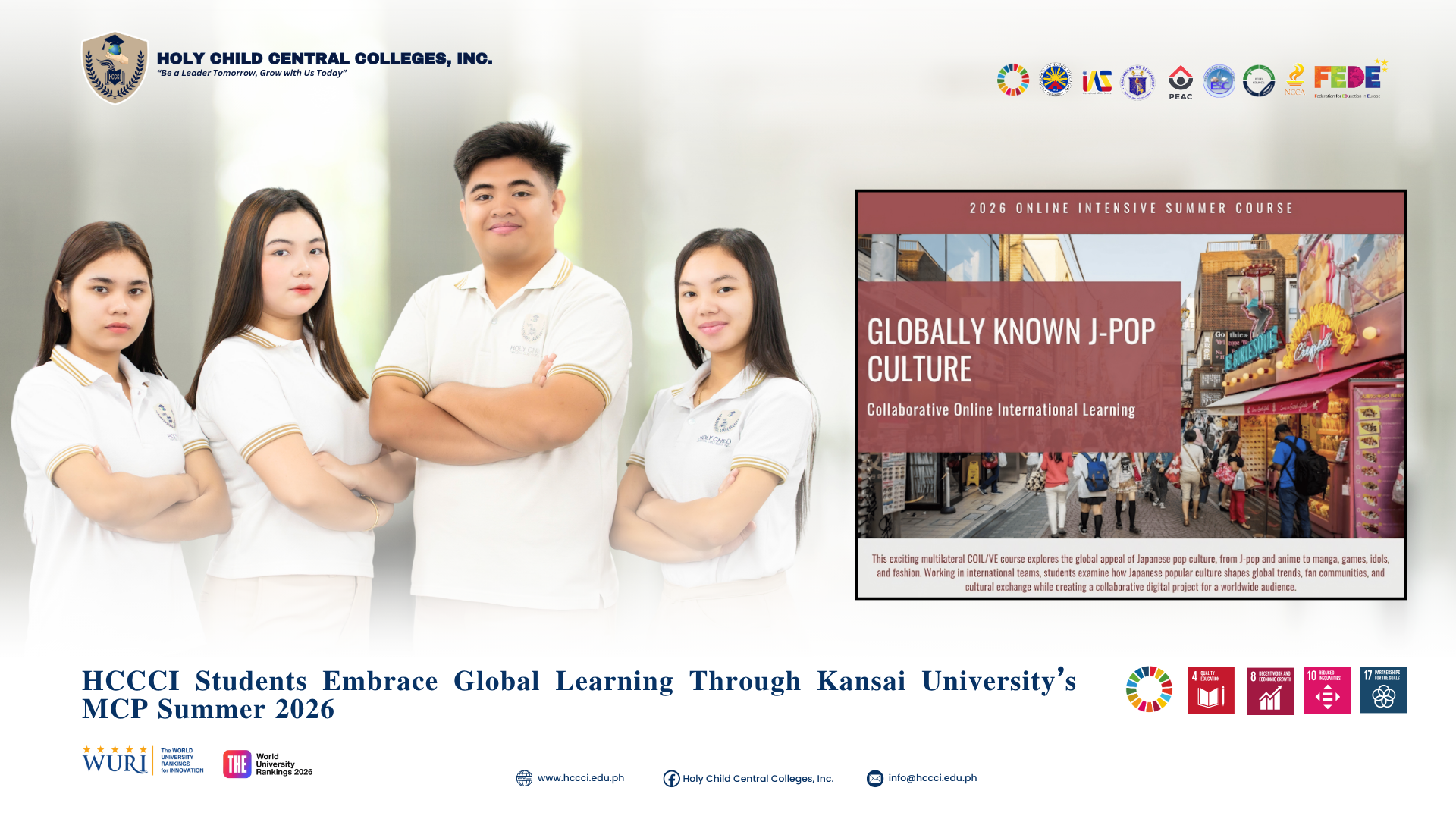
𝐇𝐂𝐂𝐂𝐈 𝐒𝐭𝐮𝐝𝐞𝐧𝐭𝐬 𝐄𝐦𝐛𝐫𝐚𝐜𝐞 𝐆𝐥𝐨𝐛𝐚𝐥 𝐋𝐞𝐚𝐫𝐧𝐢𝐧𝐠 𝐓𝐡𝐫𝐨𝐮𝐠𝐡 𝐊𝐚𝐧𝐬𝐚𝐢 𝐔𝐧𝐢𝐯𝐞𝐫𝐬𝐢𝐭𝐲’𝐬 𝐌𝐂𝐏 𝐒𝐮𝐦𝐦𝐞𝐫 𝟐𝟎𝟐𝟔
Four students from Holy Child Central Colleges, Inc. (HCCCI) have successfully completed the Multilateral COIL/VE Project (MCP) Summer 2026 of Kansai University, featuring the international learning program “Globally Known J-Pop Culture.”
The program provided the HCCCI participants with an enriching opportunity to engage in a multilateral Collaborative Online International Learning (COIL)/Virtual Exchange (VE) experience, connecting students across borders through technology-enabled academic and cultural exchange. Through the program, the students explored the global influence of Japanese popular culture while participating in intercultural learning and collaboration with international peers.
Representing two academic units of the institution, the HCCCI participants were Athena Jaila G. Cuyco from the College of Teacher Education, and Mark Angelo B. Dizon, Maria Fernanda C. Toledo, and Joylyn M. Nuñez from the College of Computer Studies.
Their participation in the MCP Summer 2026 allowed them to look beyond their respective disciplines and engage with diverse perspectives in an international academic setting. The experience strengthened their intercultural communication, collaboration, critical thinking, and digital competencies while encouraging them to appreciate how culture can serve as a bridge for meaningful global connections.
The successful completion of the program reflects HCCCI’s continuing commitment to internationalizing student learning and making global academic experiences more accessible through virtual platforms. Through COIL and Virtual Exchange initiatives, students are given opportunities to develop global competencies and establish meaningful connections with peers and academic communities beyond the Philippines.
The participation of Cuyco, Dizon, Toledo, and Nuñez also highlights the institution’s growing engagement in international collaborative learning. Their experience demonstrates that global education can transcend geographical boundaries, enabling students from different disciplines and backgrounds to learn together, exchange ideas, and develop a deeper understanding of the interconnected world.
This international learning initiative advances Sustainable Development Goal 4: Quality Education, by providing inclusive and innovative learning opportunities; SDG 8: Decent Work and Economic Growth, by developing digital, communication, collaboration, adaptability, and intercultural competencies that prepare students for future employment and participation in a global workforce; SDG 10: Reduced Inequalities, by expanding access to international learning experiences through virtual mobility; and SDG 17: Partnerships for the Goals, by strengthening educational collaboration and international academic networks.
Through initiatives such as the Multilateral COIL/VE Project, HCCCI continues to pursue its commitment to developing globally competent learners who are prepared to connect across cultures, collaborate beyond borders, and contribute meaningfully to an increasingly interconnected world.